

In a quiet museum gallery in early 2023, an unexpected discovery about Roman glasswork began with nothing more than a simple turn of the wrist, a gesture that revealed symbols long overlooked by scholars and central to a new study from Washington State University. Researchers report that carved marks once dismissed as decoration may instead be the signatures of collaborative workshops that shaped some of the most intricate glass objects of late antiquity.
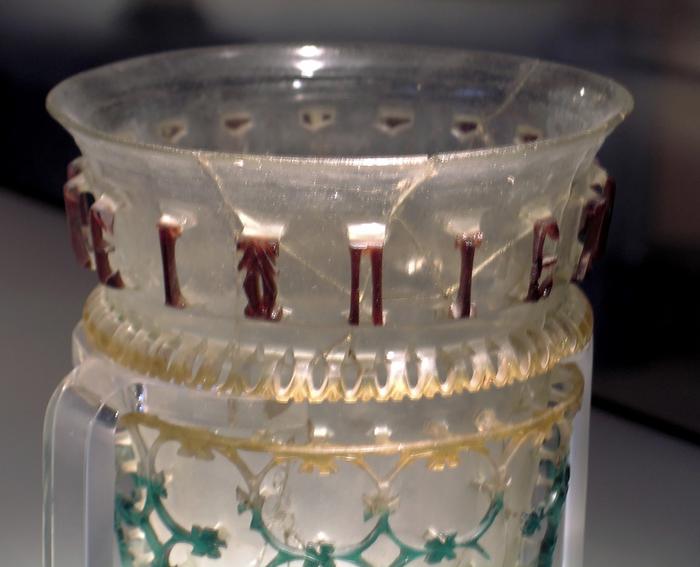
Art historian and glassblower Hallie Meredith made the finding while examining Roman glass cage cups at the Metropolitan Museum of Art, luxury vessels carved from thick glass blanks sometime between the third and sixth centuries CE. These objects, known as diatreta, consist of an inner cup encased in an airy lattice held together by impossibly thin bridges. They have been admired for centuries, yet their makers remained remarkably obscure. Meredith noticed that several vessels bore small openwork motifs on their reverse sides, including symbols such as diamonds or leaves, positioned beside inscriptions wishing their owners long life. Her research suggests these symbols formed a visual vocabulary used by workshops to identify their collective labor.
Tracing A Language Of Makers
Turning one cup to view its hidden side transformed a fleeting curiosity into a broader investigation. Meredith located the same carved symbols on additional vessels and fragments, connecting them through shared patterns in tool marks, unfinished surfaces, and decorative choices. In two recent papers, including one published in World Archaeology, she reconstructs the work cultures of Roman artisans by piecing together evidence scattered across private collections and museum archives. Rather than envisioning master craftsmen working in isolation, her studies propose a collaborative system involving engravers, polishers, apprentices, and other specialists contributing to each vessel through iterative stages of production.
“Because I am trained as a maker, I kept wanting to flip things over,” said Meredith, who began glassblowing as an undergraduate in college and has continued to practice ever since.
The recurring motifs, once treated as mere embellishment, point to coordinated groups of craftworkers who shared technical knowledge and visual conventions. Meredith argues that these symbols acted as workshop marks, a kind of branding that reflected collective authorship rather than individual signatures. This interpretation adds new texture to longstanding debates about how openwork vessels were made, shifting attention away from purely technical questions and toward the social worlds that enabled such ambitious creations.
Reconstructing Lives Behind The Lattice
By studying unfinished pieces, repaired artifacts, and recycled materials, Meredith demonstrates that Roman craft production involved a dynamic process shaped by hierarchical relationships and collaborative problem solving. Her practical experience as a glassblower informs this analytical approach. At Washington State University, she teaches a course that encourages students to recreate aspects of ancient making through 3D printing and digital tools, using these reconstructions to better understand the challenges ancient artisans faced and the decisions they made during production.
“When that happens, patterns appear that everyone else has literally photographed out of the frame.”
She applies the same hands on sensibility to her forthcoming monograph, The Roman Craftworkers of Late Antiquity, which expands on themes introduced in her articles and aims to reframe our understanding of artisans as active agents with distinct identities and shared practices. Her next research project extends this inquiry into the realm of language. Partnering with WSU computer science students, Meredith is developing a searchable database to track non standard writing in thousands of artifacts, from misspellings to mixed alphabets. She believes some of these anomalies reflect multilingual craftworkers adapting scripts to new audiences and contexts.
Meredith’s work challenges the long standing focus on elites in the study of ancient art and instead encourages attention to the anonymous individuals who shaped materials with skill and ingenuity. The carved marks glinting beside inscriptions on fragile glass vessels serve as enduring reminders of these artisans. When light grazes a diatretum’s lattice, the object reveals more than technical mastery, it also reveals the presence of the hands that made it and the shared language they used to mark their efforts.