

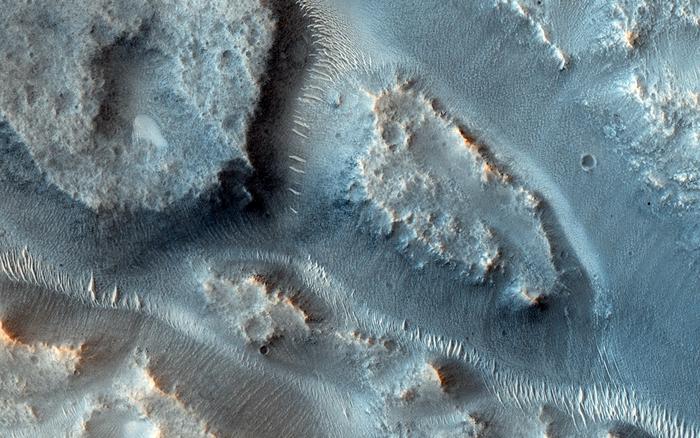
Billions of years ago, Mars had rain. Water carved valleys, filled craters to the brim, spilled over their rims in catastrophic floods, and carved canyons that stretched for hundreds of kilometers. New research from The University of Texas at Austin has mapped 16 massive river drainage systems on Mars for the first time, revealing that these ancient watersheds transported nearly half of all the sediment ever moved by Martian rivers.
The discovery matters because on Earth, large river basins like the Amazon sustain extraordinary biodiversity. Scientists believe similar systems on Mars could have been the most promising cradles for life when water still flowed across the red planet’s surface.
Where Rivers Once Dominated A Cratered Landscape
Researchers Abdallah S. Zaki and Timothy A. Goudge pieced together previously published datasets of Martian valley networks, lakes, rivers, and canyons to outline these drainage systems. They identified 19 major clusters of water-carved features, 16 of which connected into watersheds spanning at least 100,000 square kilometers. That’s the threshold scientists use to define large drainage basins on Earth, where 91 such systems exist. The study appears in Proceedings of the National Academy of Sciences.
“We did the simplest thing that could be done. We just mapped them and pieced them together,” said Zaki, a postdoctoral fellow who led the research.
These 16 Martian watersheds collectively cover roughly 4 million square kilometers, about 5% of the planet’s ancient terrain. That’s far less than Earth, where large drainage systems blanket 44% of the land. The disparity makes sense: Earth’s tectonic plates build mountains and carve valleys, creating the varied topography that channels water into sprawling networks. Mars lacks plate tectonics entirely.
Yet despite covering just a sliver of Mars’ ancient landscape, these 16 drainage systems account for 42% of all sediment eroded by Martian rivers. The largest single contributor? The Ma’adim Vallis system, which alone produced 15% of the planet’s total river sediment.
Catastrophic Floods Connected Isolated Valleys
Mars is pockmarked with impact craters, and craters trap water. That should have fragmented the planet’s drainage into disconnected puddles. Instead, something integrated these isolated basins into continent-scale river networks. The answer appears to be catastrophic flooding.
When ancient Martian lakes filled to capacity, they breached their crater rims and unleashed massive floods that carved outlet canyons. These floods connected previously isolated valley systems into larger drainage networks. The researchers found that 49% of all outlet canyon length on Mars sits within these 16 large drainage systems. Outlet canyons alone contributed 17% of Mars’ total river sediment budget.
“The longer the distance, the more you have water interacting with rocks, so there’s a higher chance of chemical reactions that could be translated into signs of life,” Zaki said.
The remaining 95% of Mars’ ancient terrain shows a very different character. Valley density in the large drainage systems reaches 0.033 kilometers per square kilometer, nearly seven times higher than the surrounding landscape. Most of Mars was a mosaic of small, disconnected river systems that drained into local craters. About 58% of all sediment eroded by Martian rivers simply settled in these nearby depressions.
But the sediment from large drainage systems traveled. Three massive sedimentary basins, Aeolis Dorsa, Arabia Terra, and Hypanis, sit at the terminus of multiple large watersheds. The drainage systems feeding these basins contributed roughly 21% of Mars’ total river sediment budget. That suggests sediment traveled hundreds or even thousands of kilometers, tumbling through water long enough for sustained chemical interactions between rocks and minerals.
Those interactions, repeated over vast distances and long timescales, create exactly the conditions that could preserve biosignatures. The researchers argue these sedimentary basins should be priority targets for future missions searching for evidence of ancient Martian life. Much of this sediment has been buried or eroded away over billions of years, but some likely remains, waiting in basins that haven’t been fully explored.