

Electrical current flowing through a junction of vanadium and iron produces unusually loud static. That noise, orders of magnitude stronger than expected, reveals something remarkable: iron behaving like a superconductor even though it isn’t one.
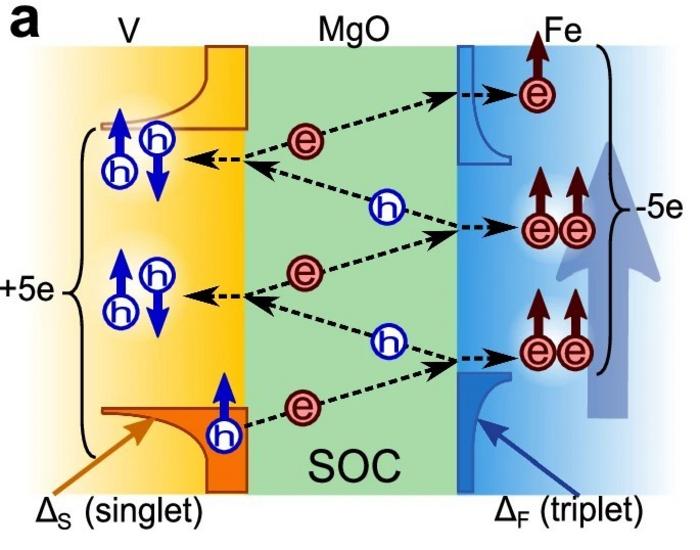
The finding, published in Nature Communications, confirms decades-old theories about how superconductivity can leak across barriers and induce quantum behavior in unlikely materials. Researchers measured the electrical fluctuations, called shot noise, in devices made of vanadium separated from iron by a thin magnesium oxide layer. The noise signature indicated electrons moving in large, coordinated groups inside the iron, matching the synchronized behavior normally seen only when two superconductors form a Josephson junction.
This matters because Josephson junctions are the building blocks of quantum computers. They typically require two superconductors facing each other across a barrier, where their paired electrons coordinate despite the separation. The 2025 Nobel Prize in Physics recognized advances in this technology. Finding junction-like behavior with only one superconductor could simplify quantum hardware design.
Ferromagnetism Finds a Loophole
Iron shouldn’t cooperate with superconductivity at all. As a ferromagnet, it aligns electron spins in the same direction, while conventional superconductors rely on opposite-spin electron pairs. These preferences normally cancel each other out.
Yet the vanadium somehow convinced the iron to form same-spin electron pairs, creating an exotic superconducting state that coexists with magnetism. The team suspects spin-orbit coupling at the magnesium oxide interface enabled this unusual pairing.
“A typical Josephson junction with two superconductors is like two army battalions marching in step along opposite banks of a river. In our experiment, there was only one battalion — yet it’s as if its marching caused citizens on the other side to form a militia and begin marching to the beat of a different drum,” Igor Žutić, SUNY Distinguished Professor at the University at Buffalo, explains.
The researchers detected this by analyzing shot noise, the unavoidable electrical jitter created when electrons arrive in bursts rather than smoothly. Jong Han, professor of physics at the University at Buffalo, describes the technique as listening to static like a stethoscope. In ordinary metals, electrons arrive mostly alone. In superconductors, they travel as pairs. The noise in these iron junctions indicated coordinated group movement characteristic of superconducting synchronization.
The magnitude of the noise was unexpected. Standard physics predicts relatively small fluctuations in such junctions, but the measurements showed giant shot noise, suggesting robust superconducting behavior induced in the iron layer.
Quantum Hardware From Everyday Materials
Same-spin electron pairing connects to topological superconductivity, a state that protects quantum information from environmental disturbance. Conventional quantum computers lose data when stray magnetic fields or thermal vibrations disrupt electron spins. Topological approaches encode information in knot-like patterns that resist such interference.
Whether these iron junctions achieve full topological protection remains unclear. The team is still theorizing how same-spin pairs became robust enough to produce Josephson-like behavior. But the materials themselves are promising. Both iron and magnesium oxide already appear in commercial magnetic hard drives and random-access memory.
The international collaboration included researchers from the Autonomous University of Madrid, where experiments were conducted in Farkhad Aliev’s lab, along with teams from Comillas Pontifical University, the University of Lorraine, Babeș-Bolyai University, and the Eastern Institute for Advanced Study. The work was supported by the U.S. Department of Energy’s Office of Science Basic Energy Sciences.
Žutić notes the practical angle: “We have added a superconducting twist to commercially viable devices.” The challenge now is understanding exactly how the iron maintains its induced superconducting state and whether similar effects can be engineered in other material combinations.