

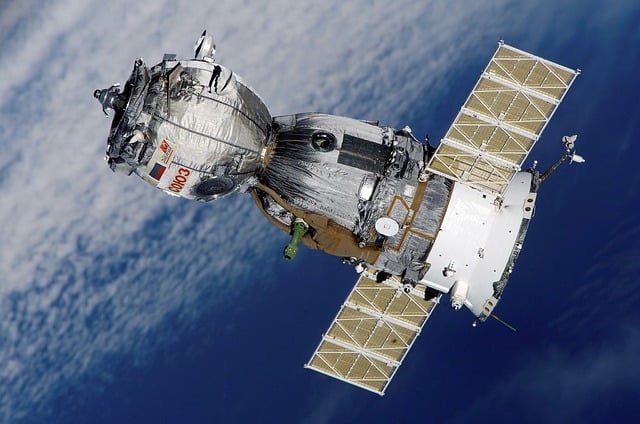
Modern satellites face an absurd problem: they collect terabytes of high-resolution imagery every orbit, but often get just ten minutes to talk to ground stations. The Sentinel-2 satellites alone capture 1.6 terabytes per orbit–far more data than any downlink can handle. The result is a cosmic traffic jam where raw pixels sit idle in space, waiting for a chance to be heard.
A new paper in Engineering proposes teaching satellites to think for themselves instead. The concept, called space computing power networks (Space-CPN), envisions spacecraft that process information directly in orbit, sharing both communication links and computing workloads. Authored by Linling Kuang, Yuanming Shi, Kai Liu, and Chunxiao Jiang, the architecture addresses a fundamental mismatch: while inter-satellite laser links now move data at over 10 gigabits per second, those brief ground-station windows create a bottleneck that no amount of bandwidth can fix.
Ditching the Library for the Summary
Traditional satellite networks operate on a simple premise: collect data in space, ship it home for processing. That model is collapsing under its own weight. As remote sensing resolution improves, the sheer volume becomes overwhelming–and transmitting raw imagery isn’t just slow, it’s a security risk.
Space-CPN flips the logic entirely. Instead of sending everything, satellites extract only what matters for a specific task. Think of it as the difference between mailing an entire library and sending a summary tailored to the question being asked. For disaster monitoring or weather forecasting, you don’t need every pixel of empty ocean–you need the features that indicate a developing storm or structural damage.
The system uses a technique called the robust information bottleneck, which allows satellites to identify essential features while discarding noise. This task-oriented approach ensures that even when communication links are shaky, the most vital information gets through first. Different orbital layers–low, medium, and geostationary–work together as a distributed brain, with ground stations remaining part of the system but no longer the only place where intelligence lives.
“Cloud cover, which may block key features of the Earth’s surface or distort signals through sun reflection, poses a major challenge for downstream remote sensing tasks that rely on distinguishing subtle differences,” Linling Kuang explains.
The architecture enables satellites to compress information based on downstream computational needs: detecting clouds, tracking storms, identifying disaster damage. Raw data stays minimal, processed results move fast.
When Power Budgets Meet Brain Science
Processing data in orbit introduces a practical constraint: satellites can’t support energy-hungry computing clusters. Conventional computer chips waste enormous amounts of power shuttling data between memory and processors–the so-called von Neumann bottleneck.
Neuromorphic computing offers a way out by mimicking how our brains work. These systems merge memory and computation, relying on sparse, event-driven signals rather than constant calculation. Spiking neural networks fire only when they detect a change, drastically reducing electricity use. In one experiment cited by the authors, a brain-inspired platform completed a task using just 6.3 joules of energy, while a standard platform required 136.9 joules.
Managing this network gets complicated fast. Space is dynamic–satellites move at thousands of miles per hour, communication links vanish without warning, and emergency demands can arise suddenly. To cope with this chaos, the researchers propose using reinforcement learning and robust optimization. These tools allow the network to adapt on the fly, scheduling tasks and sharing learned models between satellites without ever needing to send raw, sensitive data back to terrestrial servers.
The paper outlines how federated and decentralized learning could train neural networks across satellite constellations. Each spacecraft learns locally, shares updates with neighbors, and contributes to a global model without exposing raw data or overwhelming communication links. It’s a vision of orbit not just as a place for cameras, but as an autonomous computing environment capable of real-time intelligence.
Whether this architecture can handle the unpredictability of space operations remains to be tested at scale, but the direction is clear: satellites are evolving from remote sensors into problem solvers.