

Inside a laboratory at the University of Basel, tiny clouds of atoms hover in a vacuum. There are no dramatic explosions or churning gears. Instead, there is only the hushed focus of scientists preparing a experiment that sounds like pure fantasy. They are proving that “spooky” quantum connections can actually make our measurements better, not worse.
For decades, quantum entanglement was a paradox that physicists loved to debate. Albert Einstein famously hated the idea, yet experiments eventually proved it was real. Now, researchers at the University of Basel and the Laboratoire Kastler Brossel in Paris have turned this laboratory curiosity into a practical powerhouse. They have demonstrated that entanglement allows sensors to measure multiple things at once with a level of precision that should be impossible on paper.
The team achieved this by cooling roughly 1,450 rubidium atoms to near absolute zero. At these temperatures, the atoms form a Bose-Einstein condensate, acting like a single quantum object. They used magnetic fields to “squeeze” the quantum noise of the atoms, then used laser beams to split the cloud into separate locations. Remarkably, the quantum link between the fragments survived the move.
Breaking the Distance Barrier
Until now, quantum metrology only worked if all your sensors were clustered in one tiny spot. The Basel team changed the game by spreading the entangled atoms out across space. This allows for a distributed network where sensors at different locations “talk” to each other through quantum correlations to cancel out errors and boost sensitivity.
The results were striking. When measuring two separate parameters simultaneously, the team saw a precision boost of about 3.6 decibels. That is roughly the same as running a traditional measurement thirty times but getting all that data in a single shot. This “quantum advantage” means the laws of physics are finally starting to work for us rather than against us.
“So far, no one has performed such a quantum measurement with spatially separated entangled atomic clouds, and the theoretical framework for such measurements was also still unclear.” – Yifan Li, Lead Researcher
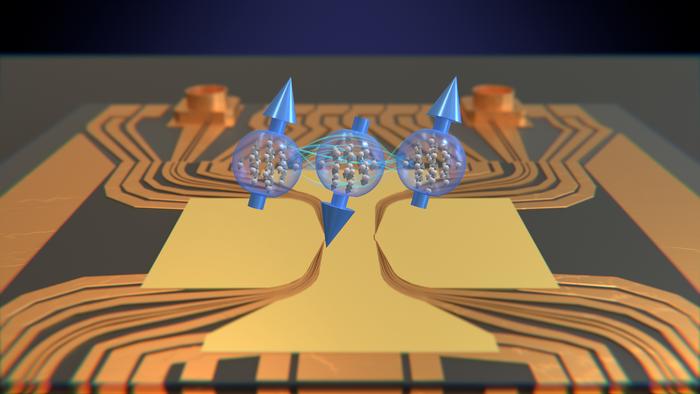
To make this work, the team had to invent their own instruction manual. They used a mathematical pattern called a Hadamard matrix to coordinate how the entanglement was shared across three separate clouds. By rotating the sensors in a specific quantum sequence, they ensured that every part of the array benefited from the shared connection.
From Atomic Clocks to Volcanic Monitoring
What can you actually do with a sensor that defies standard limits? The applications are everywhere you need extreme precision. Lex Joosten, a PhD student on the project, points to optical lattice clocks. These instruments are so accurate they could keep time to within a second over a billion years. Entangling atoms across these clocks could help us measure how gravity subtly warps space over tiny distances.
The technology could also revolutionize how we look under the Earth’s surface. Entangled gravimeters could map tiny variations in gravity to reveal buried structures or monitor volcanic activity in real time. Because these sensors are linked by “spooky action,” they can detect signals that would normally be lost in the background noise of the universe.
Scaling this up to millions of atoms will be the next big hurdle, as environmental noise tends to break fragile quantum links. However, the Basel team has proven the core principle. Nature’s strangest features, once dismissed as mere oddities, are becoming humanity’s most sensitive tools for exploring the world.