

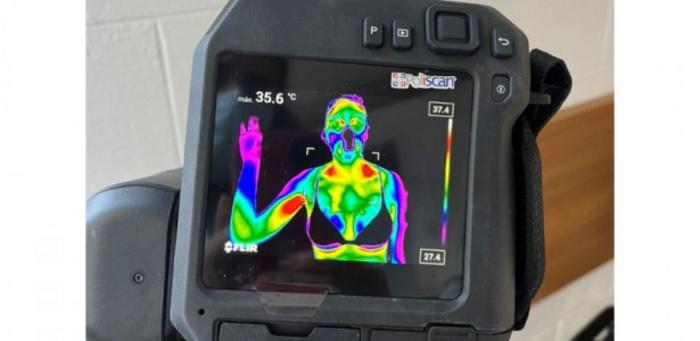
The cold room sat at precisely 18 degrees Celsius, cool enough to be uncomfortable but not quite cold enough to make you shiver. That temperature matters. For the 121 women sitting in that São Paulo research facility, wearing standardized clothing while infrared cameras tracked the heat blooming across their necks and collarbones, the line between “manageable cold” and actual shivering was the difference between measuring brown fat activity and measuring something else entirely.
“If the individual starts to shiver, they’ll expend additional energy,” explains Ana Carolina Junqueira Vasques of the State University of Campinas, who led the study. “That’s why the temperature was maintained at 18 °C, which is considered manageable cold.” The cameras were hunting for warmth in a specific spot: the supraclavicular region, that territory above your collarbone where, it turns out, adults harbor something scientists only discovered about 15 years ago.
Brown fat isn’t the stuff that jiggles or that we spend time trying to lose; it’s metabolically more like a furnace than a storage unit. “This tissue is rich in mitochondria, which are structures responsible for energy production in cells, giving it its brownish color and high metabolic activity,” Vasques says. Unlike white fat, which stores energy for later, brown adipose tissue burns through glucose and lipids to generate heat, which is why cold exposure lights it up on thermal imaging. The researchers wanted to know whether women who’d been through multiple rounds of dieting, the ones who lose weight intentionally only to regain it unintentionally, still had the same brown fat activity as women who hadn’t experienced this pattern.
They didn’t. The “cyclers,” as the research team called them (women reporting three or more episodes of intentional weight loss followed by unplanned regain of at least 4.5 kilograms over the past four years), showed up to the lab with more body fat overall, more visceral fat packed around their organs, worse blood pressure, and less favorable glucose and lipid profiles. “This camera takes images and captures exactly the hottest regions, painting them in a different color,” Vasques explains. “Based on the intensity of this color, we can quantify how much BAT is activated in each participant.” The cyclers’ supraclavicular regions stayed cooler, suggesting their brown fat wasn’t working as hard.
The immediate conclusion might be that yo-yo dieting itself damages brown fat. That’s not quite what the data showed. When Vasques and her colleagues ran more sophisticated statistical analyses, the relationship became more nuanced. “The yo-yo effect probably acts indirectly,” she says. “Over successive cycles of weight loss and regain, there’s a progressive worsening of body composition, with recovery predominantly of fat and not muscle mass. Therefore, what really explains the lower brown fat activity isn’t the yo-yo effect alone, but rather excess body fat.”
Here’s the mechanism: each restrictive diet triggers defensive responses in the body, which attempts to protect against perceived starvation by becoming more efficient at storing energy and reducing how much it burns at rest. Hunger and satiety hormones shift. Basal metabolism slows. “When a person regains weight, it comes back mainly in the form of fat, not lean mass,” Vasques points out. Over multiple cycles, this means someone might return to their starting weight but with a higher percentage of their body composed of fat rather than muscle. And it’s that accumulated adiposity, rather than the cycling itself, that’s associated with reduced brown fat activity.
The team chose to study only women aged 20 to 41, deliberately excluding anyone who’d entered menopause. “The study focused on young women who were still outside the menopause period precisely to avoid hormonal interference that alters the distribution of body fat,” Vasques says. “Additionally, women tend to suffer from greater aesthetic pressure and often resort to restrictive diets, which increases the occurrence of the yo-yo effect.” The decision wasn’t random; women experience different amounts and activity levels of brown fat compared to men, and the aesthetic pressures that drive restrictive dieting affect women disproportionately.
Brown fat’s recent fame has sometimes positioned it as a potential weight-loss target. Cold plunges, special supplements, certain medications—all have been touted as ways to activate more of it. But Vasques is careful about these claims. You can’t easily measure brown fat activity in a doctor’s office; it requires research equipment like infrared thermography or specialized imaging. And while physical activity, reduction of body fat, and cold exposure can all stimulate it, brown fat shouldn’t be viewed as a silver bullet for obesity. “Its most relevant role is improving glucose and lipid metabolism and helping protect against diabetes and cardiovascular disease,” she says.
The study’s findings suggest something important about how we think about weight management. If the real problem isn’t the number on the scale going up and down, but rather the progressive accumulation of fat mass over time, then strategies focused purely on losing weight quickly might be missing the point. “Obesity treatment strategies should prioritize body composition quality, long-term sustainable fat percentage reduction, and muscle mass preservation with multidisciplinary approaches and lasting behavioral changes,” Vasques says.
There’s something almost poetic about brown fat in this context. It’s the metabolically active tissue, the stuff that actually burns energy rather than storing it, and yo-yo dieting—by progressively replacing muscle with fat—might be inadvertently reducing the body’s capacity to do exactly what dieters are trying to achieve. Each cycle of restriction and regain doesn’t just bring the weight back; it brings it back in a form that makes the next round of weight loss even harder, and potentially less effective at improving metabolic health.
The women who sat in that 18-degree room, some of them “cyclers” with histories of multiple diets, some not, were participating in research that might eventually reshape how we approach obesity treatment. Not with another restrictive diet, but perhaps with strategies that acknowledge the body’s dogged defense of its energy stores and work with that biology rather than against it. The infrared cameras painted their thermal maps in color, warmer regions glowing bright where brown fat was working hardest. The cyclers showed less of that glow, but the message isn’t that they’ve permanently damaged something. It’s that the path forward might need to look different from the path that got them there—one that builds muscle rather than just cutting calories, that changes composition rather than just chasing numbers, and that works with the body’s furnaces rather than accidentally banking their fires.