

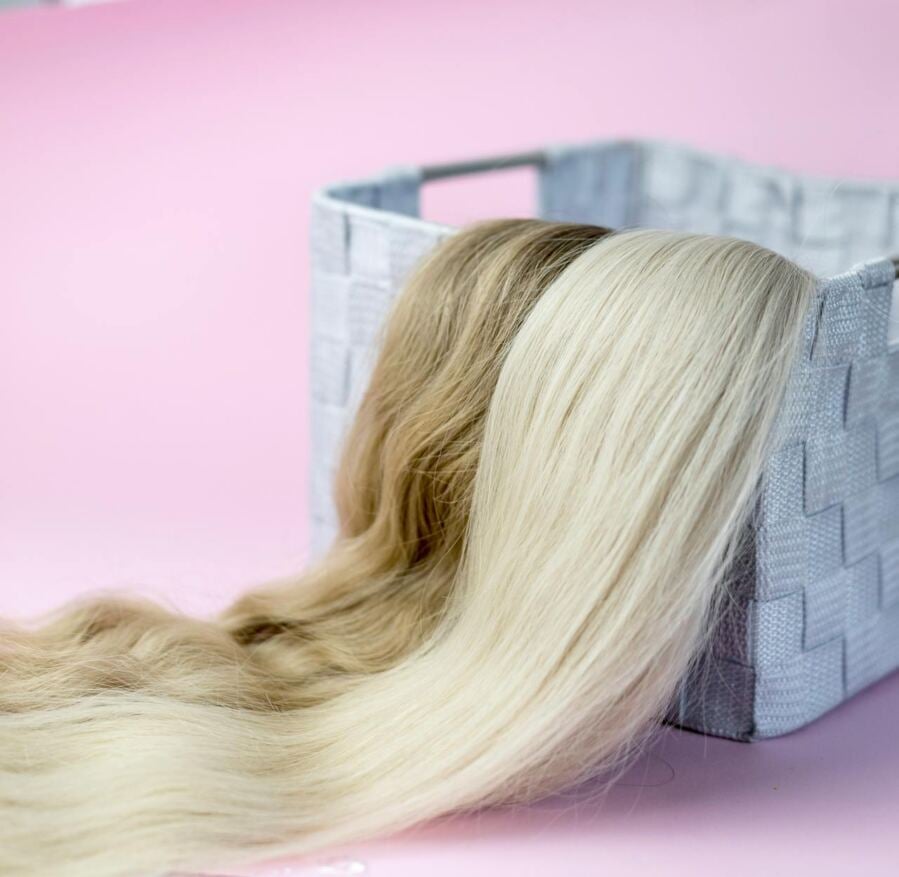
Pick up a packet of braiding hair from any beauty supply shop and you will find precious little on the label about what’s in it. Maybe a fibre type. Maybe a claim about flame resistance or water repellency. What you won’t find is a list of ingredients, which is odd for something that sits against your scalp for weeks or months at a time, gets heated with styling tools, and can release chemicals into the air you breathe.
Elissia Franklin, a research scientist at Silent Spring Institute in Massachusetts, wanted to know what those missing ingredients actually were. So she bought 43 popular hair extension products from shops and websites, ran them through some of the most sensitive analytical chemistry available, and got back a number that should give anyone pause: 933 distinct chemical signatures across the samples, with more than 5,000 individual detections in total.
“While prior reports have found some chemicals of concern in hair extensions, there’s still much we don’t know about their overall chemical makeup,” says Franklin. “We wanted to get a better picture of the extent of the problem.” The picture that emerged, published this week in the journal Environment & Health, is considerably worse than previous studies had suggested. Of the 169 chemicals the team could identify, 48 turned up on major hazard lists. Twelve are flagged under California’s Proposition 65 for causing cancer, birth defects or reproductive harm. All but two of the 43 products contained at least one hazardous substance. The two exceptions? Both were labelled “non-toxic” or “toxic-free”.
The findings matter most for Black women. More than 70 percent of Black women in the US report wearing hair extensions at least once a year, compared with less than 10 percent of women from other racial and ethnic groups. Many wear them for cultural and personal reasons, as well as convenience. “This is an industry that has long overlooked the health of Black women, who should not have to choose between cultural expression, convenience, and their health,” says Franklin.
To get at the full chemical composition of these products, Franklin’s team used a technique called nontargeted analysis, which does pretty much what it sounds like. Rather than testing for a predetermined shortlist of suspect chemicals, you cast the widest possible net. Using two-dimensional gas chromatography paired with high-resolution mass spectrometry, the researchers separated and identified compounds across the whole volatile and semivolatile range, then fed the results through machine-learning software to match chemical signatures against a library maintained by the US National Institute of Standards and Technology. It is, to date, the most comprehensive chemical screening of hair extensions ever published.
The rogues’ gallery they uncovered reads like an environmental health textbook. Flame retardants, phthalates, pesticides, styrene, tetrachloroethane. Seventeen chemicals linked to breast cancer showed up across 36 of the samples, including compounds known to alter hormones in ways that raise risk. Four flame retardants appeared in both synthetic products and those made from natural fibres including human hair, suggesting contamination during manufacturing or treatment rather than anything inherent to the base material.
But the real surprise was the organotins. These metallic compounds are typically used as heat stabilisers in PVC plastic, and the EU classifies them as substances of very high concern. Dibutyltin compounds are severely restricted there, banned from consumer products if concentrations exceed 0.1 percent tin by weight. Franklin’s team found them in roughly 10 percent of the samples tested, with some containing tin at concentrations up to 0.45 percent. Well above the European threshold, in other words, though no such limit exists in the US.
“We were especially surprised to find organotins,” says Franklin. “These are commonly used as heat stabilizers in PVC and have been linked with skin irritation, which is a common complaint among hair extension users.” Tributyltin chloride, confirmed in several samples, is a well-known endocrine disruptor associated with metabolic disruption and insulin resistance in animal studies. It was once widely used in marine antifouling paints before being banned for its devastating effects on aquatic life. That it should turn up in a product worn on people’s heads is, at the very least, worth some concern.
The exposure routes aren’t trivial, either. Extensions sit against the skin for extended periods. They get heated, boiled and styled, all of which can release volatile compounds into the air. The team even simulated what happens when people prewash synthetic hair in apple cider vinegar, a common home remedy, and found that tin leached into the acidic solution. A hot shower produced measurable leaching too.
With the global hair extensions market projected to surpass $14 billion by 2028 and the United States the world’s leading importer, pressure for regulation is building. New York has introduced legislation requiring manufacturers to disclose all ingredients in synthetic braids and extensions. New Jersey is pushing a bill to ban harmful chemicals from these products outright. At the federal level, the Safer Beauty Bill Package would direct the Food and Drug Administration to regulate their safety for the first time.
For now, though, consumers are largely on their own. Companies rarely disclose what chemicals go into their products, leaving wearers in the dark about what they’re putting on their bodies. Franklin’s study found that the products making green claims, such as “no PVC” or “biodegradable”, did tend to contain fewer hazardous chemicals. But the broader message is harder to dodge. In a market worth billions, built on products that touch the skin and enter the lungs, we still don’t require manufacturers to tell you what’s inside the packet.
Study link: https://pubs.acs.org/doi/10.1021/envhealth.5c00549