

Deep inside a cancer cell’s nucleus, where biologists have long assumed only the genome and its dedicated machinery hold court, researchers have found something that shouldn’t be there. More than 200 enzymes whose normal job is generating energy for the cell, digesting molecules in the cytoplasm, or building biochemical raw materials, are sitting directly on the DNA. Not visiting. Residing.
The discovery, published today in Nature Communications by a team at the Centre for Genomic Regulation in Barcelona, suggests the cell’s metabolic and genetic systems aren’t the separate empires biologists have treated them as. “We’ve been treating metabolism and genome regulation as two separate universes, but our work suggests they’re talking to each other, and cancer cells might be exploiting these conversations to survive,” says Dr. Savvas Kourtis, first author of the study.
The team, led by Dr. Sara Sdelci at the CRG, analysed proteins physically attached to chromatin (the form DNA takes inside living cells) across 44 cancer cell lines and 10 healthy tissue types. In total they catalogued some 5,100 proteins per sample. The metabolic enzymes that turned up amounted to roughly 7% of everything found clinging to DNA, a proportion that surprised even the researchers given how firmly the field has held to the idea of metabolism and epigenetics as largely separate systems.
What startled them most was which enzymes showed up. Among the unexpected arrivals were components of oxidative phosphorylation, the intricate molecular machinery that generates the majority of a cell’s energy supply and lives, almost by definition, in the mitochondria. These aren’t small peripheral proteins; they are core constituents of processes textbooks locate nowhere near the nucleus.
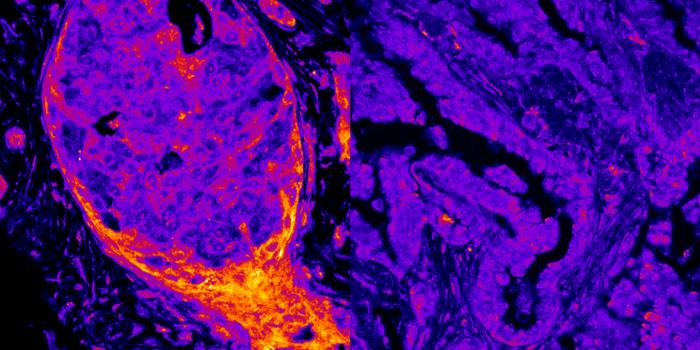
And their presence isn’t uniform. Breast cancer cells turn out to be crowded with oxidative phosphorylation enzymes on their chromatin; lung cancer cells have almost none. When Sdelci’s team examined tissue microarray samples from actual patients, the pattern held. The implication is that different tumour types are maintaining what the paper calls a “nuclear metabolic fingerprint”, a characteristic signature that may reflect, or actively reinforce, the cancer’s particular identity. “It could help explain why tumours of different origins, even when carrying the same mutations, often respond very differently to chemotherapy, radiotherapy, or targeted inhibitors,” Sdelci says.
The team then pushed further, trying to work out what at least some of these misplaced enzymes are actually doing. A group involved in one-carbon folate metabolism, a set of reactions that provide raw materials for building and repairing DNA, turned out to respond dynamically to DNA damage. When the team irradiated cells, these enzymes flooded toward the chromatin within hours and their accumulation scaled with the severity of the damage. More intriguingly, a single enzyme called IMPDH2 showed completely different behaviour depending on its location: force it to stay in the nucleus and it shored up genome stability; confine it to the cytoplasm and it redirected its activity toward other pathways entirely. Same enzyme, opposite consequences. “Many of these enzymes synthesize essential building blocks of life, and their nuclear localization is associated with DNA repair,” says Sdelci. “Their presence in the nucleus may therefore directly shape how cancer cells respond to genotoxic stress, a hallmark of many chemotherapeutic treatments. It’s an entirely new world to explore.”
None of this tells us yet what most of the 200-plus enzymes are doing in there. Some may be catalysing reactions, producing local pools of metabolites that modify the chromatin around them. Others might be switching genes on or off through physical contact alone, regardless of any enzymatic activity. Still others could be providing structural scaffolding, pure architecture with no metabolic function whatsoever. “Each enzyme may have its own, unique nuclear function, so this must be addressed one by one,” says Kourtis. That’s a formidable inventory to work through.
There’s also a more basic puzzle the paper raises but cannot yet answer: how do these enzymes get past the nuclear pore in the first place? The pore is a molecular checkpoint, and many of the enzymes found on DNA are considerably larger than what it normally allows through. Something is smuggling them in, or helping them through in pieces, or the pore’s size limits are more negotiable than current models suggest. The team identified a handful of candidate proteins (FKBP5 and Lamin B1, for instance, which interact with a subunit of the cellular respiration complex) that may act as nuclear import facilitators, but the general mechanism remains opaque.
For oncology, the more immediate question is whether this nuclear metabolic layer explains some of the field’s longer-standing puzzles. Standard cancer metabolism research focuses on where and how tumours generate energy, essentially asking what fuel the cancer is burning. A parallel set of studies targets DNA repair mechanisms in the hope of making tumours easier to kill with genotoxic drugs. The Barcelona team’s data suggest these two research streams may be interrogating different facets of the same underlying system, which could matter a great deal for understanding why two tumours with identical mutations still behave so differently in the clinic.
Mapping the nuclear metabolic fingerprint more precisely across tumour types could also flag new biomarkers, patterns of enzyme presence or absence that predict how a cancer will respond to treatment before it’s even begun. And because the mechanisms pulling these enzymes into the nucleus are themselves potentially targetable, there may eventually be drugs that don’t attack metabolic activity in general (which is hard, given how much normal tissue depends on the same pathways) but instead disrupt the specific nuclear recruitment machinery that cancers appear to rely on.
That’s speculative for now. Sdelci’s team has produced an atlas, a systematic mapping of a phenomenon that had previously been seen only in fragments, and the atlas is already large enough to generate years of follow-up work. The individual enzyme-by-enzyme audit that Kourtis describes as necessary will take time; the field is nowhere near a full accounting. What the study has done, more than anything, is make it harder to maintain the assumption that metabolism happens over there, in the mitochondria and the cytoplasm, whilst the genome sits elsewhere, insulated from all that messy chemistry.
Study link: https://www.nature.com/articles/s41467-026-69217-2
