
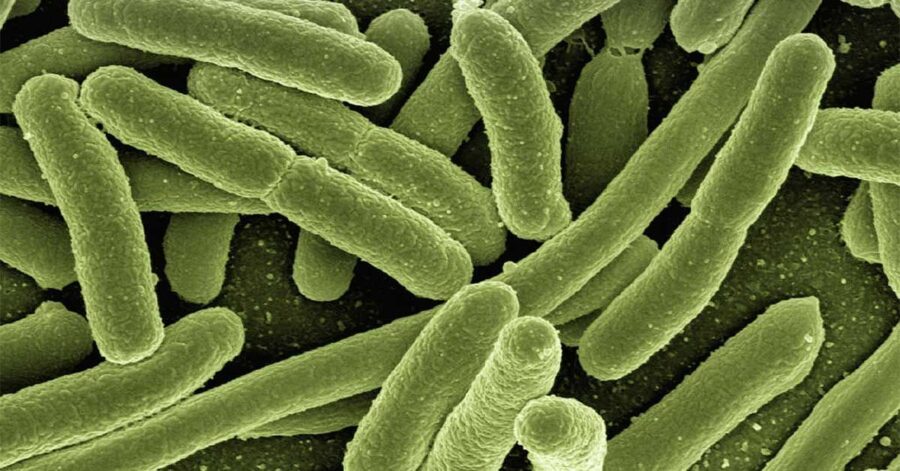
Every seventeen minutes, give or take, a bacteriophage called T7 tears open an E. coli cell from the inside. It has spent that time making perhaps 180 copies of itself, each one packed with DNA, and now the cell ruptures to release them into the world. Scientists at the National University of Singapore have been watching this cycle very carefully. Not because they want to destroy bacteria, but because they think the whole violent business could be repurposed: turned, with a bit of engineering, into the fastest known way to teach microbes an entirely new metabolic trick.
The trick they have in mind is eating plastic. Specifically, breaking down ethylene glycol, a chemical released when PET plastic degrades, and using it as a food source. Bacteria can’t do this naturally with any real efficiency, which is a problem, because we produce millions of tonnes of PET annually and the recycling infrastructure for it is, to put it charitably, patchy.
The challenge of engineering plastic-eating microbes isn’t finding one useful gene and swapping it in. That would be straightforward enough. The problem is that consuming ethylene glycol requires a coordinated set of five genes acting in sequence, something like an assembly line where every machine has to work in concert, and optimising the whole assembly line at once has historically required either painstaking manual tinkering (slow, controlled) or allowing evolution to run more or less freely (fast, but liable to go wrong in unpredictable ways). What Fredens and his colleagues have built, published in Nature Microbiology on 1 May 2026, is a method that tries to get the best of both approaches without the worst of either. They call it Lytic Selection and Evolution, or LySE.
“Traditionally, scientists had to choose between slow but highly controlled evolution methods, or super-fast but uncontrollable continuous methods,” said Assistant Professor Julius Fredens. “Our goal was to create a best-of-both-worlds system: a tool that rapidly evolves large biological pathways while still letting us hit the pause button to control the process and prevent unwanted genetic errors.”
A Deliberately Sloppy Photocopier
The key to LySE is a modified version of the T7 virus’s own DNA-copying enzyme, which the researchers have deliberately made error-prone, something like taking a precise photocopier and tweaking it to produce typos at a roughly controllable rate. The engineered variant makes mistakes about 160,000 times more often than the bacterium’s own copying machinery, generating a flood of mutations in the genes it replicates.
Crucially, those target genes travel on a small separate ring of DNA called a phagemid, packed into the T7 phage particles during each lytic cycle. The phagemid goes through the hypermutagenic copying; the bacterium’s own genome does not. “LySE sidesteps those two problems by exploiting bacteriophage T7,” explained Shujian Ong, a PhD candidate who conducted much of the research. “We have engineered the virus so that, when it makes new virus particles, it also packs in an extra small ring of DNA called a phagemid which carries the group of genes they want to improve.”
The system cycles between two phases. At high virus-to-cell ratios, the phagemid gets mutated and packaged into new virus particles. At low ratios, those particles infect fresh bacteria, the mutated genes end up in new hosts, and researchers let cells compete under selection pressure, keeping whichever strains grow best. Then they lyse those survivors and repeat. Because every lysis event kills the host bacteria entirely, any stray mutations that crept into the bacterial genome are discarded before the next round. This is, it turns out, a harder problem to solve than it sounds: in conventional continuous evolution systems, bacteria accumulate so-called cheater mutations in their own DNA that let them survive selection without actually improving the target genes, making results unreliable and very difficult to interpret. LySE sidesteps the issue structurally, not by policing it.
“Without LySE, a bacterium’s instinct is to mutate its own entire genome to find ways to eat more plastic, but it struggles to find optimal solutions that way,” Fredens added. “LySE improves the target gene cluster tremendously without accumulating unwanted mutations in the rest of the bacterium’s DNA.”
Fifty Per Cent Better in Five Rounds
To test the system, the NUS team evolved their five-gene ethylene glycol pathway through five cycles of LySE, each round applying slightly more selection pressure by reducing the glucose available and forcing cells to rely more heavily on the plastic-derived carbon source. The best-performing strain at the end produced about 50.9 per cent more biomass using ethylene glycol as its sole food source. Sequencing of the evolved genes revealed mutations in both protein-coding regions and regulatory switches, each improvement confirmed by transplanting individual changes into fresh bacteria one at a time, to check they actually worked. That last step matters: it rules out the possibility that the gains were due to some uncharacterised genomic effect rather than the pathway changes themselves.
The method can handle gene clusters up to roughly 40,000 DNA letters long, five times the limit of the most widely used phage-based evolution systems. That opens up a substantial range of targets that were previously impractical: biosynthetic pathways for pharmaceuticals, routes for degrading environmental pollutants, and metabolic networks for carbon capture, all of which tend to be large and complex enough that existing tools struggle.
A patent has been filed, and the team plans to push beyond plastic degradation entirely. The longer-term ambition is to use LySE to optimise synthetic metabolic pathways designed computationally, routes that have never existed in any living organism, and get them working efficiently inside real cells. “A key target is engineering synthetic CO2-fixing metabolic pathways, taking computationally designed routes that have never existed in the real world and optimising them so they actually function efficiently inside living cells,” said Fredens. “With LySE, we can take AI-designed enzymes and metabolic pathways and rapidly optimise them to work in practice. That is where massive potential lies.”
The Longer Game
The scale of ambition here is worth sitting with for a moment. Directed evolution has already produced Nobel Prize-winning results. The question has always been how to speed it up without losing control, how to explore more of the possible genetic landscape without getting lost in it. LySE doesn’t fully resolve that tension, partly because its mutation rates favour certain types of genetic change over others, and partly because the system can still generate beneficial mutations outside the target genes (though rarely, and mitigatable with tighter selection). But it does represent a practical advance, one that runs on standard laboratory equipment and doesn’t require specialist expertise in phage biology to use.
What comes next, if the CO2-fixing ambitions pan out, could be rather stranger: microbes optimised to run metabolic programs that natural evolution never tried, doing chemistry that life on Earth hasn’t managed in four billion years of trying.
Source: https://doi.org/10.1038/s41564-026-02346-y
Frequently Asked Questions
What is LySE and how is it different from other evolution methods?
LySE (Lytic Selection and Evolution) is a new platform developed at the National University of Singapore that uses a modified bacteriophage to rapidly mutate and test groups of genes in bacteria. Unlike older “continuous” evolution systems, which run too fast to control and tend to produce bacteria that cheat rather than genuinely improve, LySE cycles through distinct mutation and selection phases with a clean host reset each round, making results easier to interpret and transfer to other bacteria.
Why is teaching bacteria to eat plastic so difficult?
Breaking down plastics like PET requires not one gene but a coordinated pathway of several genes acting in sequence. Optimising all of them together is far harder than tweaking a single protein, because changes in one gene affect the others. Most evolution tools either work too slowly for multigene systems or lack the control needed to identify which genetic changes are actually responsible for improvement.
How much faster can bacteria degrade plastic using this method?
In the proof-of-concept experiment, bacteria evolved through five LySE cycles produced roughly 50 per cent more biomass when fed ethylene glycol (a PET plastic building block) as their sole carbon source, compared with unevolved bacteria carrying the same gene pathway. The researchers also confirmed that the improvements stayed in place when the evolved genes were moved into fresh bacteria, which is a crucial step for any real-world application.
Could LySE be used for things other than plastic degradation?
Yes. Because the system can handle gene clusters up to around 40,000 DNA letters long, it is suitable for a wide range of targets: optimising pharmaceutical biosynthesis pathways, engineering microbes to break down environmental pollutants, and potentially running entirely synthetic metabolic routes for carbon capture. The NUS team’s stated next goal is using LySE to optimise AI-designed enzymes and metabolic pathways that have no natural equivalent.
What are the limitations of LySE as it currently stands?
The engineered DNA polymerase at the heart of LySE favours certain types of mutation (transitions) over others (transversions), which means it doesn’t explore all possible genetic changes equally. Beneficial mutations can also occasionally arise outside the target gene cluster, though the researchers found this was rare and can be minimised with careful selection pressure. The system also requires each round of evolution to be manually initiated, which makes it slower per cycle than the fastest fully continuous methods.
ScienceBlog.com has no paywalls, no sponsored content, and no agenda beyond getting the science right. Every story here is written to inform, not to impress an advertiser or push a point of view.
Good science journalism takes time — reading the papers, checking the claims, finding researchers who can put findings in context. We do that work because we think it matters.
If you find this site useful, consider supporting it with a donation. Even a few dollars a month helps keep the coverage independent and free for everyone.