

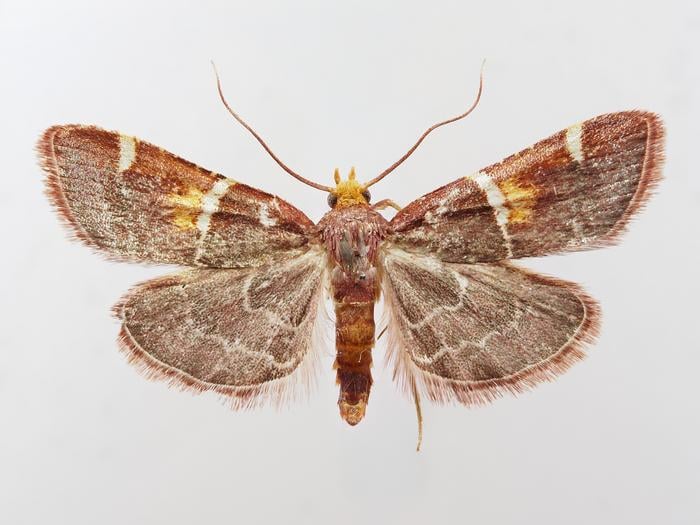
Somewhere in the naming of animals, science and theology have always made uneasy company. The Old Testament hands Adam his first job: go through every creature and give it a name. Taxonomy, in other words, is possibly the oldest human profession. Peter Huemer, a moth researcher at the Tyrolean State Museum in Innsbruck, seems to reckon it’s also one of the most urgent. His newest contribution to that ancient ledger is a small purple moth from the mountains of Crete, and he has named it, with deliberate intent, after the new head of the Catholic Church.
The species, Pyralis papaleonei, was described in the journal Nota Lepidopterologica on 28 April 2026, just days after Robert Prevost became Pope Leo XIV. The timing was not accidental.
What Huemer’s team found in the White Mountains of western Crete (the Lefka Ori, a region of limestone ravines and high summer sun) is a medium-sized moth with a wingspan of roughly two centimetres. That’s not especially large, but the coloring is something else: purple forewings interrupted by an orange-golden patch, bordered by prominent white bands. It is conspicuous, even gaudy by moth standards. And yet it had never been formally described. Researchers from three institutions (the Tyrolean State Museum, the Finnish Museum of Natural History, and the Bavarian State Collection of Zoology) distinguished it from its closest relatives using classical morphological characteristics, wing patterning, genital morphology, and genetic fingerprinting. The molecular data were fairly decisive: a divergence of around 6 percent from its nearest known relative, which is comfortably beyond the threshold that signals a distinct species.
It belongs to the genus Pyralis, a group with a history of rather grand names. When the Austrian naturalists Denis and Schiffermüller described the founding species of the group in 1775, they called it Pyralis regalis, “royal,” on account of its splendid coloration. Later additions brought us Pyralis princeps and Pyralis cardinalis. A pope, perhaps, was overdue.
Europe’s Hidden Moths
The discovery sits somewhat awkwardly against our assumptions about European biodiversity. This is not the Amazon, after all; it is not even particularly remote. Crete is one of the most thoroughly tramped-over islands in the Mediterranean, by tourists and naturalists alike. And yet Pyralis papaleonei was hiding here, presumably for millennia, showing up under artificial lights in June, its purple wings apparently unremarkable enough to pass unnoticed. It appears to be endemic to the island, known only from this one mountain range so far. Whether it occurs elsewhere on Crete, or whether the White Mountains represent its entire range, remains to be worked out.
Huemer, who now volunteers at the museum whose Natural Science Collections he once led, is blunt about what this means: “We are facing a global biodiversity crisis, yet only a fraction of the world’s species has been scientifically documented. Effective conservation of biodiversity requires that species are first recognised, described, and named.”
The broader numbers support that plainly stated anxiety. Around 700 new moth species are described globally each year, most of them from tropical regions where diversity is highest and scientific attention historically thinnest. But the tropics are not the only place where the ledger is incomplete. In the Alps alone, approximately 200 species previously unknown to science have turned up in recent decades. Europe, in other words, is not done. The pyraloid moths (the superfamily to which Pyralis papaleonei belongs) encompass something like 16,000 described species worldwide; how many more remain unnamed is, by definition, unknown, though the figure is thought to be substantial.
A Message Addressed Upward
The choice of name carries a weight that goes beyond the genus’s tradition of ecclesiastical nomenclature. Huemer is a Catholic, and he is aware that butterflies and moths carry particular resonance in Christian iconography: symbols of resurrection, of the soul’s transformation, of metamorphosis as metaphor. The caterpillar that enters its chrysalis and emerges winged has served theologians and poets for centuries as an image of spiritual renewal. Naming a new species after the pope is, in this reading, both a tribute and a kind of petition, a request that the Church use its global moral authority to draw attention to the biodiversity crisis. Whether Pope Leo XIV will notice a purple moth named in his honor is perhaps unlikely. Whether the gesture matters is a different question.
Conservation biologists have long argued that you cannot protect what you have not named. The logic is not merely administrative. A species without a name cannot appear in legislation, cannot be tracked in population studies, cannot be prioritised in habitat management plans. Taxonomy is, in this sense, the prerequisite for everything else. The trouble is that it’s slow, painstaking, and chronically underfunded; a single species description can take years of specimen comparison, molecular analysis, and literature review. Huemer, working now as a volunteer, is one of a dwindling number of specialists capable of doing this work in Europe’s alpine and Mediterranean systems.
What is not yet known about Pyralis papaleonei is considerable. Its larval stage is undescribed; its host plant, if it has a specific one, unknown. Population size, range within the White Mountains, and sensitivity to the habitat changes underway in Crete’s high-altitude zones are all, for now, gaps. It has been found at artificial light sources, suggesting it flies at night. June appears to be its main flight period. Beyond that, this species is, scientifically speaking, just beginning.
The White Mountains, for their part, are not a stable environment. Crete’s mountain ecosystems are under pressure from overgrazing, climate-driven shifts in vegetation zones, and the creeping intrusion of tourism infrastructure. An endemic species with a restricted range in an already-stressed habitat is, as a matter of arithmetic, more vulnerable than most. The fact that it was found at all is partly luck, partly the accumulated expertise of researchers who have spent decades learning what European moths actually look like.
The paper’s authors are careful not to overstate what they’ve found. A new moth species. Two centimetres across. Purple wings, orange-gold patch, white bands. Active in June, in one mountain range, in one Greek island. It is a small thing, on the scale of global biodiversity. But Huemer’s implicit argument is that every named species is a small thing, and that small things, taken together, are what the living world is made of. Naming them is not a bureaucratic exercise. It is, possibly, the oldest and most pressing task we have.
Source: Huemer et al., Nota Lepidopterologica, 2026. DOI: 10.3897/nl.49.185483
Frequently Asked Questions
Why does naming a new species actually matter for conservation?
A species that hasn’t been formally described and named can’t appear in conservation legislation, habitat management plans, or population monitoring programs. Taxonomy is essentially the prerequisite for legal protection: without a name, a species is invisible to the systems we rely on to safeguard biodiversity. That’s why researchers like Peter Huemer argue that the pace of species description needs to keep up with the pace of habitat loss, which it currently doesn’t.
Is it really possible that undiscovered moth species are still hiding in Europe?
Apparently yes. Around 200 moth and butterfly species previously unknown to science have been identified in the Alps alone over recent decades, and the Mediterranean islands have proven similarly productive. The assumption that European biodiversity is essentially fully documented turns out to be wrong, partly because the micro-moth groups are so diverse and so understudied compared with, say, birds or mammals. Pyralis papaleonei is strikingly colourful for something that managed to avoid scientific description until 2026.
How do scientists decide whether something is a genuinely new species rather than a variation of an existing one?
In this case the researchers used both morphological comparison (wing pattern, coloration, genital structure) and genetic fingerprinting. The molecular analysis showed roughly 6 percent genetic divergence from the closest known relative, which is a fairly decisive signal in the moth world. Neither approach alone is always sufficient, which is why taxonomists typically use multiple lines of evidence, and why the process takes as long as it does.
What’s the significance of naming the moth after Pope Leo XIV specifically?
The researcher Peter Huemer has been explicit that the name is intended as a symbolic appeal, not just a tribute. Butterflies and moths carry longstanding symbolic weight in Christian iconography as images of resurrection and transformation, and Huemer is hoping the Church’s global reach might be turned toward publicising the biodiversity crisis. The genus Pyralis already has a tradition of ecclesiastical names, including cardinalis and regalis, so a papal species fits the lineage.
