

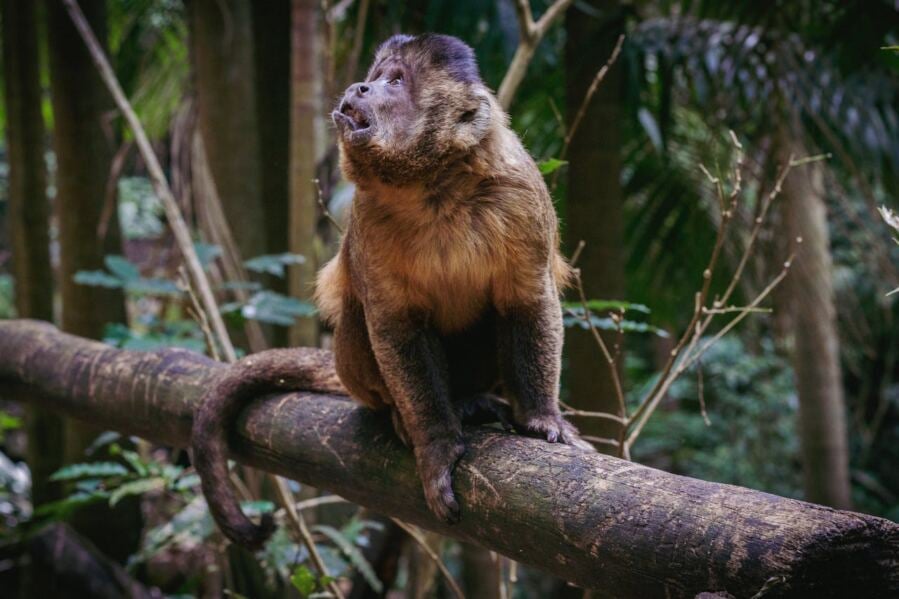
By January, many rivers and streams in Costa Rica’s Guanacaste province are greatly reduced by the dry season. The tropical forest, which looked improbably lush just weeks before, starts shedding leaves in fistfuls, and the shade that made it navigable in the wet months begins disappearing overhead. For the white-faced capuchin monkeys picking their way through this landscape, the timing matters enormously. A researcher with a GPS unit clipped to her backpack follows at close range, logging sleep sites, counting fruit bites, tracking which direction the group moves when it runs into its neighbors. She has been doing this, more or less, since 1990.
Susan Perry, an anthropologist at UCLA who has led the Lomas Barbudal Monkey Project in Costa Rica for 35 years, has accumulated something genuinely rare: a longitudinal record of 12 neighboring capuchin groups spanning three decades, complete with demographic censuses, satellite imagery and enough behavioral data to start asking questions that shorter studies simply can’t reach.
The question she and her colleagues at Germany’s Max Planck Institute of Animal Behavior set out to answer, published this week in Nature Ecology and Evolution, is deceptively simple. Is it better to live in a big group or a small one? The answer, it turns out, depends almost entirely on what the weather has been doing lately.
The Arithmetic of Group Living
Every capuchin group faces a version of the same trade-off. More individuals means more allies in territorial disputes, more eyes scanning for predators, more muscle when a neighboring group wanders too close. But more individuals also means more mouths eating from the same patch of fruiting trees, which depletes those patches faster and forces everyone to range further to find food. Ecologists call the first problem scramble competition: not direct fighting, just the collective exhaustion of shared resources. For decades, the standard prediction has been that larger groups should travel further each day to compensate. Perry’s data says otherwise.
“It seems that larger groups compensate for the larger number of mouths to feed not by traveling further each day, but by having a larger variety of resources they can visit, which allows them to visit less depleted food patches,” Perry said.
The mechanism, when you look at the data, is territorial expansion rather than extended daily marches. Bigger groups gradually push their home ranges outward, claiming ground from smaller neighbors. In the dataset, which tracked 335 individually identified monkeys across more than 900 dyadic group comparisons, the pattern was stark: when a neighboring group grew larger relative to a focal group, it encroached on the focal group’s range. In 84% of cases where overlap increased substantially, the group that had become relatively bigger was the one doing the encroaching. Smaller groups, roughly, got squeezed.
Dry Season: The Pressure Builds
The dry season is where things get politically complicated. As water and food concentrate along the rivers, every group gets funneled toward the same strips of evergreen riparian forest. Home range overlap between groups actually decreases in the dry months (they’re fighting over the good patches rather than casually sharing them), but encounter rates go up. Groups are running into each other more often per unit of shared space than during the wet season. Larger groups tend to end up occupying the highest-quality riverside areas; smaller groups get pushed to the scrappier parts of the forest. Direct resource defence, it seems, becomes the dominant game precisely when there’s something worth defending.
What the 33 years of data captured that shorter studies couldn’t is how this seasonal arithmetic gets scrambled by El Niño and La Niña. Both climate cycles, which periodically push Guanacaste’s weather toward extremes, amplified within-group competition for larger groups. An exceptionally dry dry season, or an unusually waterlogged wet one, made the foraging disadvantage of being large significantly worse. “Long-term data sets such as this one are so valuable scientifically that they make the hardships seem worthwhile,” Perry said. The hardships are literal: a 12 or 13-hour day following monkeys through difficult terrain, year after year, to capture conditions that might happen once a decade.
Intermediate anomalies, curiously, told a different story. When climatic conditions partially counterbalanced the typical seasonal pattern (a wet season that ran drier than average, or a dry season with unexpected rainfall), the foraging penalty for large groups largely disappeared and their territorial advantage over smaller neighbors seemed to sharpen. The researchers speculate that intermediate climate fluctuations may increase patchiness in habitat quality in ways that large groups, with their numerical muscle, can exploit more effectively than small ones can.
A Buffer That Has Limits
The findings sketch a picture of capuchin social structure as something more dynamic than a fixed optimum. Large groups endure the costs of internal competition partly by bullying smaller neighbors out of better foraging grounds. Small groups persist by reducing their internal competition load, staying close to their core areas and exploiting the gaps that larger groups leave between each other (the territorial equivalent of buffer zones, not unlike the underused ground between rival wolf pack territories). Neither strategy is unconditionally superior.
“But under climatic extremes, that buffer reaches its limits, and monkeys may adjust by making changes to group size, for example, by dispersing to other groups,” Perry noted. The nine permanent group fissions recorded over the study period probably represent precisely those moments: when conditions pushed a large group past the point where its territorial advantages could offset the metabolic costs of all those extra mouths.
El Niño and La Niña are not new; capuchins have presumably been navigating their rhythms for a long time. What is new is the expectation that these cycles will intensify as the climate warms, compressing or eliminating the intermediate conditions that seem to buffer large groups against their own size. Whether that tilts the evolutionary balance toward smaller groups, triggers more frequent fissions or reshapes social structures in ways we can’t yet predict is a question that, Perry would probably tell you, requires another few decades of following monkeys into the dry season with a GPS unit clipped to your backpack.
DOI: https://doi.org/10.1038/s41559-026-03048-8
Frequently Asked Questions
Why don’t larger capuchin groups just travel further each day to find more food?
The intuitive prediction is that bigger groups, which deplete patches faster, should cover more ground daily. But the Lomas Barbudal data shows they don’t. Instead, larger groups expand their total home range over time, visiting a broader variety of foraging sites over longer timescales rather than extending individual days. This strategy probably minimises the physiological costs of locomotion while still giving groups access to fresher, less-depleted patches.
How do smaller capuchin groups survive being surrounded by larger, more dominant neighbors?
Smaller groups benefit from two things the data highlight. First, they face less within-group competition for food, since there are fewer mouths sharing each patch. Second, large groups tend to avoid each other’s territories, creating underused buffer zones that smaller groups can exploit without direct confrontation. It’s a niche carved out by the mutual wariness of the bigger players rather than any particular strength of the small group itself.
Is El Niño the same thing as climate change?
No. El Niño and La Niña are natural, cyclical fluctuations in Pacific sea surface temperatures that have been occurring for millennia. What climate change is expected to do is make these cycles more intense and perhaps more frequent, extending the most extreme conditions and potentially shrinking the intermediate phases that the Lomas Barbudal study suggests are relatively benign for large capuchin groups.
Why does this research require 33 years of data rather than a shorter study?
Many of the patterns the team identified only become visible across multiple climate cycles. A three- or five-year study would almost certainly miss an El Niño event, let alone the interaction between ENSO extremes and group size. The 33-year record also captured nine permanent group fissions, rare events that represent the breaking point for oversized groups under ecological pressure. Without that longitudinal depth, such events would look like statistical noise rather than an ecologically meaningful threshold.