

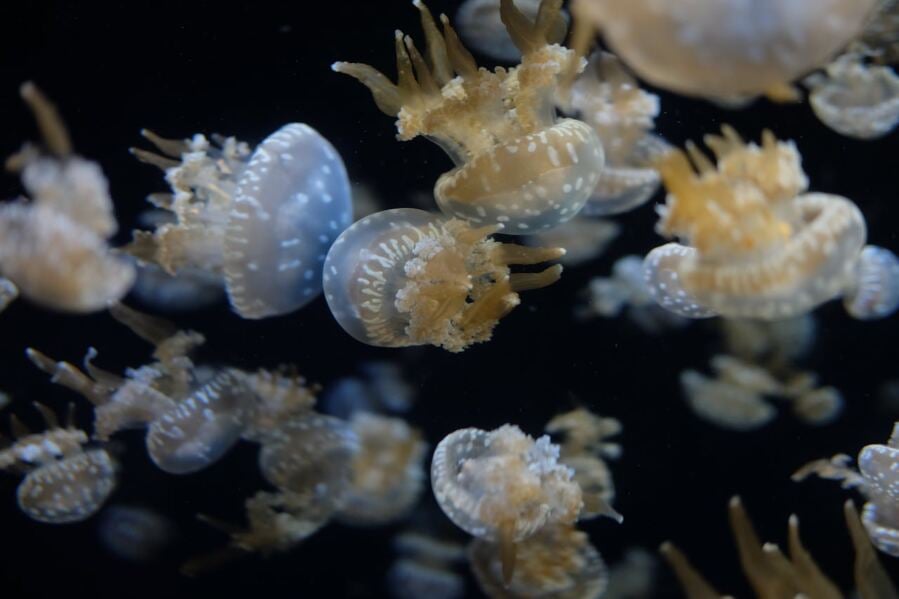
Pull a trammel net out of the Mediterranean and, on a bad morning, half of what comes up isn’t fish. Rhizostoma pulmo, the barrel jellyfish, can reach the size of a dustbin lid; it clogs the mesh, tears the netting, stings the crew, and drives down the value of whatever commercial catch manages to make it aboard. For generations of small-scale fishers working the Spanish coast between Catalonia and Alicante, jellyfish bycatch has been roughly what you’d expect: a nuisance, a cost, something to dump overboard and forget. New research suggests that calculation may be entirely wrong.
Scientists at the Catholic University of Valencia have been spending the past year or so asking a rather different question. Not how to get rid of the jellyfish, but whether the animals are worth something.
The short answer, it turns out, is yes. Collagen, the structural protein that keeps skin firm, wounds closed, and cartilage functional, is present in jellyfish in surprisingly high concentrations. The pharmaceutical and cosmetic industries already use collagen extracted from bovine and porcine sources, but marine alternatives are increasingly attractive: they sidestep concerns about zoonotic disease transmission, fit more easily with dietary restrictions, and, if produced from bycatch, would come from material that’s currently being discarded anyway. The catch was always the assumption that accidentally netted jellyfish, tumbled around in fishing gear for hours, exposed to heat and sun and mechanical stress, would be too degraded to be any use. Raquel Torres and her colleagues at the COLMED project set out to test whether that assumption actually held up.
From Nuisance to Raw Material
It doesn’t. When Torres’s team compared collagen extracted from bycatch R. pulmo specimens with collagen extracted from jellyfish carefully hand-netted to preserve their tissue, the differences were, in the technical language of the paper, minimal. Three separate analytical methods, gel electrophoresis, infrared spectroscopy, and X-ray diffraction, all produced essentially the same picture: the bycatch collagen retained its characteristic molecular bands, its preserved amide groups, and the native triple-helical arrangement that makes collagen structurally useful in the first place. “The key result was very encouraging,” Torres said. “Collagen obtained from bycatch jellyfish showed the same main structural features and very similar quality to collagen from carefully collected specimens.” In other words, hours in a trammel net doesn’t seem to ruin the protein. The discarded material has been, all along, a viable raw material.
Whether that finding translates into anything commercially useful, though, depends on questions that go well beyond the chemistry lab. Which is where the fishers come in.
Working with four small-scale fishing guilds, in Port de la Selva and Roses on the Catalan coast, and Jávea and Moraira further south in the Valencian Community, the COLMED team spent more than a year building what amounts to an unusual partnership. “The collaboration with fishers was one of the most valuable parts of the project,” Torres said. “Their practical knowledge of the sea, seasonal changes, fishing gear, and species behavior is incredibly valuable and often underappreciated.” Sixteen active small-scale fishers participated in semi-structured interviews; the team ran training sessions in the guild facilities on jellyfish identification; research staff joined the first six fishing trips. And then the fishers took over the monitoring, reporting bycatch events, photographing specimens, logging data on species and gear type and abundance across 13 months of observation.
The monitoring produced the first quantitative baseline of jellyfish bycatch in the region. Over that period, 70 bycatch events were recorded across three species. R. pulmo showed up throughout the year, peaking in summer and fall, sometimes in bursts of 51 to 100 animals in a single event. Pelagia noctiluca, the stinging mauve jellyfish familiar to anyone who’s ever had a bad swim off a Mediterranean beach, turned out to be numerically dominant on the Catalan coast, accounting for more than half of recorded individuals, though its collagen yield is far lower than R. pulmo’s and therefore much less commercially interesting.
Willing but Waiting for Infrastructure
The fishers’ attitudes were perhaps the study’s other main finding, and in some ways the most telling. Most participants already had some grasp of circular bioeconomy concepts; more than 80% believed that jellyfish bycatch could become a useful resource. Nearly all expressed willingness to participate in pilot initiatives. Every single respondent said they’d dedicate vessel time to jellyfish collection if a stable market existed. Torres notes that the knowledge exchange ran in both directions: the fishers brought irreplaceable understanding of seasonal patterns and gear behavior, while the researchers shared the science of what the jellyfish might be worth.
What the fishers were considerably less enthusiastic about were the things that currently don’t exist. Seventy-five percent cited a lack of institutional incentives as a barrier. Nearly 70% pointed to absent market demand. A fair number flagged the absence of infrastructure, training, and any clear pathway from jellyfish-in-the-net to product-on-the-market. Torres acknowledged their willingness was conditional, and sensibly so: the systems that would make participation viable aren’t there yet.
Dr Ainara Ballesteros, who co-leads the COLMED project, is alert to the misconceptions that surround this kind of work. “One common misconception is that jellyfish are only harmful organisms with no positive value,” she said. Another, perhaps more relevant to the sceptics who’d wonder whether fishers would really get anything out of processing a pest species: “Another misconception is that waste materials are automatically low quality.” The collagen results speak to that directly. And if the economic argument can be made credibly, the rest may follow. “Innovative circular economy models,” Ballesteros argues, “can help support both environmental goals and coastal livelihoods.” Not either-or. Both.
A Protein With Reach
The potential applications for jellyfish-derived collagen are rather broader than the bycatch origins might suggest. Type I collagen, the variety the R. pulmo samples most closely resemble, is already used in wound dressings, tissue-engineering scaffolds, drug delivery systems, and skin-care formulations. There’s some preliminary evidence that R. pulmo collagen can support cartilage cell proliferation, suggesting possible applications in joint repair that would be of real interest to orthopaedic medicine. The fact that the bycatch specimens yielded essentially the same collagen quality as carefully handled animals is, from a production standpoint, significant: it means the collection infrastructure that already exists, the boats, the nets, the ports, the existing handling routines, could in principle feed directly into a collagen supply chain with relatively modest additional investment.
There are caveats. The yields from the acid-soluble extraction method were lower than those reported in studies using pepsin-assisted or ultrasound-assisted techniques; the simpler approach was chosen deliberately, to establish a clean comparison, but commercial production would almost certainly need more aggressive methods. Further analyses, including amino acid profiling, are still needed to fully characterise the material. And the gap between laboratory validation and commercial viability is one that many promising marine biotech findings have failed to cross.
Still, the logic has a certain momentum. Jellyfish blooms in the Mediterranean appear to be intensifying, driven by warming waters, shifts in predator populations, and coastal nutrient runoff. The bycatch problem, in other words, is probably getting worse. If the animals that are already fouling the nets can be transformed into a raw material worth collecting and processing, the calculus changes entirely. The nuisance becomes the point. For coastal fishing communities already dealing with generational decline, uncertain catches, and thin margins, a new income stream built on something they’d previously thrown away could matter more than it might first appear.
https://doi.org/10.3389/fmars.2026.1760045
Frequently Asked Questions
Does being accidentally caught in a fishing net actually damage the collagen inside a jellyfish?
Apparently not, at least not significantly. When researchers compared collagen from bycatch barrel jellyfish with collagen from animals carefully hand-netted to preserve their tissue, three independent analytical methods all showed the same molecular structure was intact. The bycatch specimens had been in fishing gear for hours, transported to port, and handled without any special preservation, yet the protein’s characteristic triple-helical arrangement was unaffected. That finding is what makes the circular economy case worth taking seriously.
Why would anyone use jellyfish collagen when we already have collagen from cows and pigs?
There are a few reasons the industry is looking for alternatives. Mammalian collagen carries a small but real risk of transmitting animal diseases to humans, and it’s incompatible with some dietary restrictions, including halal, kosher, and vegetarian requirements. Marine collagen sidesteps both problems and appears to have good biocompatibility. If it can be sourced from bycatch that would otherwise be discarded, it also becomes arguably more sustainable than farming animals specifically for protein extraction.
Could jellyfish collagen actually end up in medical treatments, or is this just for face creams?
The research suggests a broader range of applications than cosmetics alone. Type I collagen, which barrel jellyfish collagen most closely resembles, is already used in wound dressings, tissue-engineering scaffolds, and systems for delivering drugs to specific sites in the body. There’s preliminary evidence that R. pulmo collagen can support the growth of cartilage cells, which opens up possible uses in joint repair. Commercial-scale production is still a long way off, but the material properties appear to be genuinely relevant to medicine, not just skincare.
Why do fishing communities need so much convincing if this could generate extra income?
The willingness is largely there. Virtually all the fishers who participated in the study said they’d be prepared to collect jellyfish if a stable market existed. The sticking points are structural rather than attitudinal: there’s no established processing infrastructure, no reliable buyer network, no regulatory framework for jellyfish as a commercial raw material, and no financial incentives from government or industry to help bridge the gap. The fishers interviewed knew exactly what the barriers were. Getting the systems in place is a policy and investment challenge as much as a scientific one.
Are Mediterranean jellyfish blooms actually getting worse, or does it just seem that way?
The evidence suggests blooms are intensifying, though the picture is complicated by the fact that long-term monitoring data are patchy. Warmer water temperatures, reductions in predator populations, and elevated coastal nutrients all appear to favour jellyfish at the expense of other species. The study documented 13 months of bycatch records across four Spanish fishing guilds, producing the first quantitative baseline for the region, which is precisely the kind of data needed to track trends over time. Citizen science platforms and fisher-researcher collaborations like COLMED are increasingly seen as essential for filling the monitoring gaps that conventional scientific surveys can’t cover at sufficient scale.
