

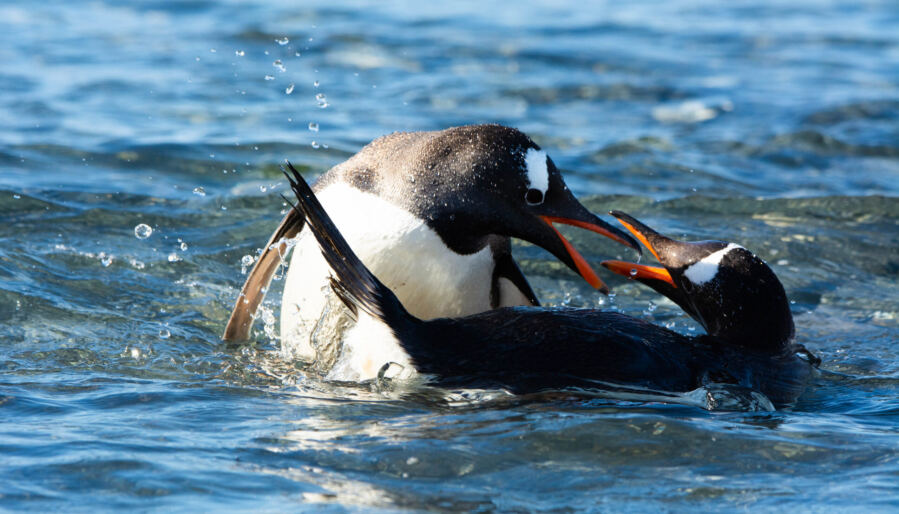
It looks like every other gentoo penguin. White belly, black back, that orange bill. Porpoises through the frigid Southern Ocean in the same way, returns to the same nesting site year after year, raises chicks that are, to any reasonable observer, completely indistinguishable from those raised on islands more than a thousand miles away. And yet genetically, the gentoo penguins of the Kerguelen archipelago (known to the French, with a kind of bleak poetry, as the Desolation Islands) are something else entirely. A separate species, hiding in plain sight for more than a century, spotted only now because scientists finally had the tools to look.
The discovery is the first new penguin species named in over a hundred years. But it comes attached to a problem: three of the four gentoo lineages now recognized as distinct species face an uncertain future as climate change reshapes the sub-Antarctic islands they inhabit.
One Species Becomes Four
For a very long time, the gentoo penguin was thought to be one widely distributed species, Pygoscelis papua, with perhaps a handful of subspecies scattered across a broad arc of the Southern Hemisphere. The taxonomy had been contested since the 19th century, with experts arguing about how many subspecies there were, or whether the divisions even meant anything biologically. Rauri Bowie, a professor of integrative biology at the University of California, Berkeley, and a curator at the Museum of Vertebrate Zoology, has worked on the question for nearly a decade alongside his colleague Juliana Vianna at Andrés Bello National University in Santiago, Chile. “There’s probably no species of penguin where the taxonomy has been more debated than the gentoo penguin,” Bowie said. “For over 100 years it’s been controversial as to how many species or how many subspecies there are.”
The new paper, published in Communications Biology in April, represents something of a consensus. It pulls together whole genome sequences from 64 individual birds across 10 breeding colonies, spanning nearly the entire geographical range of the species complex. That’s a lot of data. Previous studies had looked at selected genetic markers; this one incorporated thousands of single nucleotide polymorphisms, tiny variations scattered across the entire genome, and overlaid them with comparisons of body size, vocalisation, diet, breeding timing and feeding behaviour.
The result was four clearly distinct lineages. The northern gentoo, Pygoscelis papua, occupies the Falkland/Malvinas and Martillo Islands off South America. The eastern gentoo, Pygoscelis taeniata, breeds on Crozet, Marion and Macquarie Islands. The southern gentoo, Pygoscelis ellsworthi, is the only one that actually lives in Antarctica proper, on the Antarctic Peninsula and South Georgia. And then there’s the new one: the southeastern gentoo, Pygoscelis kerguelensis, which evolved on Kerguelen and possibly nearby Heard Island, roughly 2,000 miles from any permanently inhabited landmass. “What this paper does,” Bowie said, “is try to address that question using cutting-edge integrative approaches.”
Why Penguins That Eat Anything Stay Put
How four species arose from one probably comes down, in part, to the gentoo’s dietary flexibility. Unlike Emperor penguins or Adélies, which specialise on krill and travel vast distances to find it, gentoos eat whatever’s available: fish, squid, cuttlefish, krill. That flexibility keeps them close to their breeding colonies; they don’t need to range far, so they don’t. And because they return to the same nesting sites year after year, island populations essentially stay put for generations.
The Antarctic Polar Front, a temperature and salinity boundary in the Southern Ocean, acts as an additional barrier to dispersal. Over roughly 300,000 to 500,000 years, isolated populations diverged, accumulating genetic differences readable now as lineage-specific signatures of positive selection. The southern gentoo shows genomic changes tied to thermoregulation, fat storage and light perception. The eastern gentoo carries enrichment in genes for oxygen transport and diving efficiency. The northern gentoo has more genes linked to digestion and cardiac performance. Each population adapted to exactly where it was stuck.
The cryptic species, Pygoscelis kerguelensis, is particularly intriguing. It falls right on the Polar Front, which may help explain why it remained invisible for so long: its position at the boundary between lineages would have made it easy to lump with whichever adjacent population a researcher happened to be studying. It looks the same. The genetic evidence, though, is unambiguous.
Three Species, Three Uncertain Futures
The timing of this discovery matters for reasons that go beyond taxonomy. Vianna pointed out the conservation dimension directly: “In Antarctica, of course, other species, not the gentoo, are threatened by climate change. But the gentoo is of most concern in the sub-Antarctic region.” The team used climate projection models to estimate where each lineage’s preferred habitat will be in 2050. Under moderate warming scenarios, all three island-inhabiting sub-Antarctic species could find their current islands unsuitable, with few or no nearby alternatives to move to. The southern species, by contrast, may actually expand its range as ice retreats and other Antarctic penguins decline. That’s probably cold comfort for the broader picture, but it does suggest the gentoos of Antarctica are, for now, reasonably well positioned.
The other three are not. “It’s very important that conservation institutions in all the different countries involved recognize and take appropriate action to save these three gentoo penguin species,” Vianna said. The sub-Antarctic is a patchwork of sovereignty: French, South African, Australian, British, Argentine, Chilean and New Zealand territories, each with its own administrative apparatus and conservation priorities. Coordinating protection for a newly recognized species across that many jurisdictions is not, to put it gently, straightforward.
Vianna sees the problem extending well beyond gentoos. Island penguin species globally, she argues, face a version of the same predicament: they evolved in isolation, they’re adapted to specific conditions, and there’s nowhere else to go. “Galapagos and other island penguin species, because they’re endemic to these islands, will find no place to go after a change in their environment,” she said. “Those islands are very isolated, and these penguins cannot adapt easily to colonize any other region.”
The genomic data gathered for this study, meanwhile, is already being repurposed. Vianna is combing through penguin genomes searching for the genetic variants associated with survival from avian influenza, which has been spreading through penguin and seabird colonies worldwide with alarming speed. Bowie has described the broader shift this kind of work represents: “Whole genome sequencing has transformed our ability to not only look at adaptation from a perspective of how things diversify, but it has really important conservation value.” Whole genomes, in other words, aren’t just for settling century-old arguments about how many species there are. They’re becoming, in a fairly literal sense, a survival tool.
Somewhere on the Desolation Islands, several thousand penguins that don’t know they’re a new species are doing what they’ve always done: diving into cold water, hauling out on rock, coming back to the same nest site year after year. The question being asked now isn’t what to call them. It’s whether the world they’re adapted to will still exist by the time the paperwork catches up.
https://doi.org/10.1038/s42003-026-10081-7
Frequently Asked Questions
How can a whole new penguin species go unnoticed for over a century?
The southeastern gentoo is what scientists call a “cryptic species,” genetically distinct but visually almost identical to its relatives. Without whole-genome sequencing, there was simply no reliable way to tell it apart from adjacent populations. Its location on one of the most remote archipelagoes on Earth, nearly 2,000 miles from any permanently inhabited landmass, didn’t help either. The tools to detect cryptic biodiversity at this level have only become widely available in the past decade.
Why does splitting one penguin species into four matter for conservation?
Species-level recognition triggers legal and institutional protections that subspecies status typically doesn’t. Each of the three newly elevated sub-Antarctic gentoo species occupies a different island group governed by a different country, and each will now need to be managed and protected independently. Recognizing them as distinct species also makes their individual population sizes visible, and those sizes, for island-endemic birds facing climate-driven habitat loss, may be considerably smaller than previously assumed.
Are all gentoo penguins in trouble, or just some of them?
The picture is genuinely mixed. The southern gentoo, the only lineage that lives in Antarctica proper, is actually predicted to expand its range as warming opens up new habitat. The other three species, the ones living on sub-Antarctic islands, face a much harder future, because climate projections suggest their current islands could become uninhabitable by 2050 with few or no suitable alternatives nearby. So the same set of discoveries that reveals a new species simultaneously reveals that three species face serious threat.
Could the gentoos’ flexible diet actually help them survive climate change?
It’s already helping in one sense: gentoo populations have been increasing on the Antarctic Peninsula while more specialist feeders like Emperor and Adélie penguins decline there, partly because gentoos can switch prey as krill availability shifts. But dietary flexibility only helps if there’s food to find, and if the island itself remains viable habitat. For the sub-Antarctic species, the core threat isn’t food availability so much as the loss of the particular thermal conditions and oceanographic features their islands depend on, none of which can be replaced simply by eating something different.
What else can penguin genomes tell us beyond species identification?
Quite a lot, apparently. The same dataset is now being searched for genetic variants associated with survival from avian influenza, which has been spreading rapidly through seabird colonies in recent years. The genomic signatures of adaptation to cold, oxygen transport, and immune response visible in these four species could help researchers identify which populations are most at risk from disease, habitat loss, or both. In that sense, the taxonomy study is as much a foundation for future conservation genetics as it is a resolution of a century-old debate.
