
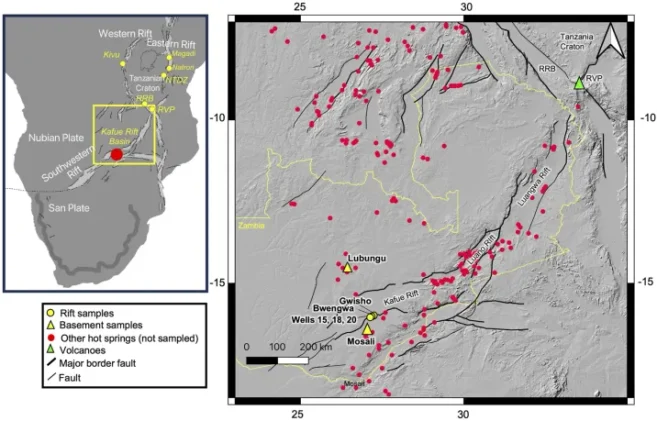
The water at Bwengwa springs doesn’t just bubble. It carries something stranger up from below: a fingerprint of helium that has no business being there, isotopically speaking. Too much of the lighter variant, not enough of the heavier one. The ratio says, unambiguously, that these gases have traveled through roughly 100 kilometres of rock to reach the surface, leaching through fractures in the crust from the semi-molten mantle beneath. And that, if a team of Oxford geochemists is right, means Zambia is sitting on top of what might eventually become a new edge of a tectonic plate.
The paper, published this week in Frontiers in Earth Science, presents the first direct geochemical evidence that the Kafue Rift of Zambia is actively connected to the Earth’s mantle, a finding that could reshape our understanding of how Africa is being pulled apart from within.
The Kafue Rift is one section of a far longer geological seam, a 2,500-kilometre zone of faulted terrain that runs from Tanzania in the northeast down through Zambia and Botswana to Namibia, possibly connecting eventually to the mid-Atlantic Ridge. Geophysicists had suspected something was happening here: subtle shifts in topography, scattered geothermal springs, low-level earthquakes. But suspicion is not evidence. To confirm that a rift is genuinely active rather than simply dormant, you need to show that fluids from the mantle are actually reaching the surface, punching up through the crust. That’s what the helium measurements now seem to confirm.
Not the helium in a party balloon. A very specific isotope of it.
Helium comes in two stable forms. Helium-3 is primordial, trapped in the mantle since Earth’s formation and rarely found in ordinary crustal rocks. Helium-4 is radiogenic, generated by the slow radioactive decay of uranium and thorium that permeates the continental crust. The ratio between them tells you where a sample came from. In the Kafue Rift springs, the team found helium-3/helium-4 ratios running eight times above what you’d expect if the gas were purely crustal in origin. “The hot springs along the Kafue rift of Zambia have helium isotope signatures which indicate that the springs have a direct connection with the Earth’s mantle, which lies between 40 and 160km below the Earth’s surface,” said Prof Mike Daly of the University of Oxford, one of the paper’s authors. Springs sampled outside the rift zone, in the surrounding basement rock, showed no such signature, confirming the mantle signal is spatially restricted to the fault corridor itself.
A carbon isotope reading from one of the springs added a second line of evidence. Carbon dioxide venting at the surface carried a carbon-13 value close to the range characteristic of mantle-derived gases, consistent with CO2 released during partial melting of rock at depths greater than 60 kilometres. The two signals together are, in geological terms, a fairly compelling argument that something deep is feeding these springs.
Reading the Stages of a Rift
What makes the Kafue Rift particularly interesting is where it sits in the developmental sequence. Continental rifting is not an event, it is a process that unfolds over tens of millions of years, progressing through recognisable stages. The team compared their measurements against a well-studied reference system: the East African Rift System, which includes mature volcanic provinces like Rungwe and the tectonically restless Lake Kivu basin in the Democratic Republic of Congo. In those older, more developed sections, carbon dioxide has become the dominant gas phase, pumped up by active magmatism. Helium concentrations drop because the volcanic flux dilutes them. The Kafue samples look quite different, and the difference is telling. Nitrogen dominates, making up between 84 and 98 percent of the gas by volume. Helium concentrations are high. CO2 is present but in modest amounts, and its carbon isotope ratio has been partially stripped out by groundwater absorbing the gas as it rises, a pattern typical of rifts where magmatic flux is still low. This geochemical profile closely matches the Northern Tanzanian Divergence Zone and the Rukwa Rift Basin, two segments of the East African system considered to be in early stages of extension. Which is roughly where the Kafue Rift seems to be too, perhaps earlier.
Daly described a rift as a large break in the Earth’s crust that creates subsidence and associated elastic uplift, but noted that most rifts stall before completing the journey to lithospheric break-up. The question is whether this one might eventually do otherwise.
Could Africa Gain a New Ocean?
That question leads to a genuinely contested piece of geodynamics. The East African Rift System is often presented as the front-runner for Africa’s eventual continental divorce: a future sea forming where the rift valleys of Ethiopia, Kenya and Tanzania now sit. Daly’s view, expressed carefully, is that the more famous rift faces some structural problems. Africa is hemmed in by mid-ocean ridges on multiple sides, tending to resist the east-west or north-south extension that would widen the East African rift into an ocean. The process, he suggested, seems to struggle to fully establish itself there.
The Southwestern Rift, by contrast, might face fewer of these obstacles. The geometry of the basement rock, ancient shear zones and crustal weaknesses inherited from Precambrian tectonics, is apparently better aligned with the pull from surrounding mid-ocean ridges. That alignment could mean a lower mechanical threshold for eventual break-up. Whether that makes it more likely to succeed where the East African Rift has so far failed, or merely interesting to contemplate, probably won’t be settled within any human lifetime.
There’s also a more immediate reason the discovery matters. Early-stage rifts like this one, where mantle fluids are reaching the surface through crustal faults but volcanism hasn’t yet swamped the system, turn out to be promising environments for certain economically valuable gases. Helium, in particular, tends to accumulate where volcanic CO2 hasn’t flushed it away. Some of the world’s most significant helium fields sit in analogous geological settings. Hydrogen, too, is increasingly sought after as an energy carrier, and early-stage rifts may preserve it before it oxidises or disperses. Geothermal energy is a more immediate prospect for Zambia, where the heat flow in the Kafue region exceeds 120 degrees Celsius per kilometre depth, anomalously high even by rift standards.
Daly was explicit about one limitation of the current study: the helium measurements come from one locality within a rift zone that stretches thousands of kilometres. The Kafue Rift is one section of the proposed Southwestern Rift of Africa. Segments to the northeast, the Luano and Luangwa rifts, and to the southwest, the Okavango Rift in Botswana and the Eiseb Rift in Namibia, remain geochemically uncharacterised. Follow-up fieldwork is underway, with results expected later this year. If those surveys find similar mantle helium signatures along the full length of the zone, the case for a single continuous and active plate boundary would become considerably harder to dismiss.
For now, Bwengwa bubbles on. The water is warm, the gas carries its mantle signature to the surface, and somewhere beneath the Central African Plateau, the lithosphere is doing something that may, given enough time, change the shape of a continent.
https://doi.org/10.3389/feart.2026.1799564
Frequently Asked Questions
How do scientists know the helium in Zambia’s springs is coming from the mantle and not just from rocks nearby?
Helium exists in two stable forms with very different origins. Helium-3 is primordial, locked in the mantle since Earth formed, while helium-4 is produced by radioactive decay in ordinary crustal rocks. The ratio between them acts as a kind of geological passport. The Kafue Rift springs showed helium-3 levels eight times higher than crustal rocks could produce, and springs just outside the rift zone showed no such signature, confirming the mantle signal is coming up specifically through the fault system.
Will Africa actually split in two, and if so when?
Possibly, but on timescales that make “when” almost meaningless in human terms. Continental rifting typically takes tens of millions of years to progress from early extension to full ocean formation, and many rifts stall before reaching that point. The Kafue Rift appears to be at a very early stage, and whether it will continue to develop or eventually go dormant is unknown. The geometry of the surrounding tectonic plates may actually favour break-up here more than along the more famous East African Rift System, but this remains speculative.
Why does it matter that carbon dioxide is still low in these springs?
In more mature rift systems where magma is actively rising, volcanic CO2 floods the system and overwhelms other gas signals. The fact that Kafue’s springs are still dominated by nitrogen and helium rather than carbon dioxide suggests magmatic activity is minimal so far, placing the rift at an early developmental stage. That’s actually useful information for resource exploration: helium and hydrogen tend to accumulate before volcanic gases disperse them, making early-stage rifts potentially more valuable for those gases than mature ones.
Could the Kafue Rift be developed for geothermal energy?
The conditions look reasonably favourable. Heat flow in the region runs above 120 degrees Celsius per kilometre of depth, which is high even by rift standards, and the active fault systems provide the fluid pathways that geothermal development requires. The springs at places like Bwengwa are already a visible expression of this heat. Whether commercial development would be feasible depends on more detailed subsurface mapping, but the researchers specifically flag geothermal potential as one of the practical implications of their findings.
Is this the same rift system as the Great Rift Valley tourists visit in Kenya?
Not exactly. The East African Rift System, which includes the Great Rift Valley, is a related but older and better-developed system to the northeast. The Southwestern Rift of Africa runs roughly parallel to it further west, connecting through Zambia, Botswana and Namibia before potentially linking to the mid-Atlantic Ridge via the Walvis Ridge. The two systems share a broad tectonic context, the break-up of Africa, but appear to be at different developmental stages, with the Kafue area considerably less mature and, so far, without the volcanoes that characterise parts of the East African system.
ScienceBlog.com has no paywalls, no sponsored content, and no agenda beyond getting the science right. Every story here is written to inform, not to impress an advertiser or push a point of view.
Good science journalism takes time — reading the papers, checking the claims, finding researchers who can put findings in context. We do that work because we think it matters.
If you find this site useful, consider supporting it with a donation. Even a few dollars a month helps keep the coverage independent and free for everyone.