

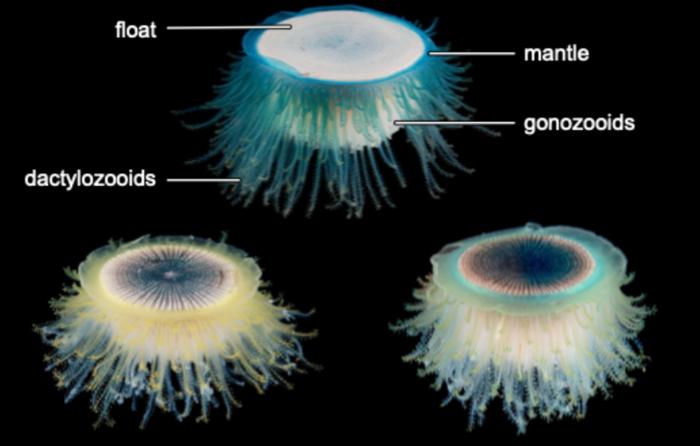
Slice through a blue button and what you find looks, improbably, like a tree. Concentric rings of chitin, the same material that makes up crab shells, packed into a disc no wider than your thumbnail. Each ring records growth added at the outer margin, layer by layer, as the colony drifts wherever the Pacific current decides to take it. Nobody had counted those rings before, not rigorously anyway, and so nobody knew just how long a blue button might be out there riding the surface of the open ocean. The answer, it turns out, is rather a long time.
A study published this week in Scientific Reports by researchers from the University of Tokyo’s Misaki Marine Biological Station estimates that some blue button colonies persist at the ocean surface for several years, possibly as long as five. That may not sound dramatic, but for a creature previously assumed to live less than a year, it reshapes what we think we know about one of the sea’s stranger ecosystems.
The blue button, Porpita porpita, is easy to miss and easier to misidentify. At first glance it looks like a small jellyfish washed up on the tideline, jewel-blue and delicate, a couple of centimetres across. Look closer and it is actually a colonial organism, a tight confederation of tiny individuals called zooids, each specialised for a particular job. Dactylozooids do the hunting, catching small prey along the colony’s fringe. Gonozooids handle reproduction at the center. A single gastrozooid digests the food for everyone. The whole operation floats on that chitinous disc, which functions more or less like a life raft, sealed air chambers and all.
Getting one into a laboratory is hard enough. Keeping it alive once you have is another problem entirely.
Associate Professor Kohei Oguchi has been walking the rock pools around Misaki, on the Miura Peninsula south of Tokyo, in search of blue buttons for years. The animals wash in unpredictably, deteriorate quickly once stranded, and have resisted almost every attempt to culture them. His team tried containers ranging from 30 centimetres to a full metre across. They tested temperatures between 18 and 25 degrees Celsius, varied the water flow, adjusted sunlight exposure, offered krill, frozen shrimp, mackerel, whitebait. More than 80 percent of specimens died within a week regardless. What finally worked was almost embarrassingly simple: a 30-centimetre plastic tub of filtered seawater, changed daily, set near a sunny window, and a diet of freshly hatched brine shrimp nauplii. “We were able to keep 10 blue button colonies alive for up to 21 days,” Oguchi said. Three weeks of observation, which does not sound like much, but for this particular animal it was enough.
The key was measuring float growth. Postdoctoral researcher Daiki Wakita photographed each colony at the start and end of its time in the lab, measuring float radius along eight axes using image-analysis software. Smaller colonies grew detectably across those few weeks; the two largest, both exceeding roughly 17 millimetres in radius, showed no measurable change at all. That size-dependent slowdown in growth is a familiar pattern in biology, and it pointed Wakita toward a well-established mathematical tool called the von Bertalanffy growth model, typically used for fish and coral. Fitted to the data within a Bayesian framework, the model let the team estimate how old each colony actually was when collected.
The numbers were not what anyone expected. A colony about 4 millimetres in radius was probably around 3 months old. One at 12 millimetres, roughly a year. At 23 millimetres, the model estimated an age of about 5 years. “From our observations of these colonies, we can now estimate that blue buttons may actually live for several years drifting on the ocean surface,” Oguchi said. “This is much longer than previously thought, which was less than a year.”
Written in Rings
The histology told its own story. When the team examined thin cross-sections of the float under a light microscope, they could see new cuticular layers being added specifically at the margin of the disc, not expanding uniformly outward from within but accreting at the edge, each new ring laid down by a sheet of secretory cells positioned just inside the outermost layer. “The chitinous float that supports the colony looks just like the cross section of a tree, with concentric rings,” Oguchi said. “We found that new layers grow from the periphery of the outer ring. This means that it doesn’t grow from the expansion of preexisting layers, which we didn’t know for sure before.” As each new ring is added, it expands the budding zones where new zooids can form, so float growth and colony growth are functionally coupled, the disc and its crew expanding together.
The comparison to trees is more than superficial. In both cases, peripheral accretion records time in a way that is, in principle, legible. Whether blue button rings could ever serve as a reliable chronometer the way tree rings do remains to be seen; the growth curves grow uncertain near the asymptote, and the estimates for large, slow-growing colonies carry real statistical spread. A 23-millimetre colony might be anywhere between roughly 3.8 and 6.3 years old by the model’s 95-percent credible interval. These are preliminary numbers, and Oguchi is careful to say so.
A Life on the Surface
What makes the finding ecologically interesting is where it places the blue button on the spectrum of cnidarian life history. True jellyfish, the scyphozoan medusae, typically survive less than a year as adults. Benthic corals, permanently anchored to the seafloor, can live for decades. Blue buttons sit somewhere in between, and that intermediate position looks like it matters. The ocean surface, where these animals live, is an uncommonly punishing environment: ultraviolet radiation, wave action, daily temperature swings. That blue buttons manage years there, rather than months, suggests their chitinous floats are doing real work as a survival strategy, something more durable than the gelatinous bodies of their jellyfish relatives.
In Japanese waters, blue button populations are thought to originate in warmer southern seas and drift north along the Kuroshio Current into the Pacific and Sea of Japan. If the new lifespan estimates hold, some of the larger colonies washing up on Japanese beaches may have been circulating at sea for several years, potentially carried through multiple ocean gyres before arriving. “My research focuses on how the different specialized individuals that make up a blue button colony develop, and how they are integrated so that the colony behaves almost like a single organism,” Oguchi said. “Being able to keep colonies alive for as long as we have for this study is an encouraging step forward.” The next ambition is to rear blue buttons from the very beginning of their life cycle, documenting development from metamorphosis onward. Cutting-edge stuff, as these things go, though given how difficult the animals have proven to keep, three weeks in a plastic tub already feels like something worth celebrating.
Wakita et al., Scientific Reports (2026). DOI: 10.1038/s41598-026-49897-y
Frequently Asked Questions
What exactly is a blue button, and is it really one animal?
Not quite. Porpita porpita is a colonial organism, meaning it is actually a confederation of genetically identical but structurally specialized individuals called zooids, all attached to a shared chitin float. Different zooids handle feeding, reproduction, and defense. The whole colony functions as a coordinated unit, much like a single animal, but it is technically a community of individuals living as one.
How did the researchers estimate age from just a few weeks of observation?
By measuring how fast the chitinous float grew during the 21-day rearing period and applying the von Bertalanffy growth model, a mathematical framework commonly used for fish and corals. Because growth slows predictably as colonies get larger, the model can work backward from a colony’s current size and growth rate to estimate how long it must have been growing. The estimates are most reliable for small, fast-growing colonies and become less certain for large, nearly-static ones.
Why does it matter how long blue buttons live?
The ocean surface is its own distinct ecosystem, called the neuston, and blue buttons are one of its key members, sitting in the middle of food webs that connect microscopic prey to larger predators. If these colonies persist for years rather than months, they represent a more stable, long-lived component of that ecosystem than previously assumed. That has implications for understanding how the surface layer functions, how plastic and other debris interacts with neustonic life, and how ocean currents distribute these animals across vast distances.
Could the lifespan estimates be wrong?
Possibly, yes. The researchers are upfront about this. Laboratory conditions do not perfectly replicate the open ocean, and the model requires extrapolating from three weeks of data over a multi-year timespan. Growth rates in captivity could be skewed in either direction, with poorer water conditions potentially suppressing growth and the absence of UV radiation and wave stress potentially inflating it. The team describes these estimates as a first quantitative framework, not a final answer.
