

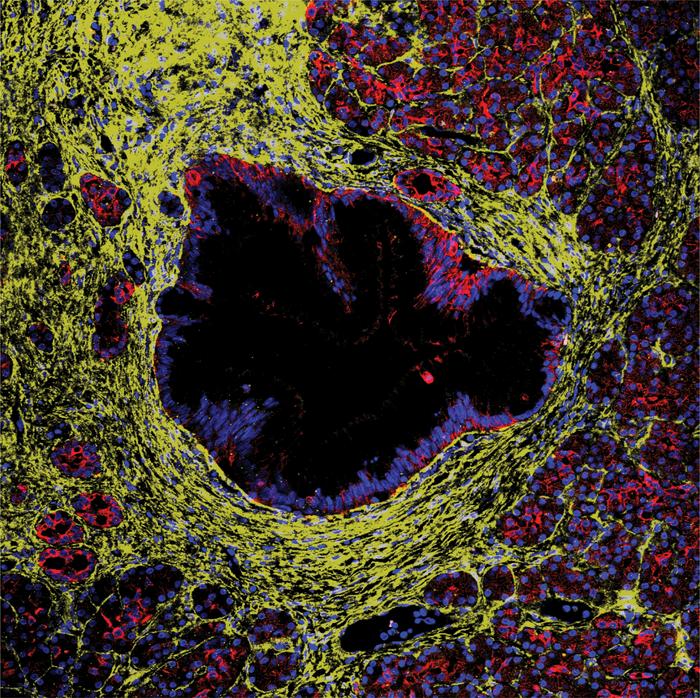
Most of us are probably walking around with them right now. Tiny clusters of abnormal cells, nestled inside an otherwise healthy pancreas, carrying the very genetic mutations that mark the early stages of one of the most lethal cancers known. Pancreatic intraepithelial neoplasias, or PanINs, turn out to be almost universal in adults, spotted in more than 60 percent of donor pancreases studied at the University of Michigan, including young donors in their twenties. And yet pancreatic cancer remains relatively rare. Something, clearly, is holding these lesions back. Researchers have long suspected that the answer lay in the tissue surrounding the abnormal cells. They were right. Just not in the way they expected.
A new study published in Cancer Discovery has upended the standard model of how precancerous lesions develop, and the findings carry real implications for understanding who might be at risk of progression to full malignancy.
In established pancreatic tumours, cancer cells do something rather clever: they recruit the tissue around them to their cause. Fibroblasts remodel into aggressive, cancer-promoting types. Macrophages, the immune system’s sentinels, cluster tightly around tumour cells and seem to help rather than hinder. The whole local environment, a region scientists call the tumour microenvironment, reorganises itself to support the tumour’s growth. The assumption, reasonable on its face, was that this process begins early. That PanIN lesions, sitting somewhere on the road between normal cells and frank cancer, would show a similarly corrupted neighbourhood. A “tumour light” microenvironment, scaled down but recognisable.
They did not. “It turns out, the microenvironment of these precursor lesions is the same as the microenvironment of the normal pancreas,” said Marina Pasca di Magliano, co-director of the Rogel and Blondy Center for Pancreatic Cancer at the University of Michigan. “The lesions have not convinced any of the cells around them to change. That’s not what we were expecting. We were expecting the two components, the cells and the microenvironment, to evolve in lockstep. They did not.”
This is what the researchers call asynchronous evolution. The epithelial cells inside a PanIN lesion are already partway down the road to cancer (showing elevated KRAS signalling, early inflammatory pathway activation, patterns that intensify in actual tumour tissue). But the stroma, that surrounding community of fibroblasts, immune cells, and extracellular matrix, remains stubbornly normal. The two compartments are out of step, and that gap might be precisely what keeps most PanINs from tipping over into malignancy.
Needles in a Haystack
Getting to this finding was not straightforward. PanIN lesions are microscopic, scattered sparsely through otherwise normal tissue, and studying them in the context of cancer patients has always introduced a confounding problem: the cancer itself disrupts the surrounding tissue, making it impossible to know what a truly “normal” precancer neighbourhood looks like. The Michigan team’s unusual advantage was access to more than 150 donated pancreases, organs not needed for transplant, collected in partnership with Gift of Life Michigan. These came from healthy individuals aged 20 to 70, providing something genuinely rare in cancer research: precancerous lesions in a normal biological context.
Even with the right tissue, the technical challenge was formidable. “These lesions are like needles in a haystack,” said co-senior author Timothy Frankel, also of the Rogel and Blondy Center. “The prior way of looking at this was to look at the entire haystack. You get a lot of information about hay and very little information about the needle. These new techniques allow us to just focus in on the needle so we can look at multiple needles using the same amount of computing power and resources.” The techniques Frankel refers to are spatial transcriptomics, which maps gene activity across tissue sections while preserving the physical location of each cell, combined with single-cell RNA sequencing and computational deconvolution to tease apart contributions from different cell types within the same microscopic spot.
The picture that emerged from all this was striking. In PanIN tissue, plasma cells cluster close to the abnormal epithelium (a pattern not seen in tumours), while macrophages, which in established cancer crowd around tumour cells, tend to stay at a distance. In frank cancer, that arrangement flips entirely. A specific fibroblast population, characterised by high expression of proteins called LRRC15, smooth muscle actin, and LEF1 (a component of WNT signalling), appears only in malignant tissue. Around PanINs, it is essentially absent. Researchers validated these spatial findings using multiple independent datasets and protein-level staining, and then went further: in laboratory co-culture experiments, cancer organoids drove LEF1 expression in cancer-associated fibroblasts but not in normal pancreatic fibroblasts, suggesting the cancer cells themselves are doing something to reprogram their stromal neighbours that PanIN cells have not yet managed.
What Might Pull the Trigger
“It is incredible to see how we can uncover the fundamental cellular mechanisms of disease etiology by blending new computational methods and cutting-edge spatial transcriptomics technologies,” said Elana Fertig of the University of Maryland School of Medicine, a co-corresponding author. “Through careful study design, we can use the spatial information to start delving into the unknown dynamics of pancreatic tumour evolution.”
What remains unknown is what actually breaks the stalemate, what external or internal pressure finally flips the microenvironment from neutral bystander to willing accomplice. The researchers point to the usual suspects: chronic inflammation, pancreatitis, smoking, age, obesity. Any or all of these could, perhaps, be what tips the balance. The hope is that if scientists can identify which stressors matter most, and how they reprogram the stromal cells around a precancerous lesion, there might be a window to intervene before the transition to cancer occurs. Identify someone whose PanIN microenvironment is starting to shift, and you might be looking at someone at genuinely elevated risk, rather than one of the millions of people quietly carrying harmless lesions they will never know about.
The team has made their full dataset publicly available at an interactive atlas (https://pascadimagliano-lab.github.io/PancAtlas/), inviting other researchers to query the data. For a disease where survival rates have barely budged in decades, partly because it is so rarely caught early, understanding what keeps the majority of precursor lesions in check could eventually matter a great deal.
https://doi.org/10.1158/2159-8290.CD-25-2001
Frequently Asked Questions
If most people have pancreatic precancer, why isn’t pancreatic cancer more common?
That’s essentially what this study set out to explain. The new finding suggests the key is the tissue surrounding the abnormal cells: in precancerous lesions, that surrounding environment remains largely normal and doesn’t cooperate with the lesion’s growth the way it does in established tumours. Most lesions appear stuck in this standoff, unable to recruit the stromal support they would need to progress. What breaks that standoff in the minority of cases that do become cancer remains an active area of investigation.
Could this lead to a way of predicting who will develop pancreatic cancer?
Potentially, yes, though the research is at an early stage. The logic is that if progression to cancer requires a specific shift in the tissue microenvironment, then detecting that shift early could flag people at genuinely elevated risk, as opposed to the much larger group quietly carrying benign precursor lesions. The particular fibroblast population identified in this study, marked by LRRC15 and LEF1 expression, appears only in malignant tissue, making it a candidate biomarker worth investigating further.
How were researchers able to study something so microscopic in human tissue?
The study depended on two things: access to over 150 donated pancreases from healthy individuals (through a partnership with organ procurement organisation Gift of Life Michigan), and a suite of new spatial genomics technologies that can map gene activity in tissue while preserving the physical location of each cell. Earlier methods essentially ground up the entire organ for analysis, losing all spatial context. The newer approach let researchers zoom in on individual lesions and map their cellular neighbourhoods with precision that wasn’t previously possible.
What are the risk factors that might push a precancerous lesion toward cancer?
The researchers don’t yet have a definitive answer, but the candidates they highlight include chronic inflammation, pancreatitis, smoking, obesity, and age. The working hypothesis is that one or more of these stressors could be what disrupts the normally quiescent microenvironment around a precancerous lesion, triggering the stromal reprogramming that seems to be required for malignant progression. Future studies are planned to test which factors are most critical.