

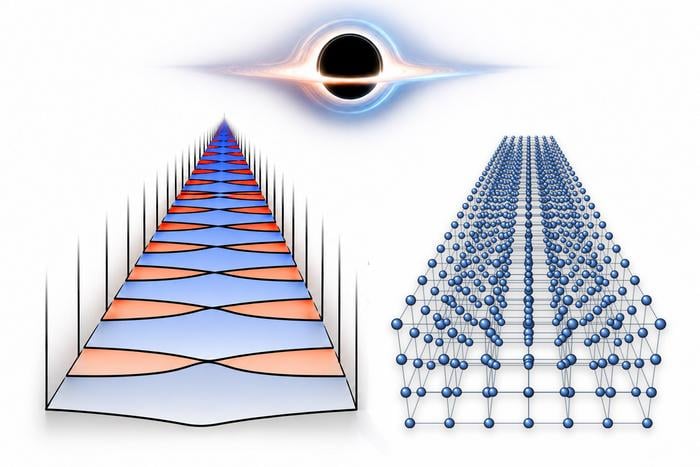
Water, at exactly zero degrees, doesn’t know what it wants to be. Add the tiniest nudge of energy and it stays liquid; subtract the same and it snaps into ice, molecules locking into a perfect repeating lattice. The tipping point itself, that knife-edge moment of indecision, is its own strange kind of object. For decades, physicists suspected something similar could happen to spacetime. Not water molecules, but the very fabric of the universe, organising itself into a crystal-like structure right on the threshold of becoming a black hole. Now, for the first time, a team from Vienna and Frankfurt has written down an exact mathematical description of what that object looks like, using nothing more than paper and pencil.
The result, published in Physical Review Letters, solves a problem that has sat open since 1993. It also reveals something genuinely odd about how black holes can form, and hints at what the very early universe may have looked like.
The story starts with a physicist named Matthew Choptuik, who in 1993 was running computer simulations of collapsing matter. He found that if you tune the energy of an infalling shell of particles to a critical threshold, the boundary between “collapse to a black hole” and “disperse harmlessly,” the resulting spacetime doesn’t just sit quietly. It pulses. It oscillates with a precise repeating rhythm, a discrete self-similarity, as if spacetime itself were a crystal with a regular lattice structure. Physicists called this state critical collapse, and they understood almost immediately that it had the hallmarks of a phase transition, something like the moment water becomes ice. The analogy was compelling; the mathematics, it turned out, was ferociously hard.
For 33 years, Choptuik’s critical solution existed only in numerical form, a thing computers could approximate but no human formula could capture. “Sometimes a tiny, seemingly insignificant cause is enough to trigger a huge and dramatic change,” says Prof. Daniel Grumiller of TU Wien, one of the authors of the new work. His ice analogy is apt. But whereas you can write down the physics of water freezing in fairly tractable equations, the equations governing spacetime near a black hole threshold are (to put it mildly) not.
The trick the Vienna-Frankfurt team used to crack it is, on the face of it, absurd. Our universe has four dimensions, three of space and one of time. The equations of general relativity in four dimensions don’t simplify easily; there’s no small number you can use to expand around, no obvious approximation scheme to exploit. But what if you let the number of dimensions grow? Not to five, or forty-two, but all the way to infinity. As Christian Ecker of Goethe University Frankfurt points out, nothing in principle prevents you from writing down the equations for any number of dimensions at all, five, or forty-two, or infinitely many. The equations in that limit, strangely, collapse into something far more manageable. The four-dimensional problem, recast as the infinite-dimensional limit of a more general theory, yields to analytical methods that simply weren’t available before.
What they found in that limit is a whole family of exact solutions, an infinite catalogue of spacetime crystal configurations, each characterised by a single function of time encoding the repeating rhythm of the structure. The solutions are, by the standards of general relativity, remarkably clean. “Our technique turns out to be remarkably stable,” says Florian Ecker of TU Wien. “Depending on the desired precision, we can systematically improve our formulas using additional approximation methods. This gives us a new method for studying black-hole-related phenomena that could previously not be analyzed analytically.”
The “crystal” label is more than metaphor. In a conventional crystal, atoms sit at regularly spaced points in space; disturb the lattice and it either holds or shatters. The Choptuik spacetime crystal has a similar dual nature. “It is a kind of intermediate state, an unstable point that can evolve in two different directions,” Grumiller explains. “It may simply dissolve again, leaving behind ordinary spacetime filled with freely moving particles. But if a tiny amount of energy is added, the evolution takes a completely different path: the inconspicuous spacetime crystal turns into a black hole.” The crystal is, in this sense, a universe balanced on the head of a pin.
Getting the infinite-dimensional solution to say something useful about our decidedly four-dimensional universe requires bringing it back down through successive corrections. The team worked through the leading-order solution (clean but imprecise), then next-to-leading order, then the level beyond that. Each correction captures more of the structure seen in Choptuik’s original numerical simulations, including the curvature of certain geometric features called null energy condition lines, which remained stubbornly wrong until the second correction was included. There’s something almost perverse about this approach: the universe you actually care about is the one farthest from the limit you’re expanding around. But the mathematics doesn’t seem to care about the perversity. It converges, at least near the centre of the spacetime crystal, faster than anyone expected.
The solutions also impose constraints that weren’t anticipated. At next-to-leading order, the team found that not all possible repeating rhythms for the crystal are mathematically consistent; most are ruled out by a condition on the way the structure’s self-similar horizon (a kind of internal boundary) behaves. This is potentially significant. At finite dimension, numerical work has long suggested there’s essentially only one critical solution of this type. The new analytic framework, if pushed to higher and higher orders, might pin down that uniqueness from first principles rather than just observing it in simulations.
There’s a cosmological dimension to this too, and it matters more than it might first appear. In the very early universe, fractions of a second after the Big Bang, the conditions were chaotic enough that critical collapse could, in principle, have happened spontaneously in small regions. The resulting objects would be primordial black holes, microscopic remnants of the universe’s infancy. Such objects have been proposed as candidates for dark matter, and whether they actually exist depends on how readily critical collapse occurred and how exactly the resulting black holes behaved. The new analytic solutions give theorists a precise framework, rather than numerical estimates, for thinking about that question.
The team is already pointing toward what comes next: extending the solution beyond the crystal’s interior to the region past its self-similar horizon, pushing the perturbative expansion to higher orders, and eventually tackling the Choptuik exponent, a number characterising how sensitive black hole formation is to initial conditions near the threshold. Numerical measurements have pinned it at roughly 0.374 in four dimensions; whether the large-dimensional expansion can reproduce that value analytically remains an open question, and probably the hardest one on the list. But for now, a 33-year-old gap in the mathematics of black holes has, at last, been filled in, with nothing but pen, paper, and the willingness to imagine a universe with infinitely many dimensions.
https://doi.org/10.1103/qgl5-5l3t
Frequently Asked Questions
Could microscopic black holes from the early universe actually exist today?
Possibly. Primordial black holes, which may have formed through critical collapse in the chaotic conditions shortly after the Big Bang, are a live candidate in cosmology. Whether they survived to the present depends on their mass and how they interacted with radiation; very small ones would have evaporated via Hawking radiation, while larger ones might still be out there. The new analytic framework gives theorists more precise tools to model how readily these objects could have formed.
Why couldn’t physicists write down a formula for this before?
General relativity’s equations are notoriously resistant to exact solutions, and the critical collapse problem adds another layer: the spacetime near the threshold is self-similar in a discrete, oscillatory way, which rules out most of the standard analytical tricks. Without a small dimensionless parameter to expand around, there was no obvious foothold. The breakthrough was recognising that the number of spatial dimensions could serve as that parameter, unlocking a regime where the equations simplify enough to solve.
What does it actually mean for spacetime to form a “crystal”?
In an ordinary crystal, atoms repeat at regular intervals in space. The Choptuik spacetime crystal is analogous: the geometry of space and time repeats at regular intervals in time, cycling through the same pattern over and over. It’s an unstable configuration that sits precisely at the boundary between two outcomes, collapse into a black hole or dispersal back into ordinary space. The crystal doesn’t persist; it either tips one way or the other depending on the tiniest fluctuation in energy.
Is the infinite-dimensions trick a real physical insight or just a mathematical convenience?
Mostly the latter, but that’s not quite the dismissal it sounds like. The infinite-dimensional limit isn’t a real place; it’s a mathematical regime where the equations become tractable. What matters is whether solutions in that limit remain informative when you bring the dimension back down toward four, which the team’s successive corrections demonstrate they do. The approach is borrowed from other areas of theoretical physics where the same trick has proved productive, including the study of large black holes.
