
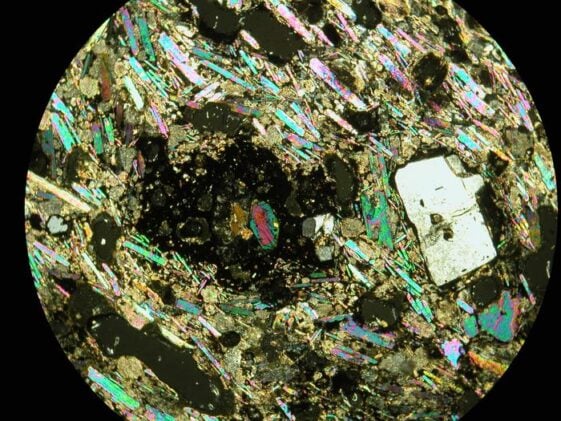
They have names that sound borrowed from a fantasy novel: melilitite, nephelinite, ultramafic lamprophyre, kimberlite. Until quite recently they were mostly the preserve of mineralogy textbooks and bewildered undergraduates, written off as curios, geological oddballs that no one quite knew what to do with. Then the world started shelling out for electric cars and wind turbines and smartphones, and these rocks turned out to contain the metals that make all of that possible. Now a team at the University of Cambridge thinks it knows where to look for more of them.
Writing in Nature Geoscience, Emilie Bowman and her colleagues report that the global distribution of rare earth element deposits is governed, to a first approximation, by the thickness of the planet’s outer shell. It is the kind of finding that makes a geologist sit up straighter.
Rare earths are the unglamorous workhorses of modern life. Neodymium and dysprosium in the magnets of wind turbines and EV motors; europium and terbium in screens; cerium in catalytic converters. China currently controls something like 70 per cent of global production, and that imbalance has set off a quiet scramble in Europe, North America, and Australia to find domestic sources. The trouble is that nobody has had a particularly good map for the search.
Stewed at the Base of the Continents
That first. Why these rocks at all?
The rocks Bowman’s team studied are CO₂-rich igneous rocks, formed when tiny pockets of mantle melt squeeze upwards and get trapped near the base of the lithosphere, the rigid outer layer of the planet. There they sit and stew, sometimes for tens of millions of years. The metals slowly concentrate. If the rocks are later re-melted, those concentrations can become economically useful ore. Carbonatites, an unusual variety made mostly of carbonate minerals rather than the silicates that dominate most volcanic rocks, are the chief prize: they host the world’s biggest rare earth deposits, including Bayan Obo in China, Mountain Pass in California and Mount Weld in Western Australia.
“Until relatively recently, this subset of igneous rocks were mere curiosities,” says Sally Gibson, the project’s senior author at Cambridge Earth Sciences. “Geologists collected them avidly; undergraduates were baffled by them in practical classes. But in recent years they have become very relevant.”
Bowman built a database of around 9,000 samples, then plotted them against a global tomographic map of the upper mantle, the kind built from the seismic waves of distant earthquakes. What emerged was a remarkably orderly progression. Basanites, the least carbon-rich of the bunch, tend to erupt through thin lithosphere of less than about 90 kilometres. Nephelinites and melilitites favour somewhat thicker crustal lids, around 80 to 120 km. Carbonatites cluster at lithospheric thicknesses around 95 to 140 km, with a median near 114 km. Kimberlites, the deepest-derived melts on the planet and incidentally the primary source of diamonds, sit on top of the very thickest ancient lithosphere, sometimes more than 230 km down. The deeper and cooler the underlying mantle, the more CO₂ the melts can carry, and the more concentrated the metals can become.
Crucially, the carbonatites that host the rare earth deposits are not, on this analysis, coming directly from very deep mantle. They appear to be derivative liquids, separated out by cooling and unmixing from the same CO₂-rich silicate magmas that produce ultramafic lamprophyres and their kin. Which means the carbonatites tend to turn up where those rocks turn up, and those rocks turn up along the edges of cratons, the ancient stable cores at the heart of every major continent.
“Rocks with the right chemistry for enrichment occur only in very specific places, mainly along the steep edges of Earth’s thickest and oldest lithosphere,” Gibson says. Sergei Lebedev, the geophysicist whose seismic models underpin much of the work, puts the imaging in homelier terms: “Using seismic waves from earthquakes, we can create a slice-through image of the lithosphere, much like a sonar can pick out features on the seabed. From this mapping we can see that lithospheric thickness plays a guiding role in where we find these deposits.”
There are caveats, naturally. The team restricted itself to rocks younger than 200 million years, because tectonics, mountain building and rifting and the rest of it, churns up older terrain and makes the seismic picture harder to read. Most of the world’s biggest economic deposits, Bayan Obo and Mountain Pass included, are older than that. Whether the same lithospheric rules apply to those is the obvious next question, and Bowman’s team is already working on it.
Where to Aim the Drill
For prospectors, the practical pitch is straightforward enough. Look along craton margins. Use the seismic data to identify the steep edges where thick old lithosphere meets thinner younger material, and target the surface geology there. “Our research is beginning to provide a kind of predictive power for where we can expect these rocks and, by extension, their associated rare earth element deposits, to form,” Bowman says. Whether that translates into actual mines is another matter, what with the years of exploration drilling, the permitting headaches and the chemistry of separating one rare earth from another, which is fiendishly hard and remains a Chinese specialty. Still, knowing where to dig is not a small thing.
“Now we have established this systematic behaviour exists, we can go back further in time,” Gibson says. “It’s going to be more challenging, but I’m hopeful that this will be a key step in predicting mineral occurrences.” Somewhere along the buried edges of the old continents, the next Mountain Pass is waiting.
https://doi.org/10.1038/s41561-026-01990-7
Frequently Asked Questions
Why are rare earth elements such a big deal geopolitically?
Rare earths are critical components in EV motors, wind turbines, smartphones, missile guidance systems and a long list of other technologies, and China currently produces around 70 per cent of the world’s supply. That concentration has prompted the US, EU, Australia and others to look hard for domestic sources, both for security and for the carbon-free economy they want to build. Finding new deposits matters because the old ones, mostly outside China, are running down or politically tangled.
How does the thickness of the lithosphere actually control where these rocks form?
Thick lithosphere keeps the underlying mantle cooler and at higher pressure, which suppresses melting. Only tiny fractions of mantle can melt under those conditions, producing small pockets of magma rich in CO₂ and incompatible metals like the rare earths. Those pockets often get stuck at the base of the lithosphere, where they slowly evolve into the kinds of CO₂-rich rocks, including carbonatites, that can later host economic ore deposits.
Are carbonatites the same thing as kimberlites?
No, though both are unusual CO₂-rich rocks and they sometimes turn up in similar regions. Kimberlites form at much greater depths, on top of the thickest cratonic lithosphere, and are the primary source of diamonds. Carbonatites form in the crust, where CO₂-rich silicate magmas cool and separate out, and they host most of the world’s biggest rare earth deposits.
Could this mapping approach actually unlock new rare earth mines outside China?
It is a guide, not a guarantee. The work narrows the search to the steep edges of ancient cratons, which is a substantial improvement on hunting more or less blindly. But finding the right rock is only the first step: exploration drilling, environmental permitting and the chemical separation of rare earths from one another remain expensive and slow, and China retains a major lead in processing. The science is moving faster than the supply chain.
ScienceBlog.com has no paywalls, no sponsored content, and no agenda beyond getting the science right. Every story here is written to inform, not to impress an advertiser or push a point of view.
Good science journalism takes time — reading the papers, checking the claims, finding researchers who can put findings in context. We do that work because we think it matters.
If you find this site useful, consider supporting it with a donation. Even a few dollars a month helps keep the coverage independent and free for everyone.