

Take a thin wafer of antimony and tellurium, roughly 30 nanometers thick, and cool it toward absolute zero. Run an alternating current through it. Apply a magnetic field sideways, not perpendicular but in the plane of the surface, and measure not the obvious voltage but the second harmonic, the faint doubled-frequency signal hiding inside the noise. What you find, if you are Giacomo Sala at the University of Geneva, is something that until very recently existed only in theory: a geometric property of electrons called the quantum metric, now caught for the second time in experiment and in a material the field has been studying for nearly two decades.
Topological insulators are, in a sense, an affront to ordinary intuition. Their bulk refuses to conduct electricity. Their surfaces cannot stop themselves from doing so.
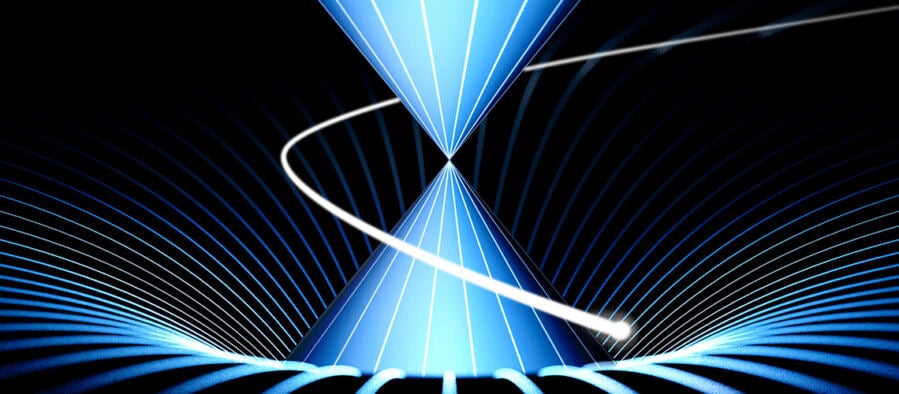
The phenomenon was first predicted and then confirmed around 2006, and it comes down to the topology of the electrons’ quantum states in the material. When certain conditions are met in the interior of a crystal, something strange happens at the boundaries: conducting channels form that are mathematically protected from disruption. Impurities, defects, rough edges, none of these kill the current. The surface states are locked in place by the geometry of the underlying physics, and among those states in certain materials you expect a single Dirac cone, a distinctive cone-shaped arrangement in energy-momentum space where electrons behave almost as if they had no mass at all.
The Berry curvature, a well-known geometric property of electron wavefunctions, has been the main tool for understanding these surface states for years. But there is a second geometric structure living alongside it. Quieter, subtler, harder to measure.
The quantum metric describes, roughly speaking, how rapidly quantum states change as you move through momentum space. It peaks at degeneracy points, exactly where the Dirac cone sits, and theory has predicted for some time that it should shape the transport properties of topological insulators in ways that Berry curvature alone cannot capture. The problem has been catching it in the act. Sala and his colleagues managed that in 2025, using a completely different material, a quantum oxide made from strontium titanate and lanthanum aluminate. Now the same team, working with collaborators in Salerno, Barcelona and Rome, reports the same effect in a genuine three-dimensional topological insulator: the antimony-telluride compound Sb2Te3, one of the most intensively studied materials in the field.
“There are several families of topological insulators,” Sala says. “The material we used in this work consists of antimony and tellurium, two metalloids with properties intermediate between those of metals and non-metals. It is one of the most extensively studied topological insulators to date, and its potential applications are highly promising.”
Getting the quantum metric to reveal itself required some ingenuity. Under normal conditions, time-reversal symmetry in topological insulators prevents the effect from showing up in transport measurements; the contributions from different parts of the Fermi surface cancel out. The trick is to break that symmetry gently by applying a magnetic field in the plane of the sample, which shifts the Dirac cone slightly in momentum space without destroying the topology. That shift generates a net signal in the second harmonic of the electrical response, and crucially, that signal has a very particular signature. It is antisymmetric in the magnetic field, it varies sinusoidally with the field direction, and below about 30 kelvin it becomes entirely independent of temperature and of how often electrons scatter off impurities. That last point is what makes the measurement convincing; scattering-independent transport is the hallmark of an intrinsic geometric effect, something that arises from the structure of the quantum states themselves rather than the messiness of any real material.
The gate voltage control adds another layer of confidence. The Hall bar devices the team fabricated had a top electrode that could shift the chemical potential of the upper surface’s Dirac cone, effectively doping it with electrons. When they did this, the nonlinear signal dropped by roughly 45 percent. The interpretation: the top and bottom surfaces of Sb2Te3 both carry topological states, but with opposite spin-momentum locking and thus opposite contributions to the nonlinear current. Moving the top Dirac cone toward the Fermi level reduces the asymmetry between them, and the net signal shrinks accordingly. As Andrea Caviglia, who led the research, puts it: “these new results extend and confirm our previous observations, which were obtained using a very different material. Moreover, they show that quantum metric effects can be controlled electrically.”
That electrical control matters more than it might initially seem. If the quantum metric were merely measurable, that would be interesting enough. But if it can be tuned with a gate voltage, the same way transistors tune ordinary conductivity in silicon, then it becomes something potentially useful in device design. Topological insulators have attracted years of attention partly because their surface states are robust; disorders that would wreck conventional conductors leave them largely intact. Adding a knob that lets you dial in the quantum geometry of those states opens questions that were, until quite recently, purely academic.
The quantitative agreement between theory and experiment is perhaps the most reassuring part of the result. The calculated nonlinear conductivity due to the quantum metric falls within the same order of magnitude as the measured values, across a range of plausible material parameters. There are uncertainties, particularly around the Lande g-factor for Sb2Te3, which could range anywhere between about 2 and 30. The best fit puts it in the region of 10, which is broadly consistent with other measurements of the material. Imperfect agreement, perhaps, but the kind of imperfect agreement that comes from real materials with real complications, not from a theory trying to fit a noise floor.
“The entire scientific community now has a new property to explore in the materials of the future,” Caviglia says, “particularly to investigate how the geometric properties of electrons can reveal the fundamental nature of these materials.” Which materials eventually benefit is still an open question. The candidates include the broader class of non-magnetic three-dimensional topological insulators, a large and varied family. Quantum metric effects should, in principle, show up in all of them, since spin-momentum locking is not a quirk of Sb2Te3 but a defining feature of the topology.
What comes next is not the replacement of your laptop’s processor with a quantum geometric device. That is not how materials physics works. What comes next is other groups, in other labs, looking at the second-harmonic signal in their topological insulator samples and asking whether they’ve been attributing it to the wrong mechanism all along.
https://doi.org/10.1038/s41563-026-02617-3
Frequently Asked Questions
What exactly is the quantum metric, and why does it keep coming up in materials physics?
The quantum metric is a geometric property of electron wavefunctions that describes how quickly quantum states change as electrons move through momentum space. Alongside the better-known Berry curvature, it shapes how materials respond to electric and magnetic fields in subtle, nonlinear ways. It has recently emerged as a unifying concept across several phenomena, from flat-band superconductivity to nonlinear electronics, which is why researchers are now working hard to measure it directly in real materials.
Why does the effect only appear below 30 kelvin?
Above about 30 K, thermal agitation causes electron-electron and electron-phonon scattering to degrade the spin polarization of the topological surface states. Once the spin polarization weakens, the geometric signal gets drowned out by more conventional transport effects. The saturation of the signal below 30 K, where it stops changing with temperature, is actually what proves the effect is genuinely geometric in origin rather than a consequence of how clean or dirty the material is.
Could quantum metric effects eventually be used in practical electronics?
The demonstration that the quantum metric can be tuned with a gate voltage is an encouraging step in that direction. Topological surface states are already attractive for applications in spintronics and quantum computing partly because they resist disruption from disorder. Combining that robustness with electrically controllable quantum geometry could enable devices that generate or detect nonlinear signals, spin currents, or photocurrents in ways conventional semiconductors cannot. Whether that translates to commercial technology depends on whether the effects can be made to work at higher temperatures.
Is this the same as what was measured in the strontium titanate experiment last year?
Related, but not identical. The 2025 measurement was made in a quantum oxide interface, a material with spin-orbit coupling but not topological surface states in the strict sense. The new result is in a genuine three-dimensional topological insulator, where the surface states are topologically protected. Observing the same underlying physics in two such different material systems strengthens the case that quantum metric effects are a general feature of systems with spin-momentum locking, rather than a quirk of any particular compound.