

It is roughly the size of a paperclip. Tucked on the inside of the elbow, strung between two bones, doing a job it was never built for. The ulnar collateral ligament, or UCL, evolved to stabilize a joint that was meant to swing from branches and hurl rocks, not to absorb the forces of a major-league fastball several hundred times a season. And it is failing. Not occasionally, not quietly, but at a rate that has become one of professional baseball’s most stubborn and expensive crises.
Cedric Attias, a mechanical engineering graduate student at the University of Waterloo, decided the problem needed an engineer’s eye rather than a surgeon’s hands. The result, published this January in Multibody System Dynamics, is the first predictive simulation of baseball pitching built specifically to find how a pitcher might throw just as hard while asking rather less of that beleaguered ligament.
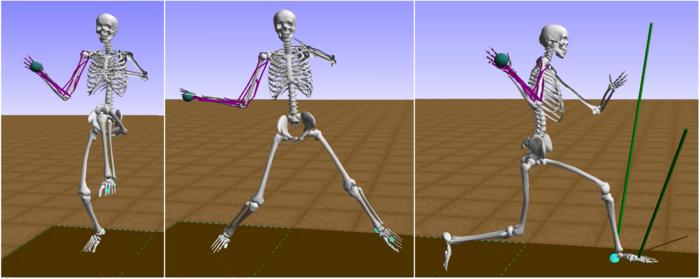
The simulation is built in OpenSim, a research platform developed at Stanford that lets scientists construct digital bodies with bones, joints, muscles, and the tendons and ligaments connecting all of it. Attias and his colleagues created a model of a major-league pitcher, calibrated against anonymised motion-capture data provided under a confidentiality agreement with MLB, and then ran it through an optimal control framework called Moco. The software, in effect, asks a question: given that you want to throw the ball at this speed, what is the motion that achieves that while minimising the load on the UCL? The model iterates thousands of solutions, exploring the space of possible body positions like a chess engine searching for a better move.
What came back surprised even the researchers.
Two mechanical factors turned out to dominate how hard the UCL gets hit: the angle at which the arm is raised at release, commonly called arm slot, and the degree to which the torso tilts away from the throwing side during delivery. Higher arm slots and more extreme contralateral trunk tilt, both features prized in hard-throwing pitchers, correlate strongly with greater ligament stress. The model suggested that pitchers who maintain a more upright posture and a lower arm slot at comparable velocities are working that small band of tissue considerably less hard.
“We confirmed that mechanics matters tremendously,” Attias said. “We showed that one pitcher throwing 93 miles an hour with controlled, upright mechanics puts meaningfully less stress on the UCL than someone using a more extreme technique to reach the same speed.”
To illustrate how far the model could be pushed, the team ran it toward extremes in both directions. At the low end, the motion that minimises elbow stress while producing the slowest speeds turned out to resemble something already visible in major-league baseball: the submarine delivery of Tyler Rogers, then of the Toronto Blue Jays, whose near-horizontal arm slot looks almost comically unlike the high-over-the-top motion coaches typically encourage. At the other extreme, the model predicted that a hypothetical pitcher capable of throwing 110 miles per hour, a speed no human has yet reached, would need mechanics more like a cricket bowler than a baseball pitcher, with a massive trunk lean and an almost vertical arm. Neither end of that spectrum was the point, exactly. The point was that the solution space is larger than most coaches and trainers have assumed.
A Ligament Built for the Wrong Sport
The UCL’s vulnerability is partly anatomical bad luck and partly arithmetic. “This ligament is especially vulnerable because it’s small, has a poor blood supply and wasn’t designed for movement this extreme or repetitive,” Attias said. Unlike muscles, which have rich vasculature and reasonable capacity to repair themselves after micro-damage, ligaments heal slowly and incompletely. A pitcher who throws four hundred pitches a week across a season is asking a tissue the size of a rubber band to resist forces that approach its structural limits, repeatedly, with minimal recovery time between insults. The cumulative toll is predictable, and the numbers are fairly grim: roughly a third of active major-league pitchers have had some form of UCL procedure.
Tommy John surgery, named for the Dodgers pitcher who first underwent it in 1974, replaces the damaged UCL with a tendon harvested from elsewhere in the body. The rehabilitation takes fourteen months or longer, and some pitchers never return to their previous level. The surgery has become so routine that it is almost unremarkable when announced; this spring José Berríos of the Blue Jays joined the list. What is perhaps more remarkable is that after fifty years of performing the procedure, baseball is still producing the same injury at roughly the same rate.
The simulation approach offers something surgical intervention cannot: the possibility of not getting there. “Our goal isn’t to tell pitchers to throw softer. It’s to help them throw smarter,” Attias said. The distinction matters. Pitching velocity is not merely a matter of pride; it is a core performance metric on which contracts and careers are built. Any intervention that meaningfully reduces a pitcher’s speed is, professionally speaking, nearly as bad as the injury it prevents. But Attias’s model suggests the trade-off may be less severe than coaches have assumed. “Our simulation found solutions that suggest there’s untapped efficiency out there,” he said.
Selling Mechanics to a Culture of Velocity
The harder problem, arguably, may be cultural rather than biomechanical. Professional pitching has spent decades optimising for a single output: ball speed. The radar gun is in every bullpen, its numbers scrutinised by scouts who associate high velocity with high potential. Mechanics that happen to reduce arm stress but shave two miles an hour off a fastball are difficult to sell to a nineteen-year-old who wants to be drafted. And the biomechanical research literature, while substantial, has historically struggled to translate findings into practice; coaches learn from coaches, not from the Journal of Orthopaedic and Sports Physical Therapy.
Attias, who now works as a biomechanist for the Seattle Mariners, is positioned to bridge that gap in a way that academic researchers rarely manage to be. His co-author Keaton Inkol is also at the Mariners, and the work grew out of a collaboration between Waterloo’s Motion Research Group and MLB’s increasingly sophisticated data infrastructure, including the KinaTrax markerless motion-capture system installed in every major-league stadium. The data pipeline that made this simulation possible is already embedded in the sport; the question is whether the insights it produces will be.
There is also the question of youth. The researchers are explicit that the model’s applications extend to junior pitchers, where the injuries are if anything more damaging because they interrupt development rather than truncate established careers. The throwing mechanics children learn tend to stick, and the arm slot a kid adopts at thirteen is roughly the arm slot they will be using at twenty-three. If the simulation can identify which early movement patterns load the UCL, the intervention point is a decade before the surgery would be scheduled.
Whether any of that happens will depend on factors well outside a musculoskeletal model’s purview: coaching culture, front-office incentives, the slow diffusion of biomechanical literacy through a sport that has, historically, trusted its gut rather than its data. But the simulation now exists. Somewhere in that solution space is a pitcher throwing 93 miles an hour with a UCL that lasts through a full career. The model has found them, notionally. The sport just has to decide whether to look.
https://doi.org/10.1007/s11044-026-10143-y
Frequently Asked Questions
Can a pitcher actually change their arm slot without losing velocity?
The simulation suggests yes, at least in some cases. The model found pitching motions that deliver similar ball speeds with meaningfully lower UCL stress, primarily by adjusting arm slot and torso tilt rather than reducing throwing effort. Whether individual pitchers can make those adjustments in practice, and retain them under game conditions, is a separate question the model doesn’t yet answer.
Why do so many pitchers end up needing Tommy John surgery even with modern sports science?
Partly because the UCL heals poorly and has almost no capacity to withstand the loads a major-league fastball imposes, and partly because the sport has spent decades selecting and training pitchers to maximise velocity rather than mechanical efficiency. The research suggests the two goals may be more compatible than assumed, but changing deeply ingrained coaching practices takes time and institutional buy-in.
Could this kind of computer modelling be used for other throwing sports?
Almost certainly. The OpenSim platform the researchers used is general-purpose, and the optimal control framework could in principle be adapted to cricket, handball, javelin, or any sport with repetitive overhead throwing. Similar UCL injury patterns do appear in other throwing athletes, though baseball pitchers generate some of the highest recorded elbow torques in any sport.
Is the submarine pitching style actually safer for the elbow?
The model suggests that at lower velocities, the mechanics resembling a submarine delivery do impose less stress on the UCL. But the relationship isn’t straightforward: at higher speeds, the model predicts very different mechanics are needed to maintain efficiency. Submarine pitchers like Tyler Rogers work at the low-stress end of the spectrum partly because their deliveries are inherently slower, not simply because of arm angle alone.