

A proton is a fussy thing to measure. It has no hard edge, no surface you can lay a ruler against, just a smear of positive charge a hair under one quadrillionth of a metre across. For a decade, physicists could not agree on exactly how wide that smear was, and the disagreement was small enough to sound trivial and large enough to threaten the rulebook of the entire universe. Now a team in Colorado says it has the answer, and the answer is reassuringly boring.
The number they landed on is roughly 0.84 femtometres, give or take. Their colleagues at the Max Planck Institute, working the problem from a different angle, came up with much the same thing at almost exactly the same time.
To understand why anyone lost sleep over a few thousandths of a femtometre, you have to go back to the strange double vision that opened up around 2010. Measure a proton’s radius using ordinary hydrogen and its electron, and you got one value. Swap that electron for a muon, a heavier cousin that orbits much closer in, and the proton suddenly looked smaller. The Colorado State University team has a homely way of putting it: imagine measuring your house with a tape measure and then again with a laser, and getting two different sizes. Both tools are valid. The house has not moved. So what gives?
That mismatch became known as the proton radius puzzle, and for years it carried a tantalising whiff of new physics. Maybe some undiscovered force was nudging the muon and the electron differently.
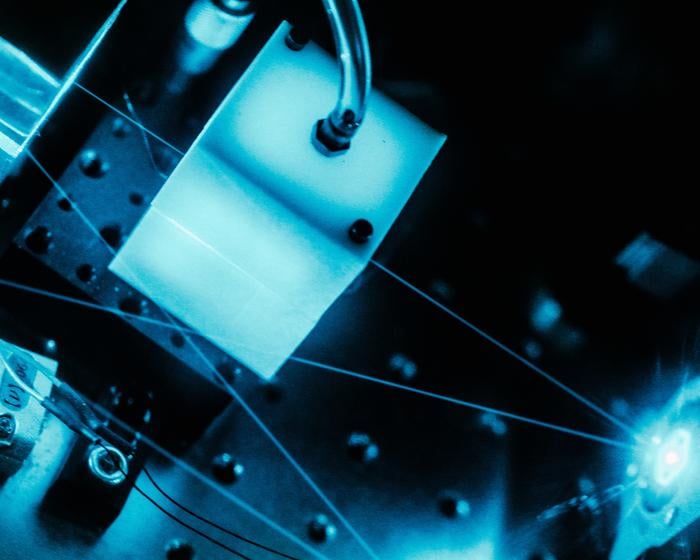
The CSU group, led by associate professor Dylan Yost, went after the puzzle with lasers rather than logic. They produced a beam of atomic hydrogen in a vacuum chamber, then used ultraviolet light to nudge the atoms’ electrons between energy levels. Because a proton’s size leaves a faint fingerprint on exactly where those energy levels sit, you can work backwards from the electron’s behaviour to the size of the thing it is orbiting.
“Our test shows precise agreement with theory on the size of a proton to parts-per-trillion levels of accuracy, eliminating the possibility of a new force or particle being responsible for the discrepancy in this case,” Yost says. “That would have significantly changed the Standard Model and is something researchers have been looking for.” Then, almost apologetically: “That doesn’t seem to be the case in this instance though.”
The hard bit, it turns out, was the hydrogen itself. Atoms in a beam are zippy little things, and they do not hang about in the laser long enough to give a clean reading. “These atoms move very fast and do not interact with the laser for long, which can wash out the signals that we are looking for,” says Ryan Bullis, the PhD student who is first author on the paper. His fix, a first of its kind for this purpose, was to hit the atoms with two laser fields at once. “We developed a new technique that uses two laser fields at the same time to increase the precision of our measurements,” he says. The result, published in Physical Review Letters, pins the radius at 0.8433 femtometres with an uncertainty so small it would be like measuring the length of the United States and being off by the width of a single virus.
So the puzzle, it seems, was never about the proton at all. It was about us, or rather about the equipment and the borrowed constants that earlier experiments leaned on.
That is, in a sense, a slightly deflating result. No new force. No rewrite of the Standard Model, the framework that has predicted particle behaviour with maddening accuracy for half a century and which physicists keep prodding in the hope it will finally crack.
But Yost is keen that nobody reads this as the small experiments losing to the big ones. His tabletop kit, he points out, does a job the Large Hadron Collider cannot. “The two approaches fill different needs. With our experiments, we can find and study fundamental physics without large particle accelerators. Our work is like a check-engine light coming on, telling the driver they need to investigate a potential problem,” he says. “Our work can tell you where to look or what is working, but you need both teams to continue to fully examine and probe the Standard Model in search of new physics.” Colliders hunt the heavy, strongly interacting stuff; laser spectroscopy is better at sniffing out anything light and shy. You want both lights on the dashboard.
With hydrogen now behaving itself, the team is already turning to its heavier relatives, deuterium first among them. “We can set hydrogen aside for now because we can be satisfied that it behaves as it should,” Yost says. “That allows us to look at other elements and interactions to be sure they are doing what we think they should be doing.” Each new atom is another place where theory and measurement might quietly part ways, another spot to shine the laser and check the engine.
For now, the puzzle that nagged at physics for ten years has been filed under “solved,” and the proton is, mercifully, just the size it ought to be. “There is always a chance that future capabilities will allow us to be even more precise,” Yost says. “But we are ready to dig back in and continue to bridge the gap between theory and experiment in the field of atomic, molecular and optical physics.”
Source: Physical Review Letters, DOI 10.1103/lgl2-6cb8
Frequently Asked Questions
What was the proton radius puzzle, and why did it bother physicists so much?
Starting around 2010, two perfectly respectable ways of measuring a proton’s size gave different answers: experiments using ordinary electrons came out larger than those using heavier muons. A gap that tiny might sound like rounding error, but it hinted that an undiscovered force could be tugging on the two particles differently, which would have meant rewriting fundamental physics. The new measurement closes that gap, and the explanation turns out to be far less exotic.
Does this mean there is no new physics hiding in the proton after all?
For this particular puzzle, yes. The Colorado State result agrees with theory to parts-per-trillion accuracy, which rules out a new force or particle being behind the old discrepancy. The mismatch instead came down to subtle issues in earlier equipment and the physical constants those experiments relied on.
How do you measure something that has no surface to put a ruler against?
You do it indirectly. A proton’s size subtly shifts the energy levels of the electron orbiting it, so by firing precisely tuned lasers at hydrogen atoms and watching how the electrons jump between levels, you can reverse-engineer the proton’s radius. The tricky part is that the atoms move so fast they barely interact with the laser, which is why the team built a new two-laser technique to sharpen the signal.
If a giant collider exists, why bother with a tabletop laser experiment?
Because they answer different questions. The Large Hadron Collider excels at producing heavy particles and powerful interactions, while laser spectroscopy is far better at catching anything light and weakly interacting that a collider would miss. The lead researcher likens his work to a car’s check-engine light: it tells you where something might be wrong, but you still need both approaches to find out what.
What happens now that hydrogen has been sorted out?
The team is moving on to heavier versions of hydrogen, starting with deuterium, to check whether they too behave exactly as theory predicts. Each new atom is a fresh opportunity for measurement and prediction to disagree, which is precisely where any genuinely new physics would eventually show up.