

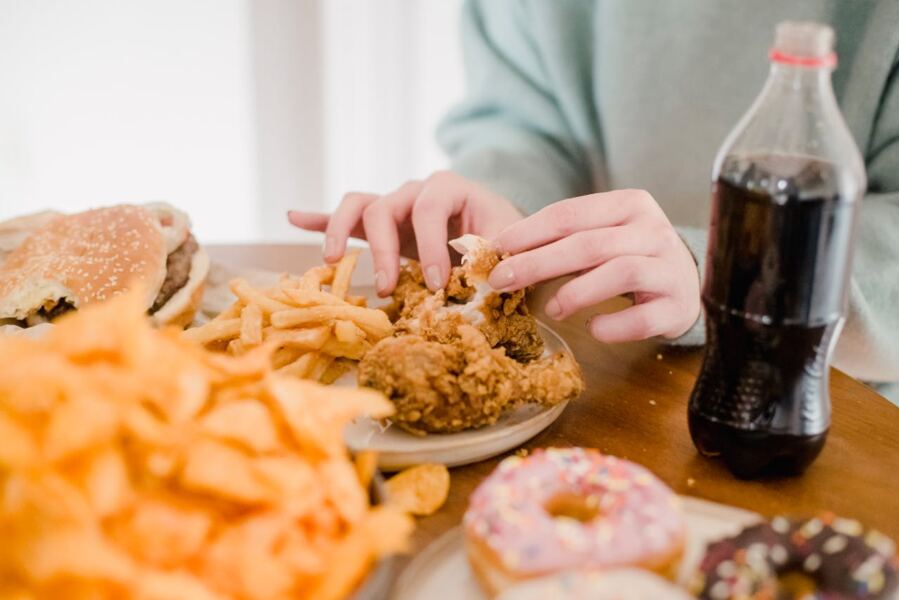
Roughly half of what lands in the average American adult’s shopping trolley, and around 60 percent of what a child eats, now comes from foods built in factories rather than kitchens. Crisps, fizzy drinks, packaged breads, ready meals, the sweetened cereal that looked so wholesome on the box. For years the argument over whether any of this matters has run along a single fault line: is it the stuff inside these products that does the damage, the salt and sugar and saturated fat, or is it something about the manufacturing itself? A new study from Tufts University has just tilted that argument, and the answer looks like it might be both.
The team, led by researchers at the Food is Medicine Institute at Tufts, pulled together two decades of data on nearly 50,000 American adults. The question they wanted to settle was deceptively simple.
When you eat more ultra-processed food, your health markers tend to look worse. That much was already well established. People who get a larger share of their calories from these products carry more weight, run higher blood sugar and blood pressure, and show less friendly cholesterol profiles. The sceptics’ reply has always been that this is hardly mysterious: ultra-processed foods are often just unhealthy foods wearing an industrial badge, packed with the very nutrients we already know to limit. Strip out the bad nutrition, they argue, and the processing effect should vanish.
So the Tufts group did exactly that, on paper at least. They took a validated scoring system that rates the nutritional quality of everything a person eats, then stripped from it any mention of processing or industrial additives, leaving a clean measure of nutrition alone.
The point was to ask a sharp question. If you account fully for how nutritious someone’s diet is, does the link between ultra-processing and ill health simply disappear? It did not. Across the board, the associations shrank but stubbornly refused to go away. For every 10 percent of daily calories coming from ultra-processed foods, the researchers still saw higher body weight, more metabolic syndrome, more diabetes, more cardiovascular disease, and a 4 percent higher risk of dying during the study period, even after the nutrition was accounted for.
“The findings suggest ultra-processed-food factors beyond nutrients,” said senior author Dariush Mozaffarian, a cardiologist who directs the institute, pointing to changes in foods’ cellular structure, lost beneficial compounds, additives and chemicals leaching from packaging, “may create health risks not addressed by traditional nutrition metrics or policies.”
Here is where it gets interesting, and a bit awkward for tidy explanations. When the team tested the usual suspects one at a time, the nutrients everyone loves to blame, adjusting for saturated fat, then added sugar, then sodium, made almost no consistent difference to the results. Those three are precisely the nutrients that food policy tends to target, the numbers on the label that warning schemes are built around. Yet here they barely shifted the needle. The implication is faintly unsettling: the part of ultra-processed food that may be hurting us is, to a meaningful degree, the part nobody is currently measuring. Loss of natural food structure that lets the gut digest things too fast. Emulsifiers and preservatives. The faint chemical residue of the packet itself.
It is worth being careful about what this kind of study can prove. This is observational work, which means it can show that two things travel together but cannot, on its own, prove that one causes the other, and the researchers are upfront that hidden factors could still be muddying the picture.
There is also a wrinkle the authors flag plainly. Not all ultra-processed foods behaved alike: sugary drinks carried by far the strongest mortality signal, processed meats hit the metabolic markers hard but showed no clear link to early death, and the sprawling “everything else” category sat somewhere in between.
What gives the findings real bite is the policy moment they have landed in. More than 20 US states have floated or passed laws taking aim at ultra-processed foods, and a federal definition is now being drawn up. The trouble, the Tufts team points out, is that some of these efforts lean on exactly the nutrient thresholds their data just found wanting. California’s law, passed in late 2025, defines an ultra-processed food partly by whether it crosses set levels of sodium, sugar or saturated fat, a criterion the authors warn opens a loophole wide enough to let plenty of genuinely industrial products slip through. There was one more twist the researchers had not gone looking for. Among lower-income adults the link between ultra-processing and death was stronger, and barely budged when nutrition was taken into account, hinting that the cheapest ultra-processed foods may also be the roughest on the body.
None of this means a frozen dinner will fell you, or that the occasional packet of biscuits is a moral failing. The effect sizes here are modest at the individual level, a fraction of a BMI point, a few percent on a risk estimate. But spread across a population that gets half its calories this way, modest effects stop being modest. “Understanding how these foods affect health is a critical public health priority, given the large proportion of the population affected,” said Juna Hatta-Langedyk, the study’s first author and, unusually for a paper of this heft, still an undergraduate.
The deeper challenge now is mechanistic. If processing itself carries risk that nutrition labels miss, then the next job is working out which bits of processing, and how, before anyone can write a sensible rule about it. That work is only just beginning, and the answers may end up reshaping not just what we are told to eat, but how we are taught to read a label at all.
Source: Hatta-Langedyk et al., American Journal of Public Health (2026), DOI 10.2105/AJPH.2026.308499
Frequently Asked Questions
If a food is ultra-processed but low in sugar, salt and fat, is it still a problem?
Possibly, according to this research. The Tufts team found that adjusting for saturated fat, added sugar and sodium did little to explain the health risks tied to ultra-processed foods, which suggests other features of processing may matter independently. That is an uncomfortable finding for nutrition labels, which are built largely around those three nutrients.
Does this study prove ultra-processed food causes disease?
No, and the authors are careful to say so. It is an observational study of nearly 50,000 adults, so it can show that heavier consumption travels alongside worse health and a higher death rate, but it cannot rule out that other unmeasured factors play a role. What strengthens the case is that the pattern held up over roughly two decades of follow-up and echoed findings from large studies in other countries.
Are some ultra-processed foods worse than others?
Yes, the categories diverged sharply. Sugar-sweetened beverages showed the strongest link to early death, processed meats damaged metabolic markers without a clear mortality signal, and a broad “other” group fell in between. It is a reminder that the ultra-processed label covers a huge and uneven range of products.
Why might cheaper ultra-processed foods be more harmful?
The study found the link between ultra-processing and death was stronger among lower-income adults and barely shifted once diet quality was accounted for. The researchers suggest, without proving it here, that the most affordable ultra-processed products may carry more of the adverse features driving the risk. Untangling exactly why is one of the open questions the findings leave behind.