

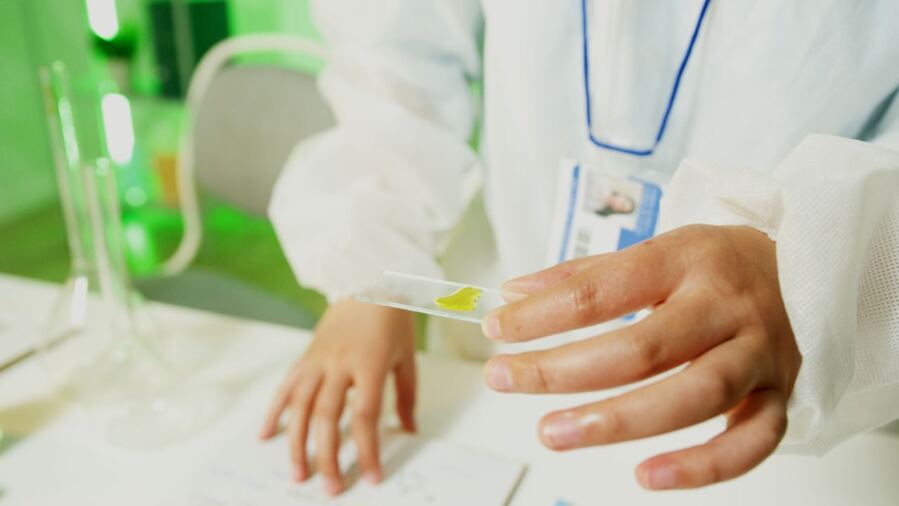
The glass slide is nothing special. A sliver of brain tumor, fixed in paraffin, sliced thinner than a hair and washed in the same two dyes pathologists have leaned on for more than a century: hematoxylin to stain the cell nuclei a bruised purple, eosin to wash the rest a dusty pink. Hospitals everywhere make these. A scanner turns one into a digital image, and that image goes to a piece of software called Hetairos. Roughly twelve minutes later, out comes a name, picked from 102 possibilities, with a number attached saying how sure the machine is.
That name is the hard part. Tumors of the brain and spinal cord are a sprawling, treacherous family, and over the past decade it has become clear that what they look like down a microscope often tells you far less than what their DNA is doing.
The gold standard for sorting them is a test called DNA methylation profiling, which reads the chemical tags sitting on top of a tumor’s genome and matches the pattern against known types. It works beautifully. It also needs a specialised lab, costly kit, a decent chunk of tumor tissue, and about two weeks. In much of the world those things simply are not on hand, and a fortnight is a long time to wait when there is something growing inside your skull.
So a team led by Moritz Gerstung at the German Cancer Research Center in Heidelberg and Felix Sahm at Heidelberg University asked a blunt question. Could you skip the molecular lab altogether and predict the methylation subtype from the cheap pink-and-purple slide alone?
What the machine learned to see
To find out, they fed the system more than 11,000 slides from 9,606 patients, gathered from eleven medical centres across four continents, each one already labelled by the molecular test it was meant to imitate. Hetairos learned to chop each scanned slide into thousands of small tiles, pull out visual features with a vision transformer, and weigh up which patches mattered before committing to one of 102 subtypes. That span covers very nearly the whole of the current World Health Organization classification.
The name is a clue to the intent. Hetairos is Greek for companion, and the researchers are careful to say it is meant to sit beside the pathologist, not shove them aside. “We developed Hetairos primarily as a tool to support diagnostics,” says Sahm. “It is not intended to replace molecular analyses, but rather to specifically complement and accelerate them. The technology could make an important contribution, particularly in countries or regions with limited resources, as it is based on standard tissue sections used worldwide.”
Here is the bit that ought to give pathologists pause, though. The team ran a straight contest: 210 cases, the H&E slide and nothing else, five board-certified neuropathologists against the machine. On its single best guess, Hetairos was right 68 percent of the time. The human specialists averaged 30 percent. Allow each side three guesses and the gap narrows but does not close, 84 percent for the software against roughly 50 for the people. These are experts being beaten at the thing they trained for years to do, on slides that, by everyone’s reckoning, were never supposed to carry this much information in the first place. “The results show that modern AI systems are now capable of recognizing extremely subtle morphological patterns that are difficult even for experienced specialists to distinguish,” says Sahm.
Crucially, the system also knows when it is out of its depth. On between half and seven in ten cases it speaks up with high confidence, and there it is correct around 87 percent of the time. When it is unsure it says so, and tends to be wrong more often, which sounds like a flaw but is closer to a virtue: a confident machine that is quietly wrong is far more dangerous than one that flags its own doubt.
Twelve days, or twelve minutes
Then there is the clock. In a prospective run alongside ordinary clinical work, the full molecular workup took about twelve days. Hetairos, churning away on the kind of computer you could buy on the high street, returned its answer in twelve minutes. Counting the staining and scanning, a result could be in hand inside a day or two rather than a fortnight. The cost gap is just as stark: a methylation analysis runs to several hundred euros, while the AI reads a slide the hospital had already made for somewhere around one or two.
It is not flawless, and the team is upfront about that. Rare tumours, the ones the system saw only a handful of times during training, still trip it up, and there a seasoned neuropathologist holds their own or better. As Gerstung puts it, the diagnosis of very rare tumour types still poses a major challenge, and there experienced neuropathologists appear to be at least on par. He expects that to improve as the datasets grow.
Where it might earn its keep soonest is in the awkward cases, the ones where the gold standard itself goes quiet. When a biopsy yields too little tissue for the molecular machinery, or when the methylation test comes back muddy, the slide is sometimes all anyone has. On 96 samples too sparse for methylation testing, many of them tiny needle biopsies, the software still called 76 correctly. And because it paints a heatmap over the slide showing which regions swayed its decision, a pathologist can look over its shoulder and check the reasoning, or pick the right patch to send off for further tests.
“The study shows that artificial intelligence is capable of deriving molecular information directly from routine tissue sections and thus fundamentally changing cancer diagnostics,” says Darui Jin, one of the lead authors. Whether it does that everywhere, or only in the well-funded hospitals that least need the help, will come down to who gets handed the tool. A slide scanner is a great deal cheaper than a methylation lab, and there are an awful lot of microscopes in the world already.
Frequently Asked Questions
How can an AI read molecular information from a slide that doesn’t show DNA?
It doesn’t read DNA directly. Instead it learns, from thousands of examples, that particular molecular subtypes leave behind faint visual fingerprints in the way cells are arranged and shaped, patterns too subtle for the human eye to reliably catch. The slide was always carrying that information; the machine just learned to notice it.
Is it accurate enough to replace the standard molecular test?
Not yet, and that isn’t the goal. On the cases where it is confident, around half to two-thirds of them, it is right roughly 87 percent of the time, but it still struggles with rare tumour types and grows less certain on slides from unfamiliar hospitals. The researchers frame it as a fast triage step that guides and speeds up molecular testing rather than a substitute for it.
Why does the twelve-minute turnaround matter so much?
Standard methylation profiling takes about two weeks and needs an expensive specialised lab that many regions of the world simply don’t have. A diagnosis available in a day or two, from a slide any hospital can already make, could mean faster treatment and could bring this level of tumour classification to places where it was never an option.
Could a wrong answer slip through unnoticed?
That risk is the reason the confidence score matters. The system tends to flag uncertainty rather than bluff, assigning low confidence to cases it is likely to get wrong, which lets clinicians know exactly which results to back up with molecular testing. It is designed to fail loudly rather than quietly.
The full study is published in Nature Cancer.
Editor’s note: This article was updated on September 14, 2026, to align its headline and wording more closely with the evidence and sources.
