

Last week I came upon a 1998 study finding that the risk of heart attack was 18 times lower in people who donate blood, compared to a matched sample of people who don’t. I ran out to my local Red Cross Blood Drive, and then came home for some follow-up reading. The consensus from a handful of studies on blood donation seems to be far less dramatic, but still worth considering.
Hippocrates thought that women purged blood every month to release their toxic humors, and that men might benefit from an artificially-induced version of menstruation. From ancient times until the 19th centuries, bloodletting was a common medical procedure. Leeches were prescribed for a wide range of ailments.
Bloodletting was thought to be beneficial in healing nearly every disease, from acne and asthma, to cancer and smallpox. Even the loss of blood from a wound was treated by…removing more blood! Bloodletting the already-wounded was thought to reduce inflammation (which is why it was employed prior to surgery as well). Bloodletting wasn’t limited to curing disease either, but was also used as a preventive measure to avoid getting sick. [source]
Modern medical wisdom dismisses these ancient, barbaric practices as fraud, mountebankery and snake oil. But like most medical practices that stood the test of time (if not epemiology), this one held a core of truth.
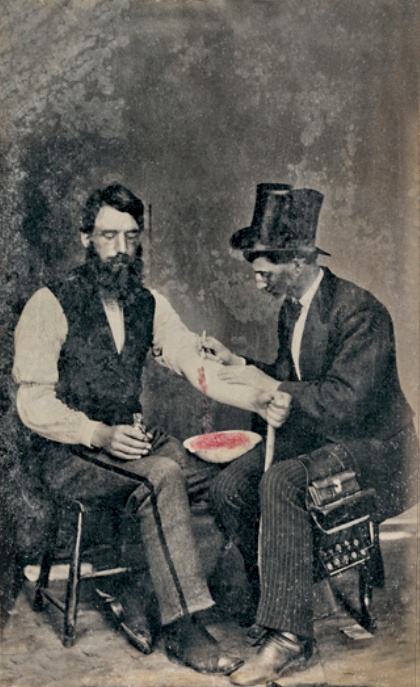
For centuries, the local barber not only offered close shaves and sharp haircuts, but also provided medical services including bloodletting. In fact, the iconic barbershop pole with its two brass balls and red and white stripes is a vestige of the days when barbers would slit customers’ arms to relieve their ailments.
Epidemiology of Blood Donation
The raw statistics are quite promising. Here is a study that found occasionally donating blood (every three years) is associated with a 50% drop in cardiovascular disease in men. This study finds a 40% reduction in cardiovascular risk, after adjusting for other differences between donor and non-donor groups. These [ref1, ref2] looked at short-term benefits for blood lipid profiles studies following blood donation. These two studies [ref1, ref2] found a slightly lower risk of cancer in blood donors. In a large study of US blood donors, this study found a 30% lower rate for all-cause mortality. This large Italian study found a modest decrease in overall mortality among blood donors.
These were balanced with other studies that found slightly higher cardiovascular risk among frequent blood donors, and several [review] that uncovered no benefit.
The Healthy Donor Effect
It is an obvious point that unhealthy people don’t respond to blood drives. How much of the statistical association with lower health risks is merely self-selection, and how much is causal? Here is a current study claiming that the unadjusted benefit is 18%, and the residual benefit after accounting for the “healthy donor effect” amounts to 7%. These percentages represent reduction in mortality rate for each additional annual blood donation. Based on this unimpeachable source, I have decided to give blood exactly 14.3 times each year, thereby reducing my risk of dying to zero.
Iron
I’m old enough to remember Jack Barry on the B&W TV, the merits of Geritol for “tired blood” — a description of anemia that was intended to suggest that low iron was the primary culprit in an epidemic of chronic fatigue.

Geritol was advertised as an iron supplement. Today’s epidemiology recognizes that anemia is far less common that the opposite, and that too much iron is a risk factor for heart disease, cancer, and Alzheimer’s. (Geritol is still sold today, but its formula has less iron
Modern thinking is that, yes, anemia might limit stamina or even cause fatigue, but people who eat meat and who don’t carry a gene for hemochromatosis are unlikely to be iron-deficient. When iron is in short supply, the body can readily increase its absorption. But the body cannot easily remove excess iron, thus excess iron accumulates in the liver. In fact, too much iron is about four times more common than too little iron in a sample of people over 50 [ref]. The consequences of too little iron are short-term, but the too much iron is a risk factor for chronic disease.
The best-established health risk from too much iron is elevated incidence of diabetes [ref1, ref2, ref3, ref4]. Insulin resistance, in turn, is associated with higher risk of all the diseases of old age. But several studies have found only a weak relationship between excess iron and cancer or mortality risk [ref1, ref2].
Hormesis
Instinct tells me that lower iron is not the only benefit, or even the main benefit from blood donation. First, the body can quickly recover iron lost to blood donation by dialing up the absorption from dietary sources. The effect on the body’s iron stores is likely to be short-term. Second, the evidence for association between high iron and high disease risk is actually weaker than the evidence for benefit from blood donation. So my guess is that this is a hormetic effect. Blood donation is like exercise or a low-calorie diet or low-dose toxins or radiation: it signals to the body that there is danger, which turns on protective mechanisms that go into high gear and overcompensate. (There is an evolutionary explanation for the overcompensation.)
Social and emotional factors have a dominant influence on longevity. It is often overlooked, but connectedness with others, sense of satisfaction and fulfillment, healthy loving relationships are all powerfully correlated with health and life expectancy. Giving blood may be an indicator of pro-social attitudes that prefigure longevity, or it may be an active pursuit of a pro-social behavior that promotes longevity through psychological pathways.
My experience
For several years, Valter Longo has been expounding a theory that an extended fast can reset the immune system. The data on blood donation suggested to me that something similar was happening, and that there might be synergistic benefit from combining a fast with blood donation. I have been doing Longo’s 5-day Fasting-Mimicking Diet every 4-6 weeks, and it happened that I was FMD-ing when I first read about the benefits of blood donation last week.
I found a Red Cross blood drive on the last day of my FMD within 5 miles of my house. I chose discretion over valor, and drove out there rather than deploying the bicycle which is my habitual mode of transit. It had been several years since I have given blood, but I could hardly be surprised that there was 40 minutes of paperwork the Red Cross asked me to read and sign. Reasons for exclusion include not just infectious diseases but travel to many regions of the world, intravenous drug use (ever), homosexual activity (ever), cancer (ever), several congenital diseases….I started to feel nervous that they would ask whether I had been on a semi-fast for 5 days, or discover that I hadn’t had a meal in almost 22 hours. They didn’t ask anything of the sort, and I was able to answer all the questions truthfully. When I had trouble raising the thermometer above 96 degrees and my blood pressure read out at 85/60, they asked if this was usual for me. I offered the excuse that ”I am a marathon runner”, which is a stretch.
Red Cross is strict about the rules, but they really do want our blood. So I slipped through, stretched out on the table and offered up my left arm. The procedure itself took only 15 minutes, and went off without a problem. No light-headedness or weakness–I got up afterward and walked out, hungry and more than ready to re-feed myself after 5 days of minimalist fare. I might have bicycled after all.
Discussion
27 reader comments
Imported threads are marked Archive. New comments are welcome and moderated for spam.
Rather than excluding healthy people what would be more interesting would be to segment blood donors by health and look at the effect of blood donation on *unhealthy* people. It might be that donation would have an outsized positive effect on those who are chronically ill, on the theory that you are helping the body to get rid of things like PFAS chemicals that have a hard time getting out of the body normally.
First great post regarding fasting and donating blood I’ve seen yet. Thank you. I donate platelets often, I wonder if it has similar effects.
Josh, this a great article, and you hit many high points (including hormesis) accurately. I'm going to save the link to this article and promote it. You even work in Sardi, the giant in this field, tangentially. Thank you.
My understanding of blood, is that each cell can only reproduce so many times during our lifetime. My question is whether that is a misunderstanding, and if not, then isn't it logical to assume we are shortening our own lifeline by donating?
I understand where you got this impression, but it's a misinterpretation. It's true that stem cells develop short telomeres with age and slow down. But people don't die because they run out of blood cells. The direct indications are that donating blood lowers mortality.
life span of RBC is 120 days and formation of RBC wbc is going on by daily basis then why it is prescriscibed to donote blood after 6 month
It had only been 18hrs into a fast and I fainted after giving blood. I felt dizzy watching the nurse pick up my pint of blood and massage the bag, swooshing the blood around in his hands. When I asked for a drink of orange juice, I heard the nurse shout a code name and "her lips are blue" before my upper body was tilted down and legs propped up. All this happened despite a high iron count.
Giving blood and fasting was not a good combination for me.
I'm on day 2 of my first ever 4-day fast. I've decided to try this since I've noticed in the last 3 years, I've aged considerably. I'm 38, 5'2" and at 134lbs, I also need to lose 20lbs. I know fasting is not a good weight loss tool but I'll focus on calorie restriction in between fasts. Now that I don't do Triathlons anymore, I won't be worried about my performance and I'll just be focusing on yoga and light training.
I just have to convince my bf that I haven't adopted an anorexic lifestyle as he is skeptical of the benefits of fasting.
Good you didn't decide to cycle for 5 miles after five days of fasting.. Imagine the irony of having a heart attack on the way to lowering it. :)
btw, why stop at 14.3 when you can go to 11 just by stopping at, say, half the 15th donation session instead of a third! (well, 3/10 since you're being exact) Over 100% MUST have rejuvenating effects. hehehe
About iron, it seems vitamin C can get oxidized by iron content on food before it gets absorbed. That's why I avoid eating them together when getting iron from animal sources, as opposed to vegetarian sources which actually gets potentialized (the iron that is, so maybe also avoid here too).
My question is, in this process of oxidation do the iron becomes less bioavailable as well or does it work as a catalyst? Because this could be a way to diminish iron surplus while still eating animal sources. Basically inverting my logic above, which was meant to maximize iron absorption.
Several years ago while donating blood, I asked Red Cross employee if they were aware of benefits. The person said yes but RC chose not to publicize as they preferred people donate for humanitarian reasons......
Example modern article from freetheanimal:
http://freetheanimal.com/2015/08/fall-bloodletting-iron.html
Yet another, much older stuff by Bill Sardi:
https://www.lewrockwell.com/2002/02/bill-sardi/blood-and-iron/
Great post Josh... What a simple, now obvious, thing to do, and I'm in to do it. And speaking of blood factors filtration, I came across an article, published in Jan 2015, and of interest to you and Dr. Katcher.
Antiaging therapy: a prospective hypothesis - goo.gl/5QZkYe
Can't decide whether the article is worth reading? Check out the Figure 1 pic. i.imgur.com/JM6IYmM.png
And then check out where the authors live. The more minds we have thinking about the issues the better off we all are... :-)
The article says that we should attach blood filters to ourselves that take out the age-related signal molecules and add back the youth promoting signals. I'm all for it. But we don't yet know the right combinations of blood factors, and we don't know how to adjust them for individual differences, and we don't know how often this would have to be done in order to sustain an anti-aging benefit. I'm glad people are working on it.
That's exactly right Josh...
We now have Engineers who understand the Big Picture Science of Longevity. And not only that, they also are tuned into the importance of the Circulatory System Milieu. Did I mention that they live in Iran? I thought that place was cut off from science?
I assume they're at the ready to build the device they've got a schematic of as soon as, well, as soon as... um... we figure out, hmm, The Details of what the Blood Factors are, hmm, and in what amounts, oh my!?, they should be repressed or increased.
Um, well, ok, but, the good news is this... Some Few People With Engineering Minds Get It... They get the Science of the Circulatory System Milieu... :-)
And there is now a first theoretical picture of the device we've imagined might exist published in a journal. And they've even defined a few important process steps and I thought you and your readers should know about it!
Cheers!
Hi, isn't really there nothing new under the Sun? This therapy is like a donation of blood between species...brrrrr
Leech Therapy in Ayurveda: Buergers Diseases, http://www.bagchee.com/books/BB97198/leech-therapy-in-ayurveda-buergers-diseases