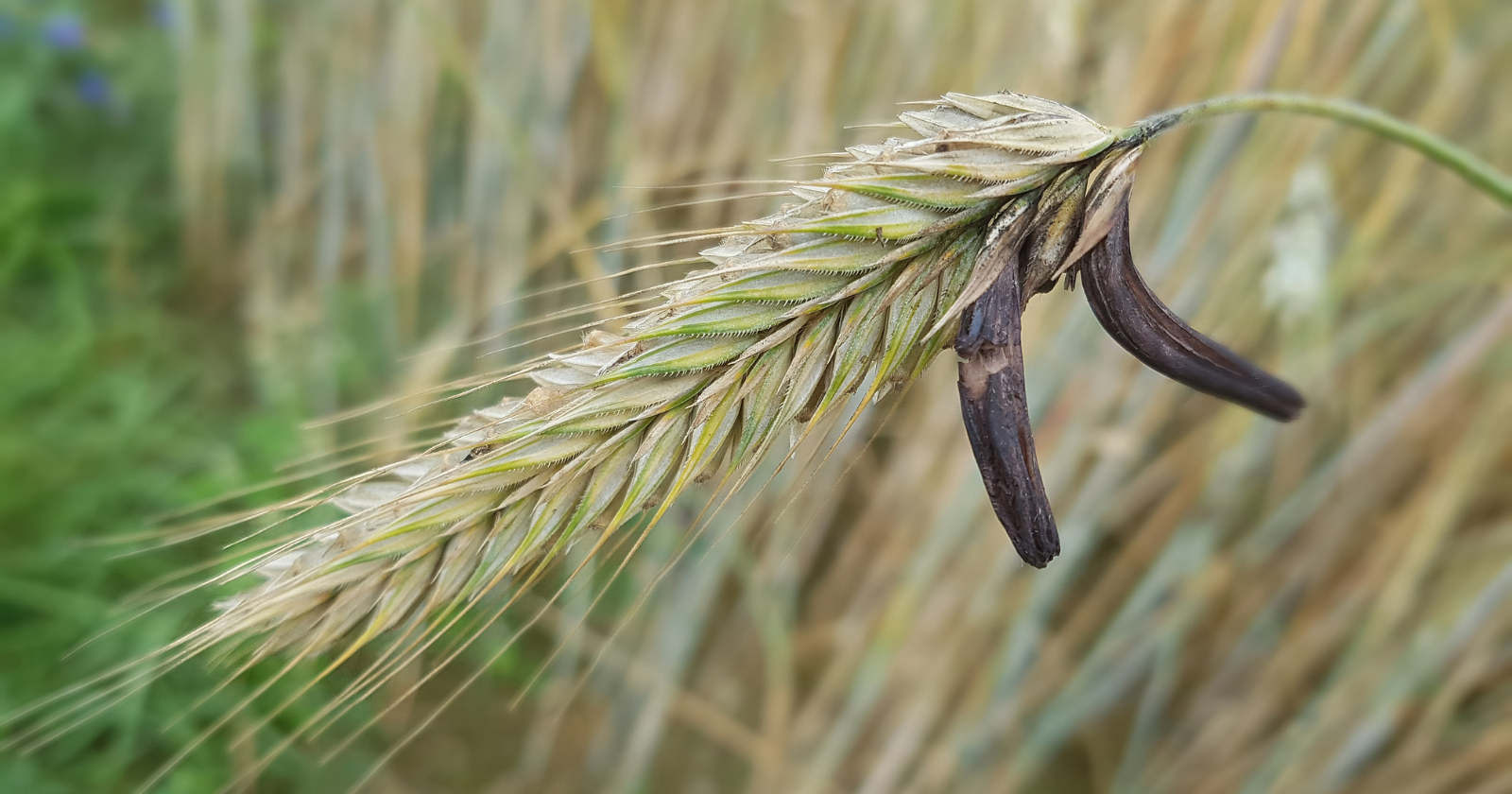
In a damp field somewhere in Europe, a fungus is swapping grains of rye for small black horns that look like mouse droppings and work like a pharmacy.
That is ergot, Claviceps purpurea, and the hard purple-black bodies it leaves behind are called sclerotia. Damp weather at flowering suits it perfectly. Harvest the crop, mill it in with everything else, and the horns go into the flour with the rest.
Those horns are a drug cabinet.
Ergot alkaloids are built on lysergic acid. Albert Hofmann was working through derivatives of it at Sandoz in Basel when he produced the twenty-fifth compound in his series in 1938, a molecule Britannica records as having come out of the same rye fungus. Another five years passed before anybody noticed what LSD did to a human brain.
What the fungus does to a body
Pharmacologist Paul Schiff Jr, writing in the American Journal of Pharmaceutical Education, sets out two versions of ergot poisoning. Convulsive ergotism brings delirium and hallucinations, muscle spasms, painfully flexed limbs and severe diarrhoea. Gangrenous ergotism is uglier. Blood vessels clamp shut, circulation to the hands and feet fails, and fingers and toes blacken and drop away.
Medieval Europe called the result St Anthony’s Fire. As documented in a survey of ergot research in the journal Toxins, it ran the full distance from convulsions and visions through to dry gangrene, lost limbs and death.
For roughly a thousand years, nobody connected any of it to bread.
A graduate student, a damp summer and 1692
So how did a crop fungus end up attached to a witch hunt? In April 1976, Science published a paper by psychology graduate student Linnda Caporael proposing that convulsive ergotism may have triggered the panic at Salem. Her case was circumstantial and rather elegant. Rye was the staple grain, the preceding growing season had been damp, and the fits recorded in the court documents resembled the fits recorded in the medical literature.
Timing helped. LSD was a live public anxiety in 1976, and LSD descends from an ergot alkaloid, so the story wrote its own headlines. Rachel Christ-Doane of the Salem Witch Museum, drawing on a lecture by historian Margot Burns, counts more than 200 American newspaper pieces once the wire services got hold of it. Bad trip in Salem, that sort of thing.
Why the specialists pushed back
Eight months later, the same journal ran a dismantling. Nicholas Spanos and Jack Gottlieb, writing in Science, observed that a household ate from a single flour barrel, yet affliction arrived in ones and twos. In the Parris home, where the whole business started, eight people lived and two fell ill.
No gangrene appeared anywhere in the record.
The affliction also travelled twenty miles to Andover, which recorded the highest rate of accusations in the whole panic. Spanos and Gottlieb found no evidence that six of the eleven afflicted girls had eaten any suspect grain before their symptoms began. And then there is the deposition of Daniel Elliott, who testified that an afflicted witness, having claimed to see a spectre, admitted “she did it for sport.”
One paper is one paper. Caporael’s idea has never been consensus among Salem historians, and Christ-Doane makes the sharper observation: reaching for a single tidy cause is itself the error, when land disputes, terror and a collapsing local order were all standing in the room together.
Ergot in the modern grain supply
Better seed cleaning and milling ended ergot as a mass killer without ending it as a problem. Brussels put legal ceilings on both sclerotia and alkaloid content in cereals in 2021, under Regulation (EU) 2021/1399, and those limits have been rewritten and tightened since.
Britain’s Agriculture and Horticulture Development Board ranks rye as the most susceptible crop, ahead of triticale, wheat and barley, and warns that alkaloids turn up in grain lots where no visible sclerotia were found at all.
Which is the quietly unsettling bit. A laboratory today can measure, in micrograms per kilogram, a poison that seventeenth-century New England could neither name nor see. That part got solved. Whatever it was that made a village start naming its neighbours has no assay, no permitted maximum, and no sign of going out of season.