Temperature swings in the Gulf Stream help drive temperature swings in the Pacific’s Kuroshio current, with the signal carried through the atmosphere over the Arctic, a climate model study in Nature Geoscience reports. In the simulations, the Gulf Stream explains 13 per cent of the Kuroshio’s internal sea surface temperature variance.
Yoko Yamagami of the Japan Agency for Marine-Earth Science and Technology and colleagues published the paper on 17 November 2026. They say North Atlantic variability contributed to the exceptional warming of the North Pacific in 2020–2024. The team also posted a preprint on arXiv, which was used to read the full text (version 3, June 2026).
How the team tested the link
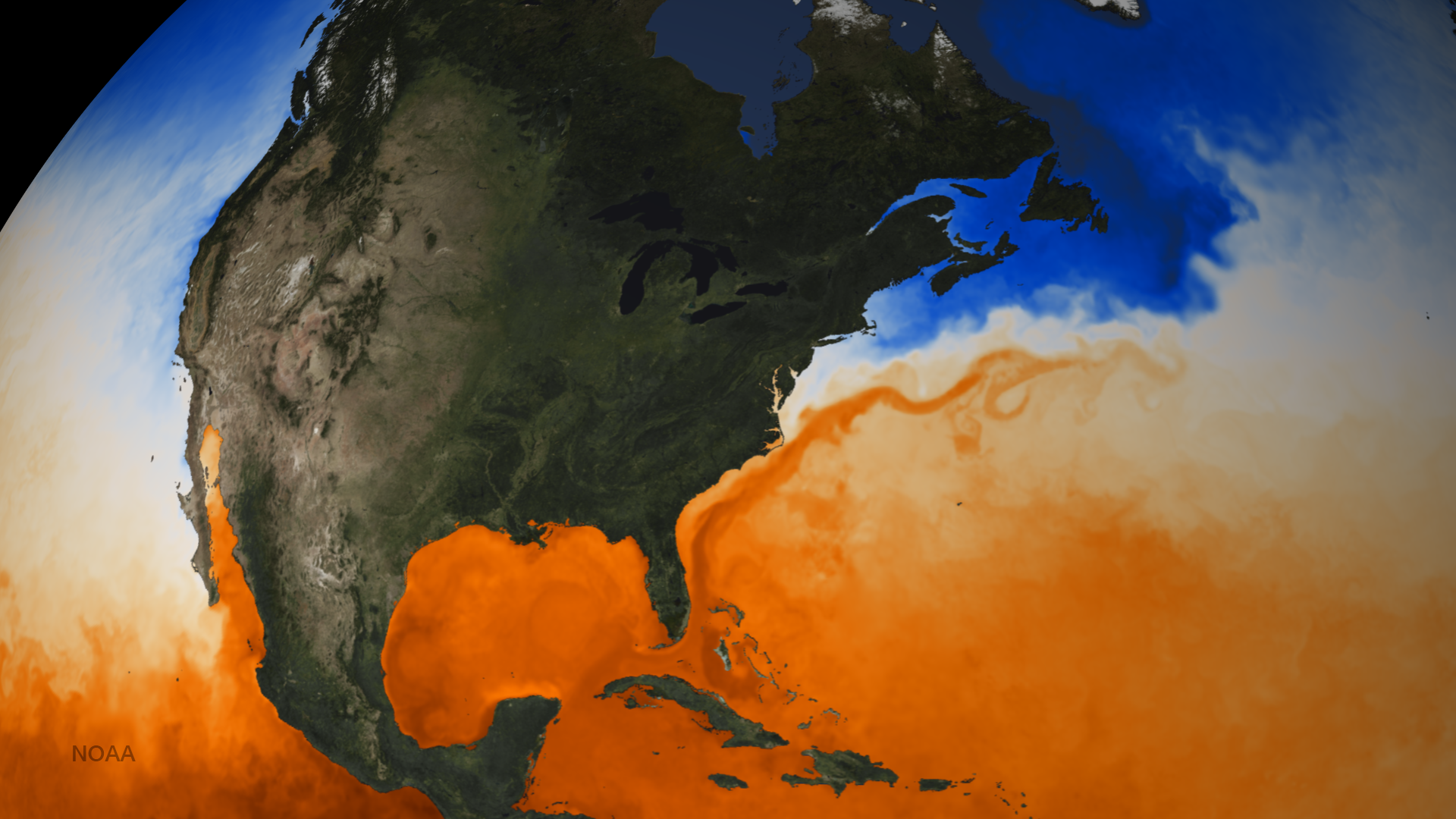
The Gulf Stream carries warm water north along the US east coast. The Kuroshio does the same east of Japan. Both currents have sharp temperature fronts that can influence the air above them, but the idea that one could affect the other across half the globe has been little explored.
The researchers used MIROC6, a climate model that took part in the sixth Coupled Model Intercomparison Project, with an ocean component that is eddy-permitting, meaning it resolves some of the swirling currents. They started from a 100-year simulation with pre-industrial conditions. They then ran two sets of experiments, each with ten ensemble members, in which sea surface temperatures in either the North Pacific or the North Atlantic were forced to follow those from the first run, while the rest of the model evolved freely.
The influence ran one way. With North Atlantic temperatures forced, Kuroshio temperatures correlated with the original run at 0.36, rising to 0.48 when only changes slower than five years were kept. With North Pacific temperatures forced, the Gulf Stream showed almost no correlation, at 0.010. Gulf Stream temperatures led Kuroshio temperatures by up to four years.
North Atlantic temperatures explained about 13 per cent of the variance in Kuroshio temperature on timescales longer than a year. Temperature changes in the tropical Pacific, a well-known driver of North Pacific variability, explained 4 per cent.
The atmospheric route
In the model, a warm Gulf Stream shifts the North Atlantic storm track north and sets up a pressure pattern like the North Atlantic Oscillation. In early winter the stratospheric polar vortex strengthens. By late winter, high pressure builds over the North Pacific and the Aleutian Low weakens.
The changed winds over the North Pacific generate slow ocean waves that travel west, a process that can take up to five years. When they reach the Kuroshio Extension, the part of the current that heads out into the open Pacific, they push it north. A heat budget in the model shows that the shift carries more warm water north, which raises surface temperatures there.
The effect depends on model detail. With a coarser ocean that does not resolve eddies, North Atlantic temperatures explained only 0.49 per cent of the Kuroshio variance, and the atmospheric response did not appear. The authors say high-resolution models are needed to capture the link. They also report that high-resolution climate models from a separate multi-model project reproduced the atmospheric pattern more consistently than low-resolution ones.
Recent North Pacific warming
The authors link the mechanism to events in the real world. In 2019–2020 the North Atlantic had a temperature dipole with a positive North Atlantic Oscillation-like pattern, and from 2021 onwards positive sea surface height anomalies persisted in the western Kuroshio Extension.
To test the contribution to 2020–2024 warming, they ran simulations of a mid-range future emissions scenario, SSP2-4.5, in which observed temperatures were restored in the Gulf Stream, the tropical Pacific or both. The scenario alone did not reproduce the observed warming pattern. Restoring Gulf Stream temperatures produced stronger warming mainly in the Kuroshio Extension, while tropical Pacific temperatures mainly affected the eastern North Pacific. With both included, the ensemble matched the observed basin-wide pattern.
What the study cannot show
The results come from model simulations, mainly from a single model, run in idealised 100-year simulations. The 13 per cent figure applies to that model’s internal variability, not to the real ocean.
The authors say control simulations alone are not enough to establish cause and effect in the link between North Atlantic temperatures and the annular-mode response. In a control run, ocean temperatures can be triggered passively by atmospheric variability, which they say explains uncertain stratospheric links across the high-resolution models. The wave model they used to explain ocean height changes also does not match the simulation in every region.
The paper’s text gives no percentage for how much of the real 2020–2024 warming came from the Gulf Stream, as opposed to human-caused warming and other factors. It also does not test whether the link will strengthen or weaken as the planet warms. The authors list that as a question for further work.
Spot an error in this article? Email [email protected]