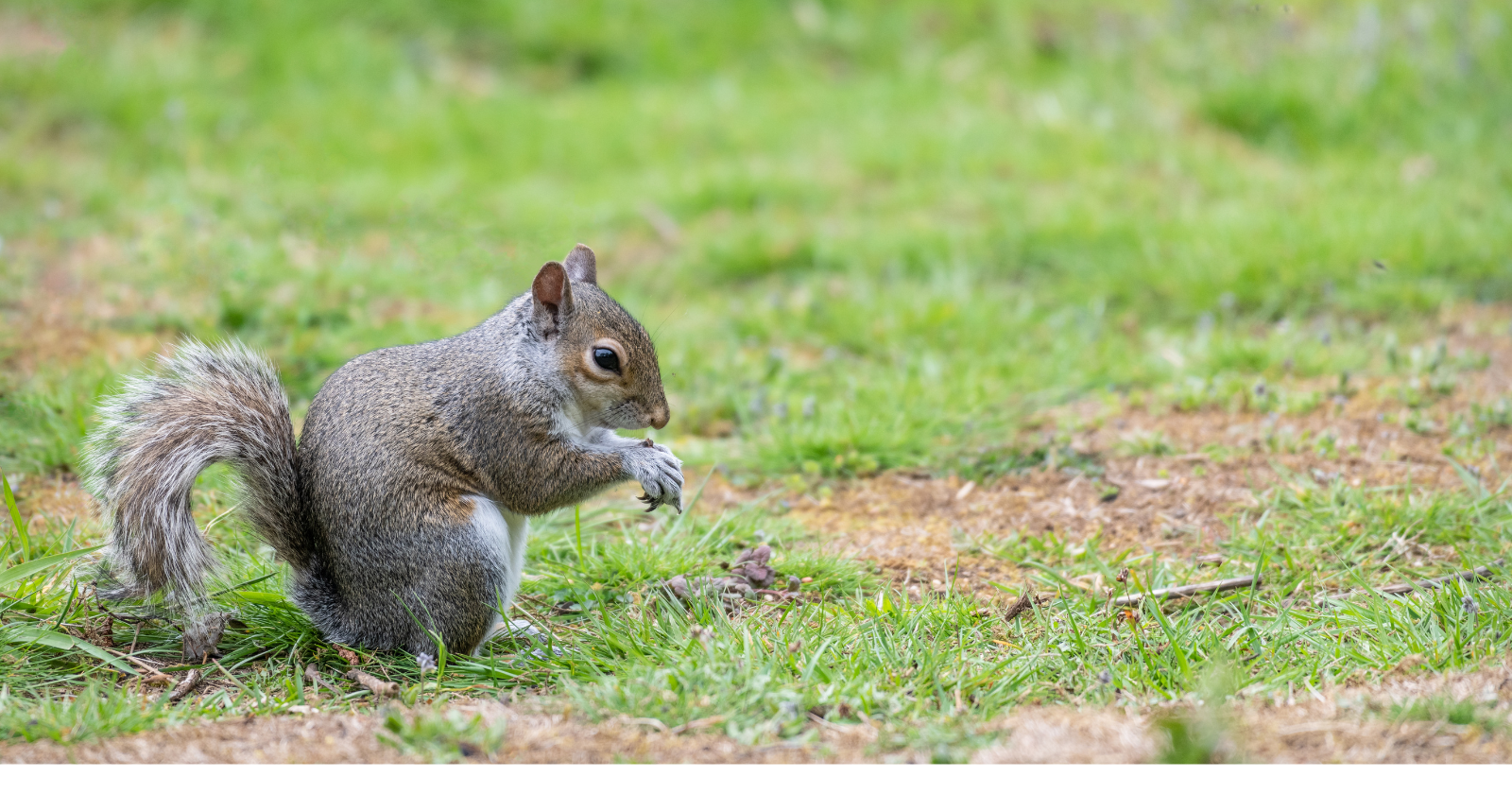
Somewhere in a Pennsylvania woodlot, a squirrel is committing fraud.
It scrapes out a hole, shoves its face into the dirt, pats the soil back down and trots off looking pleased with itself. Textbook burial. The only snag is the acorn, still held in its mouth. The hole was empty the whole time, and the performance was staged for whoever happened to be nearby.
What the field crews actually saw
Michael Steele, a biologist at Wilkes University, spent years watching grey squirrels bury nuts and then sending observers in to dig those caches back up. The empty hole kept appearing. Steele and his co-authors reported it in a 2008 paper in Animal Behaviour, drawing on more than 500 trials at the Pennsylvania site plus a second population studied in Connecticut and Massachusetts.
Fake burials showed up in roughly 13 per cent of caching events at both locations. Rare enough to miss if you blink, frequent enough to be real. They became more common when another squirrel was close by, and they measurably lowered the odds that a human standing in for a pilferer would find the genuine nut. The authors called it the first experimental evidence of behavioural deception in a wild rodent.
A second experiment pushed harder, with researchers deliberately robbing caches to see what the squirrels would do about it. Decoy digging appeared as one item in a broader set of anti-theft responses rather than a standalone party trick.
Why a decoy pays for itself
Theft eats a serious chunk of the winter budget. Certain squirrels lose as much as a quarter of everything they cache to members of their own species, as documented by National Wildlife magazine, and a grown animal can eat close to a kilogram of nuts a week while hiding thousands across a season.
Every stolen acorn is a February meal that no longer exists.
Set against that, a decoy costs only the effort of digging and covering an empty hole. Anyone who follows up gets dirt, wasted effort, and a lesson that shadowing this particular squirrel is a poor use of an afternoon.
Sylvia Halkin, a biologist at Central Connecticut State University and one of Steele’s co-authors, found the manoeuvre sits inside a much larger bag of tricks. Her students handed out peanuts, watched where they went, then dug them up. The squirrels adapted fast: burying under bushes where observers could not see, choosing muddy ground that made digging unpleasant, sinking several empty holes before committing a nut to one of them, sometimes carrying the prize up a tree entirely.
Does the audience have to be a squirrel?
Apparently so. Lisa Leaver and colleagues at the University of Exeter observed wild greys caching with onlookers present and reported in Animal Cognition that the animals spaced their caches further apart and preferentially turned their backs on other squirrels while burying. Crows and jays standing by produced no such response, despite robbing caches themselves. Lucy Hopewell and Leaver later documented further social effects on cache-making in the journal Ethology.
Birds run comparable routines. Western scrub-jays offered a choice between noisy pebbles and silent soil picked the quiet option when a competitor could hear them but not see them, a result Gert Stulp, Nathan Emery, Simon Verhulst and Nicola Clayton published in Biology Letters.
Whether any of this counts as lying
Digging a fake cache in front of a rival has an obvious payoff, and payoffs do not require one mind modelling another. A behaviour can be strategic in effect while running on something much simpler than intent.
Even the birds are contested on this point. James Thom and Nicola Clayton published work in PLOS ONE defending jay re-caching as genuine cache protection, arguing against a rival model that explains the same behaviour as stress combined with patchy memory.
Steele’s finding is one strong field study, observed across two separate populations. That is better evidence than most claims about animal cunning can muster, and still well short of proof that a squirrel pictures what a rival believes.
The filing system underneath
Whatever is happening upstairs, it sits on top of genuine bookkeeping. Mikel Delgado and Lucia Jacobs tracked 45 fox squirrels on the University of California, Berkeley campus, handing each one a run of almonds, pecans, hazelnuts and walnuts and mapping every burial by GPS. Writing in Royal Society Open Science, they found the animals sorted caches by nut species, the rodent version of keeping onions on one shelf and apples on another.
That pattern only held when the squirrels were collecting from a single fixed spot. Scatter the source, and the sorting fell away, which suggests a flexible strategy rather than a fixed instinct. Berkeley’s write-up put the annual workload at three to ten thousand nuts per animal.
So the reputation for absent-mindedness is doing a lot of unpaid work. A pilferer who writes off its neighbours as scatterbrained stops watching them properly, which is precisely where a cacher wants its rivals sitting. Nobody knows whether a squirrel intends that outcome, and the oak seedlings coming up from the caches nobody bothered to rob are indifferent either way.