

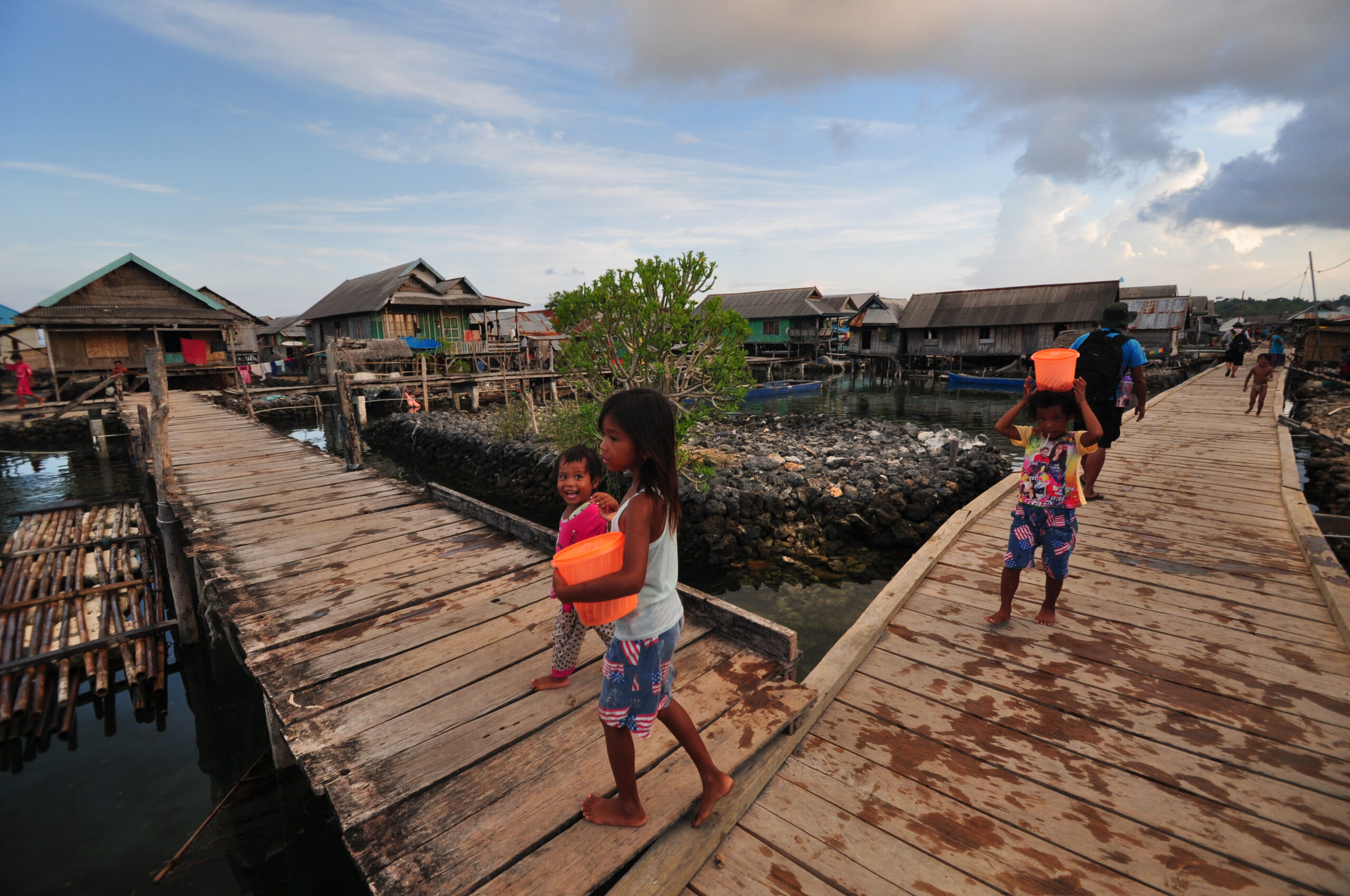
A portable ultrasound machine, hauled into a village on the eastern arm of Sulawesi, is the instrument at the center of this story. In 2015, Melissa Ilardo carried one into Jaya Bakti, a Bajau settlement in Indonesia, and asked people to lie still while she imaged an organ most of them had never thought about. She repeated the procedure a short distance away in Koyoan, a village of Saluan people — farmers, not divers. By the end, she had scans of 59 Bajau and 34 Saluan spleens, plus saliva samples for DNA.
The spleen is a fist-sized reservoir tucked under the left ribs, and in a breath-hold diver it behaves like a spare oxygen tank. When a face hits cold water, the mammalian dive reflex kicks in: heart rate drops, peripheral blood vessels clamp down, and the spleen contracts, squeezing a bolus of oxygen-carrying red blood cells into circulation. A bigger reservoir means a bigger bolus. That logic is what sent Ilardo, then a PhD student working with Eske Willerslev and with Berkeley geneticist Rasmus Nielsen, looking for a population that spends an extraordinary share of its life below the surface.
The Bajau, often described as sea nomads, fit. They dive on a single breath with wooden goggles and spears, harvesting fish and shellfish at depth, and Ilardo has estimated they spend up to about 60 percent of a working day underwater — a fraction she has compared to that of sea otters. Some Bajau families still live in houseboats or stilt houses over the water; some dive for hours daily across a lifetime that begins in childhood.
What the scans showed
After filtering the data to account for relatedness between participants — villages this size are full of cousins, and shared ancestry can fake a signal — the comparison held. Bajau spleens were, as the authors and Berkeley News summarized the finding, about 50 percent larger than those of their Saluan neighbors, or “half again as large.” That framing is the researchers’ own summary of the effect, not a precise clinical measurement applicable to any given individual; spleen size varies with body size, sex, age and health, and the study’s statistics were built to strip those confounders out.
The more telling number is one that didn’t move. Within the Bajau sample, spleens of people who dive and people who don’t were not measurably different. Non-diving Bajau — those who work on land, or who simply never took it up — carried the same enlarged organ as the spearfishers. Training, in other words, doesn’t appear to explain it. Whatever is making these spleens big is present before anyone gets in the water.
That result reframes a familiar physiology story. Human divers do show measurable short-term spleen responses to repeated breath-holding, and elite freedivers train their tolerance for hypoxia. But a trait that shows up in the non-divers of a population, and not in a closely related neighboring population living about 25 kilometers away, points toward inheritance rather than conditioning.
A gene for thyroid hormone, of all things
The genomic scan, published in Cell in April 2018, turned up a variant in PDE10A at notably higher frequency in the Bajau than in comparison populations, and the variant tracked with larger spleen size in the study sample.
PDE10A is not an obvious diving gene. Its strongest expression signal in the study sits in the thyroid gland, and in a European cohort the version of the variant favored in the Bajau went with higher circulating thyroxine; thyroid hormone levels, in turn, have been strongly linked to spleen size in mice, where animals lacking the hormone develop small spleens that partly recover when it is restored. The gene is also active in smooth muscle, the tissue that does the contracting when the spleen squeezes. The plausible chain runs from a hormonal set point through organ development to the size of the reservoir available on any given dive. It is a chain with several links the study could not directly observe in humans, and the authors were careful about that. An association between a variant and an organ measurement in fewer than a hundred people is a starting point, not a mechanism.
Several other candidate regions surfaced in the scan as well, including signals near genes involved in the vasoconstriction response — the peripheral clamp-down that shunts blood to the brain and heart during a breath-hold. The picture the paper sketches is not one gene making one bigger organ but a set of adjustments to an ancient reflex that all mammals share and that the Bajau have been leaning on, by some estimates, for more than a thousand years.
Why a spleen in Sulawesi matters to a hospital in Salt Lake City
The medical interest here is not about producing better divers. It is about hypoxia — oxygen starvation — which is what kills tissue in a stroke, a heart attack, a drowning, a respiratory collapse. The Bajau represent a natural experiment in tolerating repeated, severe, short-term oxygen deprivation without apparent harm, and the researchers have argued that understanding which genetic switches are flipped in such a population could inform how clinicians think about acute hypoxia in patients.
That is a long road, and the study does not shorten it much on its own. What it does offer is an unusually clean demonstration of recent human adaptation to a way of making a living — alongside the Tibetan and Andean high-altitude cases — measured with a machine that fits in a backpack, in two villages a short distance apart.
There is a time pressure around the work. Bajau communities are under increasing strain from industrial fishing, resettlement policies and the disappearance of the reefs they depend on, and the full-time diving life that produced the phenotype is becoming rarer with each generation. The physiology is thousands of years old; the opportunity to study it in place is not guaranteed to last.