In November 2023, a mechanical engineer at the University of Leeds published a paper in the Journal of the Royal Society Interface that took an established piece of beekeeping doctrine, tested it with the mathematical techniques the building industry uses to assess wall insulation, and concluded that the doctrine had been wrong for about one hundred and twenty years. The paper, published under Derek Mitchell’s name in Volume 20 of the journal, is titled “Honeybee cluster—not insulation but stressful heat sink.” What Mitchell had done was to take the accepted description of what happens when a colony of Apis mellifera bees clusters together in a hive during cold weather, and to test whether that description held up against four standard quantitative definitions of what insulation actually is. According to the paper itself, which is open access via PubMed Central, the cluster fails all four insulation criteria and meets all three of Mitchell’s criteria for a heat sink. Which is close to the opposite of what beekeeping textbooks have been telling their readers since 1914.
The consequence, if the analysis holds, is not merely academic.
What the traditional model said
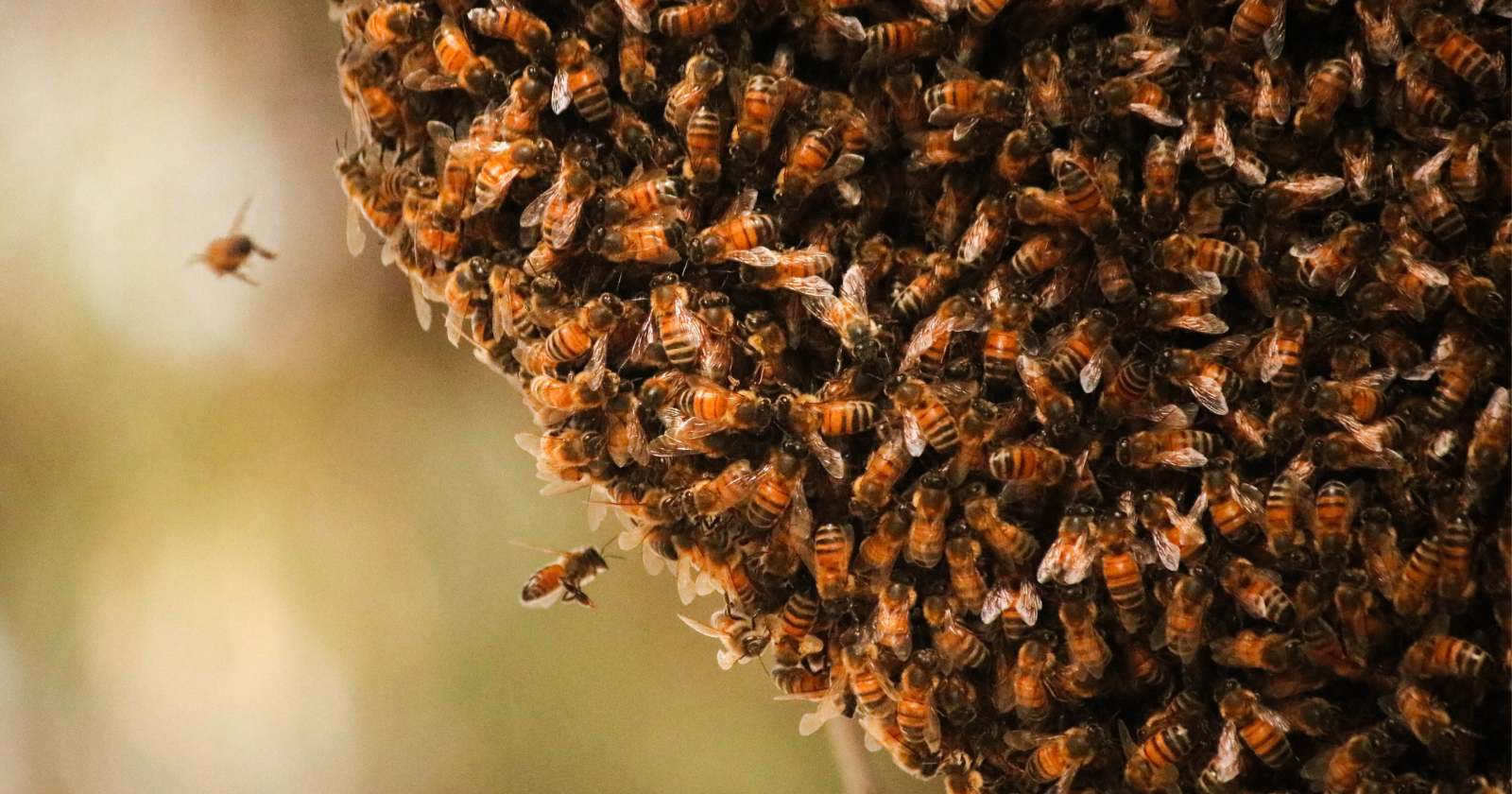
The image the beekeeping literature has favoured, since the earliest twentieth-century texts, is one of a warm, insulating layer of bees on the outside of the cluster protecting a warmer inner core. The outer bees, on this view, function like the outer wool of a blanket around a sleeping body: their bodies and the trapped air between them slow the escape of heat from the core, so the core can be maintained at or above 18 degrees Celsius even when the ambient air around the hive is 40 degrees below zero. A study led by Fabrice Requier’s group at the Université Paris-Saclay, published in Ecological Indicators in December 2024 and based on 1,083 temperature sensors distributed across 31 hives in France, Germany and Greece, independently documents the temperature architecture Mitchell is arguing about: bees form a cluster to hold the nest above the 10 degrees Celsius chill-coma threshold, with cluster centres averaging 27 to 35 degrees and surface temperatures decreasing to between 18 and 29 degrees. The very tight compaction of the mantle bees was traditionally read as evidence that this insulating behaviour was working, and the thin wooden walls of standard hives were treated as acceptable because the bees were seen as doing the thermal work themselves. Two adjacent practices grew out of this reading. In the 1930s, thin-walled hives were placed in climates that regularly reach thirty degrees below zero, on the assumption that the mantle would compensate. In the late 1960s, Canadian commercial beekeepers began keeping colonies in cold storage at around four degrees Celsius through the winter, again on the theory that clustering was benign. Since the 2020s, and increasingly in Idaho, Washington and Southern California, similar refrigeration practices have been used in summer to force bees into a brood-break state that makes chemical treatment of Varroa mites easier.
What Mitchell actually did
Mitchell’s approach was to apply the standard engineering definitions of insulation and heat sink to the cluster geometry and see which the cluster actually satisfies. On the accumulated evidence of a hundred years of experimental data from previous investigators, he built a model of a spherical cluster inside a rectangular hive inside a bare cold landscape with a radiating sky, using the effective medium theory to derive the thermal conductivity of a mixture of bee bodies, hair and air across a full range of packing densities. He then tested the mantle against four definitions of insulation: whether adding more mantle reduces heat loss, whether the effective conductivity of the mantle decreases as clustering progresses, whether the mantle has a lower conductivity than the cluster core, and whether the mantle’s thermal resistance (its R-value) increases as clustering progresses. On all four definitions, the mantle failed. In fact, the paper found that when a colony transitions from its pre-cluster distribution to a fully dense cluster, the effective thermal conductivity approximately doubles and the mantle’s R-value can decrease by more than a factor of eleven. The mantle is not adding insulation as it compresses. It is losing it.
The mechanism is the compression itself
The reason the effect operates in the opposite direction from the traditional intuition is a specific property of porous insulating materials, which behave counter-intuitively when compressed. According to Mitchell’s own summary of his findings, written for The Conversation and republished by ScienceAlert, a down jacket is the illustrative case. Down insulates because of the small pockets of still air trapped between the feathers. Compress the down and those pockets of air disappear, the feathers touch one another more directly, the thermal conductivity of the compressed feather mass rises to something closer to that of a solid leather jacket, and the insulating value collapses. A cluster of honeybees under cold stress does something structurally similar. As the outside air temperature falls, the bees on the outer surface of the mantle chill down toward 10 degrees Celsius. Below this temperature, individual mantle bees die and fall off the cluster. To avoid falling below 10 degrees Celsius, the surviving mantle bees crowd closer to the bees behind them that are still warm. That compression closes the air gaps between the mantle bees, raises the effective thermal conductivity of the mantle, and increases the rate at which heat flows from the core out through the mantle to the outside, which is precisely what a heat sink does. What Mitchell’s paper describes, in the language of engineering rather than beekeeping, is compressed down turning into leather.
What this changes for hive design
On the current best interpretation of Mitchell’s numbers, the consequence for practical beekeeping is that standard hive walls are contributing to the problem rather than being neutral. According to the University of Leeds’ announcement of the paper, earlier work by the same author established that most manufactured hives lose heat at roughly seven times the rate that natural tree hollows do. Manufactured hive walls are about 19 mm of thin wood, and the tree cavities in which Apis mellifera evolved to overwinter have walls of the order of 150 mm. Mitchell’s calculation is that hive walls need to provide substantially more insulation than 19 mm of wood, on the order of 30 mm of polystyrene or its equivalent, to bring the hive’s thermal performance close enough to the tree cavity for a colony to overwinter without being forced into a persistent stress cluster. That change would remove the compression mechanism that produces the “wrapping in leather” outcome in the first place, because the bees would not need to compress themselves against the hive wall to hold 10 degrees Celsius at the mantle surface. Mitchell has framed the argument in explicitly welfare terms. The traditional view of clustering as benign has, on his analysis, licensed a practice of housing bees in thermal conditions they would not choose themselves, and of using refrigeration to force them into a stress behaviour that requires them to burn through as much as 60 kg of honey in the most adverse conditions. Whether the practice should continue is, on Mitchell’s reading, an ethics question as much as an entomological one.
The wider point his paper makes, sitting underneath the numbers, is that the hive itself is best understood as part of the honeybee’s extended phenotype rather than as an inert container the bees happen to inhabit. Thin-walled boxes are not neutral.