Astronomers have weighed a bubble of extremely hot gas around a pair of quasars seen as they were about 2.8 billion years after the Big Bang, and found it holds some 9.7 x 10^60 ergs of thermal energy, enough, in principle, to shut down star formation and heat the surrounding space. The measurement picks out one system, where earlier detections relied on an average over many. It was published in Nature Astronomy on 18 November.
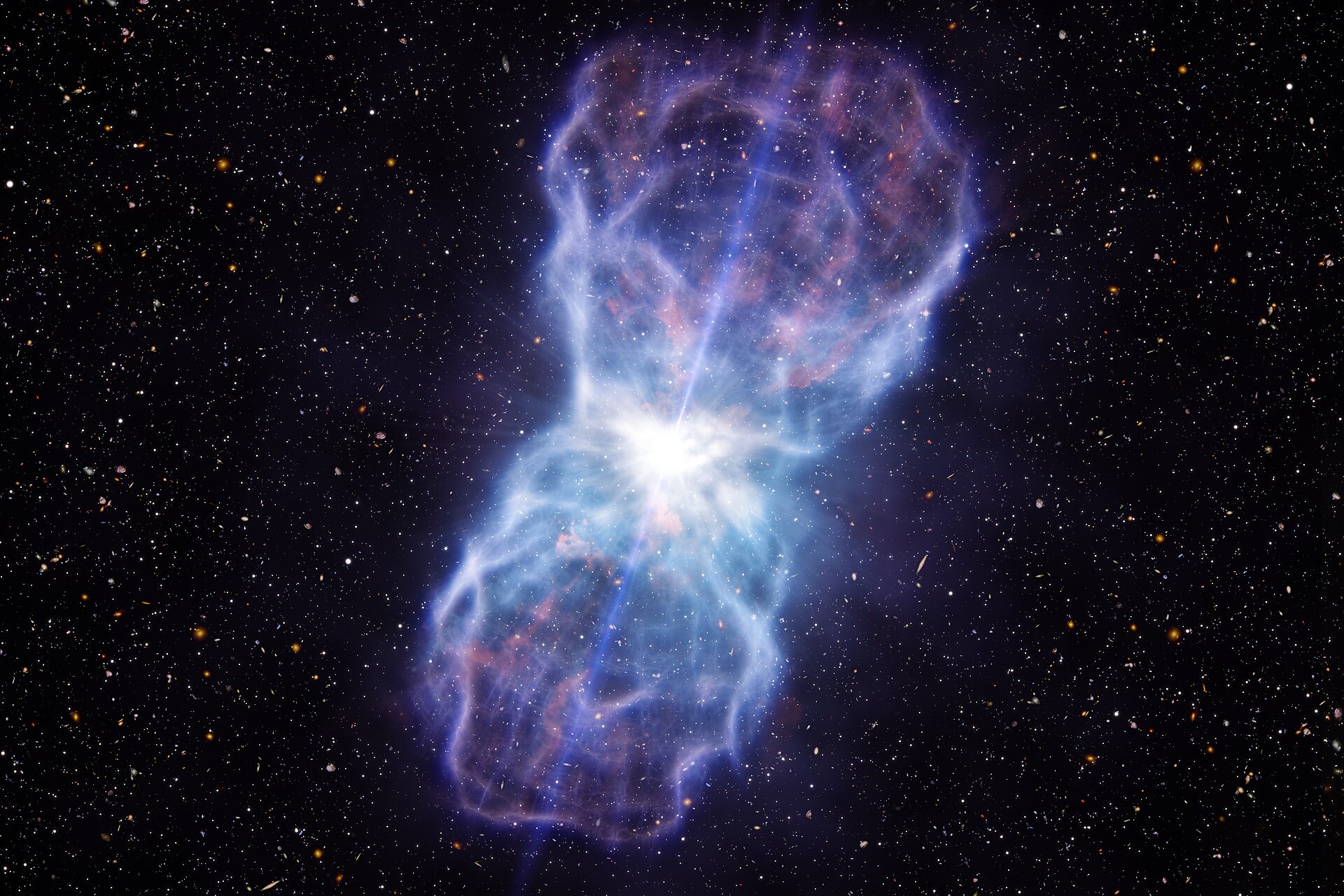
The team, led by Kirsten Hall of the Center for Astrophysics | Harvard & Smithsonian with Nadia Zakamska, Yu-Ching Chen and Xiaohui Fan and theorist Jake Bennett, studied a dual quasar catalogued as J1549+1245, at redshift 2.37. Quasars are galaxies whose central black holes are feeding so fiercely that they outshine the stars around them.
Galaxy formation models require that such black holes dump large amounts of energy into their surroundings, a process called feedback that keeps galaxies from growing too big. The energy is hard to catch in the act because the gas it heats is too hot and thin to glow in ordinary images.
Reading a shadow on the oldest light
To find it, the researchers used the thermal Sunyaev-Zel’dovich effect, a small distortion left in the cosmic microwave background, the relic radiation from the early universe, when its photons scatter off fast-moving electrons in hot gas. At some millimetre wavelengths this shows up as a dip, a deficit of light along the line of sight.
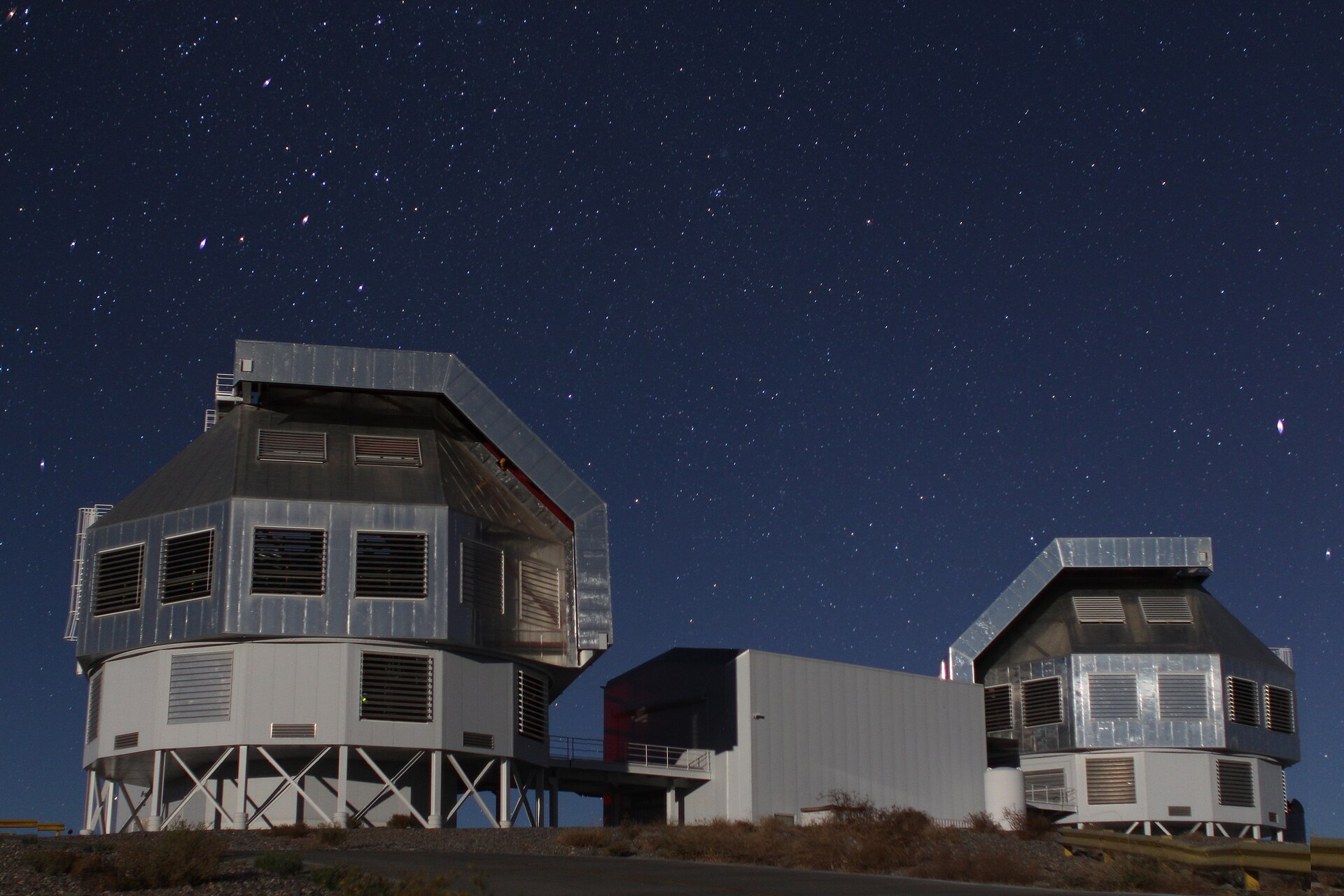
Combining data from the Atacama Large Millimeter/submillimeter Array, its compact companion array, the Very Large Array and the Submillimeter Array, the team measured that dip around J1549+1245 at about six times the noise level. Because the strength of the effect is set by the gas pressure added up along the line of sight, it converts directly into a total thermal energy.
On the scale of the galaxies themselves, about 10 to 15 kiloparsecs, that energy came to 9.7 x 10^60 ergs, with an uncertainty of about 1.6. The paper reports that this exceeds the hot gas expected in a dark-matter halo of 10 trillion solar masses by a factor of 3.6, and amounts to at least 0.6 per cent of the energy the quasars will emit over their lifetime.
Signs of a larger bubble
The data also showed hints of hot gas much farther out. A roughly 100-kiloparsec region of missing light, offset from the quasars, registered at about five times the noise and corresponds to 6.4 x 10^60 ergs. A tentative signal on scales near 600 kiloparsecs, which the authors flag as weak at 2.9 times the noise and caution against over-reading, would imply more energy still.
Star formation cannot supply energy on this scale, the authors argue: the most powerful starburst winds fall orders of magnitude short. Comparing with the FABLE cosmological simulations, they find that a halo like this one without black-hole feedback would hold only about a quarter to a third of the measured energy. The excess, they conclude, points to the quasars’ winds.
The result sharpens an earlier finding from much of the same group. In a 2019 study they detected the same effect only as a statistical average over 109,829 quasars. Isolating it around one system is a step towards imaging feedback object by object.
What the study cannot show
The measurement captures how much thermal energy is present now, in one system. It does not track the gas forward in time, and it does not demonstrate that the outflows caused the surrounding structure to change; “carry enough energy to shape” is a statement about the energy budget, not an observed outcome.
The source of the heat is also not pinned down. The authors say the hot gas could come from winds driven by either quasar, or from the assembling halo around them, or a mix, and they work through each case without settling on one. The large-scale signals carry the heaviest caveats: the 600-kiloparsec detection is marginal, and the team searched for, but could not rule out, an intervening group of galaxies behind part of the signal.
A single object cannot establish that quasar feedback works this way across the universe. The authors frame the system as an unusually clean test case and cast the measurement as “the first strong detection of the total thermal energy of the hottest phase of gas in an individual quasar system”, one they hope the next generation of millimetre telescopes will repeat on many more.
Spot an error in this article? Email [email protected]