
In an article published in the PNAS scientific journal, researchers from Aalto University and the VTT Technical Research Centre of Finland showed experimentally that vacuum has properties not previously observed. According to the laws of quantum mechanics, it is a state with abundant potentials. Vacuum contains momentarily appearing and disappearing virtual pairs, which can be converted into detectable light particles.
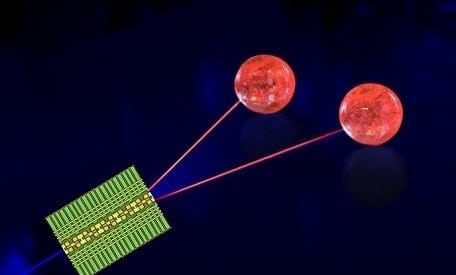
The researchers conducted a mirror experiment to show that by changing the position of the mirror in a vacuum, virtual particles can be transformed into real photons that can be experimentally observed. In a vacuum, there is energy and noise, the existence of which follows the uncertainty principle in quantum mechanics.
 ’If we act fast enough, we can prevent the particles from recombining – they will then be transformed into real particles that can be detected’, says Dr. Sorin Paraoanu from the Aalto University School of Science.
For the experiment, the researchers used an array of superconducting quantum-interference devices (SQUID). These parts resemble devices used in imaging small magnetic fields in the brain. By changing the magnetic field, the speed of light in the device can be changed. From the standpoint of the electromagnetic field of the vacuum, radiation reflecting from this kind of device experiences it as a moving mirror.
’By quickly varying the speed of light in the array, we can extract microwave photons out of the vacuum’s quantum noise’, explains doctoral student Pasi Lähteenmäki.
Future research directions for these kinds of devices include the creation of an artificial event horizon and observation or Hawking radiation emanating from it. The present observation will help cosmologists to get closer to the riddle of the birth of the universe and advance the development of extremely powerful quantum computers.
ScienceBlog.com has no paywalls, no sponsored content, and no agenda beyond getting the science right. Every story here is written to inform, not to impress an advertiser or push a point of view.
Good science journalism takes time — reading the papers, checking the claims, finding researchers who can put findings in context. We do that work because we think it matters.
If you find this site useful, consider supporting it with a donation. Even a few dollars a month helps keep the coverage independent and free for everyone.