
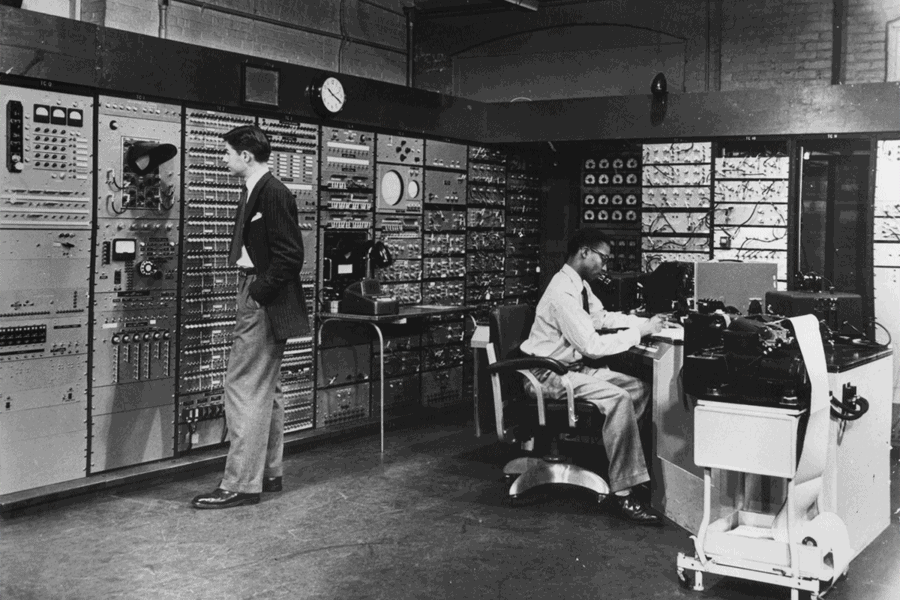
The caption on a black-and-white photo reads, in part: “In 1951, high school graduate Joe Thompson, 18, was trained as one of the first two computer operators. The computer was the Whirlwind, the prototype for the SAGE air defense system.”
MIT’s Whirlwind was one of the earliest high-speed digital computers, and Thompson played a key role in its operation at the start of his decades-long career in computing. With help from Deborah Douglas, director of collections at the MIT Museum, David Brock of the Computer History Museum recently caught up with Thompson, the first person trained as a Whirlwind operator at the MIT Digital Computer Laboratory, to learn more about his time with the project and his subsequent years as a leader in the computing industry.
“They at MIT were looking for bright, young kids who were not going to college,” Thompson told Brock. “I was the first [operator] to see if it would work, and I guess it worked well. … You had to learn the whole system, and you’d get to the point where you understand what they’re doing.”
Also seen in the photo is system programmer John “Jack” Gilmore. According to a publication from the Computer History Museum, “It had been Jack Gilmore of the Whirlwind project, famous for his software contributions, who had been key to bringing Joe Thompson into the project in an MIT push to meet the demands for skilled staff by recruiting from local high schools those students who were academically and socially exceptional, but for whom, for whatever reasons, college was inaccessible.”
After Whirlwind, Thompson accepted a job with RAND as a programmer working on the SAGE air defense system software. He transferred to California with the company, and his group eventually spun off into the non-profit System Development Corporation. Thompson retired in the 1990s after four decades in computing.
Gilmore would go on to work in advanced computing research at MIT Lincoln Laboratory before starting his own firm and spending the rest of his career in the computing industry. He died in 2015.
ScienceBlog.com has no paywalls, no sponsored content, and no agenda beyond getting the science right. Every story here is written to inform, not to impress an advertiser or push a point of view.
Good science journalism takes time — reading the papers, checking the claims, finding researchers who can put findings in context. We do that work because we think it matters.
If you find this site useful, consider supporting it with a donation. Even a few dollars a month helps keep the coverage independent and free for everyone.