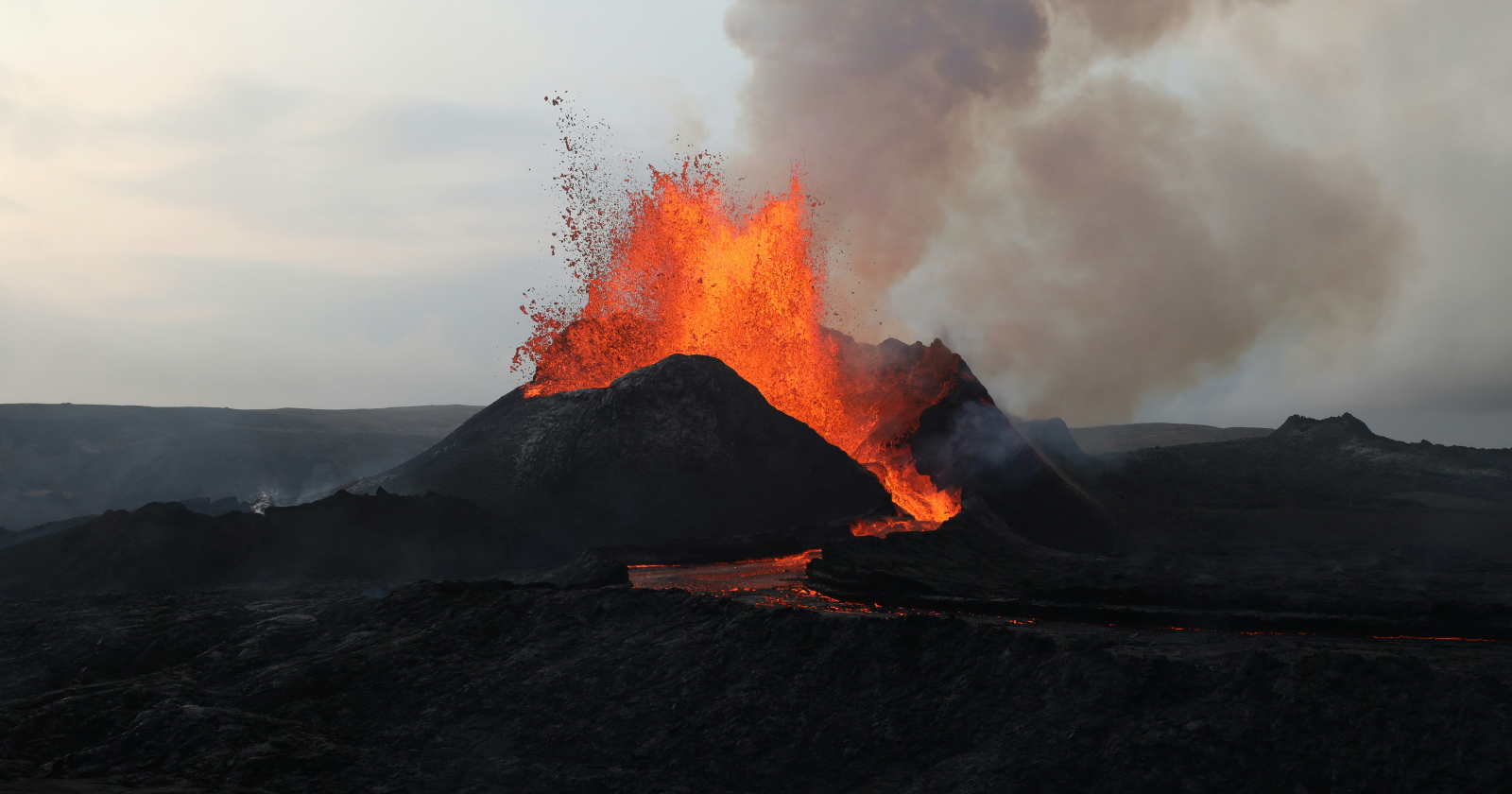
The morning of April 10, 1815, on the Indonesian island of Sumbawa, started the way most mornings had for centuries: warm, humid, unremarkable.
By that night, the sky over the island had gone the color of a bruise, ash was raining down thick enough to collapse roofs, and a mountain called Tambora had begun a chain reaction that wouldn’t fully play out for another two years, on the other side of the planet, to people who had no idea Tambora existed.
Here’s roughly how one mountain managed to reach that far.
How a mountain shuts down a year, step by step
1. The mountain lets go
According to NOAA’s National Environmental Satellite, Data, and Information Service, Tambora’s eruption rated a 7 on the Volcanic Explosivity Index, a scale that tops out at 10 and hadn’t recorded anything that severe since the year 180. The mountain ejected roughly 31 cubic miles of ash and rock. Pyroclastic flows, moving down the slopes at highway speed, killed 11,000 people within days. That part of the disaster was fast, local, and immediately obvious to everyone nearby.
Rafts of floating pumice, in places several feet thick, drifted across the surrounding sea for weeks afterward, thick enough to strand passing ships. Entire villages on the mountain’s slopes were gone before anyone outside the immediate region even heard what had happened, because word still traveled at the speed of a ship’s sail, not a signal.
2. The debris climbs past the weather
What made Tambora different from an ordinary large eruption is where its plume ended up. Ash that stays low in the atmosphere rains out within weeks. Ash and sulfur dioxide that punch through into the stratosphere, the layer above where ordinary weather happens, can circle the entire globe and stay suspended for a year or more. Tambora’s plume went high enough to do exactly that, turning a local disaster into a planetary one almost by accident.
This is the step that decides whether an eruption becomes a headline for a season or a footnote in a century’s worth of harvests. Plenty of large volcanoes erupt without doing anything close to what Tambora did, because their debris never makes it past that ceiling. Height, more than raw size, is what turned one mountain into a hemisphere-wide problem.
3. Sunlight gets rationed
Once in the stratosphere, that haze of ash and sulfate particles reflects sunlight back into space before it ever reaches the ground. The same NOAA account notes the sky over the region darkened enough to block the sun outright for a stretch of days, and the Northern Hemisphere’s average temperature over the following year dropped by roughly a full degree Fahrenheit, spread across an entire hemisphere rather than concentrated anywhere in particular.
4. Two growing seasons fail, an ocean apart
By June 1816, frost was killing crops across Vermont and upstate New York, a full month later in the calendar than frost has any business showing up. According to the UCAR Center for Science Education, summer temperatures across parts of Europe ran as much as 3 degrees Celsius below normal that same year, with rain through most of what should have been the growing season. Grain prices spiked on two continents that had never traded weather data, because there was no such thing yet.
5. Nobody is told why
Volcanologist Haraldur Sigurdsson, of the University of Rhode Island, has spent much of his career reconstructing exactly this sequence. He told NPR why the mountain earned that attention: “I knew that it was the largest and the most important volcanic eruption on the earth because it caused the year without a summer, a big global climate change.” At the time, though, nobody living through the ruined harvests connected any of it to a mountain they’d never heard of. More than 100,000 people died over the following decade, not from the eruption itself but from the famine it set off, region by region, without anyone tracing the chain back to its start.
6. The chain finally gets a name
It took decades of ice cores, tree rings, and old ship logs pieced together long after the fact for anyone to draw a straight line from a specific mountain to a specific ruined summer on the other side of the planet. “The year without a summer” became the name people eventually gave 1816, once the connection was finally made. Nobody living through it in real time had that name, or that explanation, available to them.
What the sequence is actually worth remembering for
I like having a clear plan for my week, my house, my family’s routines. Discipline, in my own life, is mostly a defense against getting swept along by a fast-moving world without a vision for where I’m actually trying to go. Tambora is a good, extreme reminder that discipline and planning only cover the part of the outcome that was ever yours to control. The famine that followed traced back to a five-step chain that started with a mountain and ended, a full year and thousands of miles later, at a dinner table that had never done anything wrong. No farmer along that chain had done anything to deserve it.
The people who came out the other side of 1816 weren’t the disciplined ones or the well-planned ones, particularly. They were the ones willing to revise the plan itself once the actual conditions on the ground stopped matching it. That’s a harder, less satisfying kind of discipline than sticking to a schedule. It’s also the one that was actually useful that year.
Five steps is a tidy way to describe it after the fact, in hindsight, with the benefit of two centuries of climate science nobody living through 1816 had access to. Nobody experienced it as five clean steps. They experienced it as one bad summer they couldn’t explain, followed by decisions they had to make anyway: replant something else, sell the farm, move somewhere the frost hadn’t reached. The five-step version is for us. The people actually living it only ever got step four, with no label attached to it.