
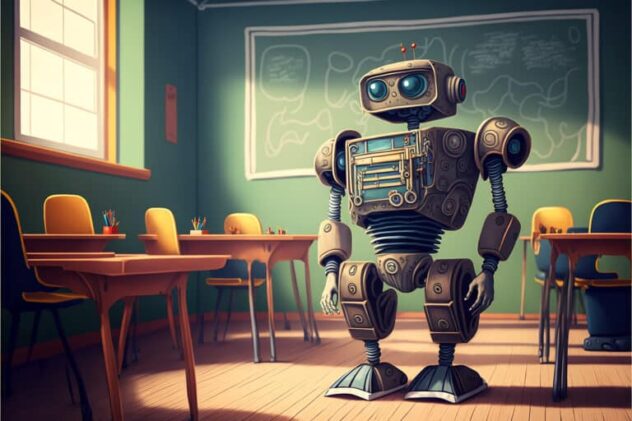
What if you could teach a team of AI programs to behave like graduate students, puzzling through complex design problems and checking each other’s work? Engineers at Duke University have done exactly that, building a crew of AI agents that can tackle intricate physics challenges nearly as well as human experts.
The system, described in ACS Photonics, represents a step toward automating specialized research tasks that currently require years of training. While the AI doesn’t consistently outperform PhD students, its best solutions come remarkably close, and in design work, one excellent answer is often all you need.
The project began with a conversation about chemical reaction modeling. Willie Padilla, the Dr. Paul Wang Distinguished Professor of Electrical and Computer Engineering at Duke, recalls a colleague describing a thorny problem he knew AI could solve, but he lacked time to tackle it himself. That got him thinking: what if AI agents could handle these problems independently?
The Challenge of Infinite Possibilities
The specific problem Padilla’s team addressed falls into a category called ill-posed inverse design. Imagine knowing exactly what you want to build, but facing countless ways to construct it with no map showing which path leads to success. That’s the daily reality for researchers designing metamaterials, synthetic structures that manipulate light in ways ordinary materials cannot.
Padilla’s lab had previously cracked this puzzle for metal-free metamaterials using deep neural networks trained on tens of thousands of simulated data points. They developed a “neural-adjoint” method that works backward from a desired result toward optimal solutions. The process worked, but required considerable human expertise to execute.
The new system replaces that human oversight with what researchers call an “agentic system,” a coordinated team of large language models, each assigned specific duties. One agent organizes data. Another writes deep learning code from scratch, drawing on thousands of examples. A third checks the work for accuracy, then passes results to a fourth agent that runs the neural-adjoint analysis.
“The idea was to create an ‘artificial scientist’ that could learn metamaterial physics and work out solutions on its own.”
An overarching AI manager coordinates the team, helping agents communicate and make strategic decisions. The system can recognize when it needs more training data or when its current approach is making sufficient progress. It can also explain its reasoning at any moment, a transparency that mimics scientific intuition.
Dary Lu, the PhD student who led the project, describes this self-awareness as perhaps the trickiest aspect to program. The AI literally announces when it hits diminishing returns and needs fresh data, or when error rates are dropping satisfactorily and it should keep iterating.
Matching Human Performance
To test their artificial scientist, the researchers set it loose on inverse design problems their lab had already solved. The results revealed both promise and limitations. Across thousands of trials, the AI’s average performance lagged behind previous graduate students. But its best designs? Those rivaled human work.
This pattern matters because design problems often require just one excellent solution, not consistent average performance. A single optimized metamaterial design can unlock new optical properties or electromagnetic behaviors, regardless of how many mediocre attempts preceded it.
The Duke team believes their demonstration shows that carefully programmed agentic systems can handle even the most complex computational challenges. More importantly, the approach isn’t limited to electromagnetics. Similar frameworks could accelerate research in chemistry, materials science, or any field grappling with inverse design problems.
“We are right on the cusp of where systems like these will be able to enhance the productivity of highly skilled workers.”
Lu sees practical implications for the job market, suggesting that building and managing these agentic systems represents a valuable emerging skill set. Padilla takes a longer view, envisioning AI systems that conduct independent research and refine their own methods, pushing human knowledge forward at unprecedented scales and speeds.
The researchers stop short of claiming their bots will replace scientists. Rather, they frame the work as a tool for acceleration, handling routine but specialized tasks that currently consume expert time. The system still requires thoughtful programming and clear problem definition from humans.
Whether these artificial scientists will truly produce novel discoveries remains an open question. For now, they have proven they can replicate expert-level work in a fraction of the time. In research fields where progress hinges on solving countless design variations, that acceleration alone could prove transformative.
ACS Photonics: 10.1021/acsphotonics.5c01514
ScienceBlog.com has no paywalls, no sponsored content, and no agenda beyond getting the science right. Every story here is written to inform, not to impress an advertiser or push a point of view.
Good science journalism takes time — reading the papers, checking the claims, finding researchers who can put findings in context. We do that work because we think it matters.
If you find this site useful, consider supporting it with a donation. Even a few dollars a month helps keep the coverage independent and free for everyone.