

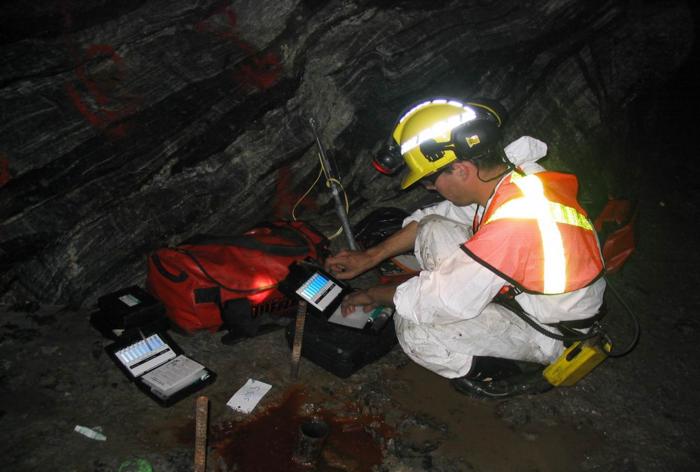
Go far enough underground in northern Ontario and the rock around you is older than almost anything on the surface of this planet. A billion years old, give or take. Gneisses and granites that predate complex life, that predate the oceans as we know them, that have been quietly sitting in the dark, doing chemistry, for longer than the imagination can really hold. And now, in operating mines near Timmins, researchers have been crouching beside boreholes and measuring something that geologists have long suspected but never quantified properly: hydrogen gas, seeping steadily from the Earth’s crust in volumes that might, if the numbers hold, actually matter for the clean energy transition.
The study, published this week in the Proceedings of the National Academy of Sciences, is the first to provide a decade-long empirical record of natural hydrogen discharging from a Precambrian continental setting. Not models. Not projections extrapolated from analogue chemistry. Measured data, collected continuously from boreholes at a working mine, showing that individual boreholes release an average of around 8 kilograms of hydrogen per year and can sustain that rate for 10 years or more.
Eight kilograms sounds modest. But the mine site contains nearly 15,000 boreholes. Extrapolate, and you get something closer to 140 tonnes of hydrogen annually from a single location, which the researchers calculate represents roughly 4.7 million kilowatt-hours of energy per year. Enough, they note, to meet the annual energy needs of more than 400 households. “The data from this study suggests there are critical untapped opportunities to access a domestic source of cost-effective energy produced from the rocks beneath our feet,” says Barbara Sherwood Lollar, the University of Toronto geochemist who led the research.
This is what people in the field call white hydrogen, the naturally occurring variety, as distinct from green hydrogen (made from water using renewable electricity) or blue hydrogen (made from natural gas with carbon capture). White hydrogen has been attracting growing interest for a few years now, most visibly since a large discovery in Mali captured attention in 2023. But the field has suffered from a shortage of exactly what Sherwood Lollar and her Ottawa collaborator Oliver Warr have now provided: hard data on how much gas actually comes out, and for how long.
The mechanism, in broad terms, is not mysterious. “Natural hydrogen is produced over time through underground chemical reactions between rocks and the groundwaters in those rocks,” Sherwood Lollar explains. Two processes drive most of it. Serpentinization, where iron-rich minerals react with water and shed hydrogen as a byproduct, has been understood for decades. Radiolysis is less famous but perhaps more important in Precambrian settings: radioactive elements in ancient rock bombard nearby water molecules and split them apart, releasing hydrogen into the surrounding fractures. Canada’s oldest terrains, it turns out, are particularly well set up for both.
The Rock Does the Work
What makes the Canadian Shield especially interesting here is a coincidence of geology that Warr describes with characteristic efficiency. “The common link is the rock,” he says. The same ancient Precambrian basement that produces hydrogen is the same geological setting that hosts Canada’s nickel, copper and diamond deposits, and that is currently being explored for lithium, helium, chromium and cobalt. Northern Ontario. Northern Quebec. Nunavut. The Northwest Territories. These are already mining country, which means they already have infrastructure, already have boreholes, already have workers on site. “The co-location of mining resources and hydrogen production and use mitigates the need for long transportation routes to market, for hydrogen storage and major hydrogen infrastructure development,” Warr says.
That co-location point is worth sitting with for a moment, because one of the persistent criticisms of hydrogen as a clean energy carrier is the infrastructure problem. Green hydrogen, for instance, tends to be produced far from where it’s needed and is genuinely difficult and expensive to store and ship. Compressed hydrogen requires heavy tanks and careful handling; liquid hydrogen needs cryogenic temperatures. A local source that could be tapped relatively close to an existing industrial consumer sidesteps much of that problem. Sherwood Lollar is direct about the appeal: “What’s more, this provides a ‘made in Canada’ resource that might be able to support local and regional industry hubs and reduce their dependence on importing hydrocarbon-based fuels.”
The existing hydrogen economy is worth pausing on too. It’s already a $135-billion global industry, mostly invisible to the public because most of it doesn’t involve cars or fuel cells. The single largest use of hydrogen is fertilizer production via the Haber-Bosch process; steel and methanol production consume vast quantities as well. Almost all of this hydrogen comes from steam methane reforming, an energy-intensive industrial process that converts natural gas and releases substantial carbon dioxide. Even setting aside transport and decarbonization ambitions entirely, any cheaper or cleaner source of hydrogen has direct relevance to existing industrial supply chains that underpin global food production. That’s not a distant future application. That’s happening right now, every day, in plants around the world.
A Different Kind of Exploration
White hydrogen has mostly been the domain of microbiologists, which is a peculiar history worth noting. The deep subsurface biosphere, teeming with microorganisms that have never seen sunlight and sustain themselves on chemical reactions between rock and water, has been studied partly for what it might tell us about life on other worlds: icy moons, Martian subsurface aquifers, anywhere liquid water meets rock in darkness. Hydrogen is a primary energy source for those ecosystems, so tracking it became a tool for astrobiology rather than energy policy. The practical energy potential, the paper’s authors note, has until now been largely speculative. That, at least, is now changing.
Sherwood Lollar is careful about what this study does and doesn’t show. A single mine site in Ontario, however productive, is not a blueprint for a global white hydrogen industry. More than 70% of the continental crust has some potential for hydrogen generation, she and Warr argue in the paper, but the concentrations and discharge rates will vary enormously. The next step, as they see it, is an alternative exploration strategy: rather than sinking new boreholes hoping to find hydrogen, survey the already-documented global network of sites where hydrogen has been measured, often incidentally, during subsurface microbiology or mining operations, and evaluate each for its economic potential using the direct measurement approach demonstrated here. The data exist; they just haven’t been looked at through this particular lens.
“There is a global race to increase hydrogen availability in order to decarbonize and reduce the costs of the existing hydrogen economy,” Sherwood Lollar says. She adds that the work has given researchers a clearer sense of the economic viability of this resource, one that can now be mapped to hydrogen deposits around the world, both known and yet to be found. Whether white hydrogen becomes a major contributor to that race or remains a useful local supplement for remote industrial sites is genuinely unclear at this stage. What’s less unclear is that a billion-year-old geological process has been happening beneath the boreal forest this whole time, and we’re only now starting to pay proper attention to it.
Source: Sherwood Lollar, B. & Warr, O. (2026). Decadal record of continental H2 reservoirs reveals potential for subsurface microbial life and natural H2 exploration. Proceedings of the National Academy of Sciences, 123(21), e2603895123. https://doi.org/10.1073/pnas.2603895123
Frequently Asked Questions
What is white hydrogen and how is it different from green or blue hydrogen?
White hydrogen is naturally occurring hydrogen gas produced by geological processes in the Earth’s crust, requiring no industrial energy to generate. Green hydrogen is made by splitting water using renewable electricity, while blue hydrogen comes from natural gas reforming with carbon capture attached. White hydrogen’s advantage is that the Earth does the production work itself, potentially making it cheaper and lower-carbon than either alternative, though its availability depends heavily on local geology.
How does ancient rock actually produce hydrogen?
Two main processes are responsible. Serpentinization occurs when iron-rich minerals in certain rocks react with water, releasing hydrogen as a chemical byproduct. Radiolysis happens when radioactive elements naturally present in old rock emit radiation that splits surrounding water molecules apart, freeing hydrogen into cracks and fractures. Precambrian rocks of the Canadian Shield are particularly rich in both the right minerals and radioactive elements, making them productive sources of both.
Could white hydrogen replace the hydrogen currently used in industry?
Not on its own, at least not any time soon. The study suggests a single large mine site could produce around 140 tonnes of hydrogen per year, which is meaningful but modest against global industrial demand running into millions of tonnes annually. The more realistic near-term picture is white hydrogen reducing costs and emissions for industries and communities located on or near hydrogen-producing geology, rather than supplying the broader market. That said, more than 70% of continental crust has some potential for hydrogen generation, so the total resource could be substantial if exploration scales up.
Why has this resource been overlooked until now?
Most research into subsurface hydrogen has been driven by microbiologists studying deep-Earth ecosystems and astrobiologists thinking about habitability on other worlds, not by energy economists. Hydrogen was being measured incidentally at mining and drilling sites, but the data weren’t being aggregated or analysed for their energy implications. This study is the first to compile a decade-long continuous record and ask, explicitly, whether the discharge rates are economically meaningful. The short answer, it turns out, is that in some places they might be.