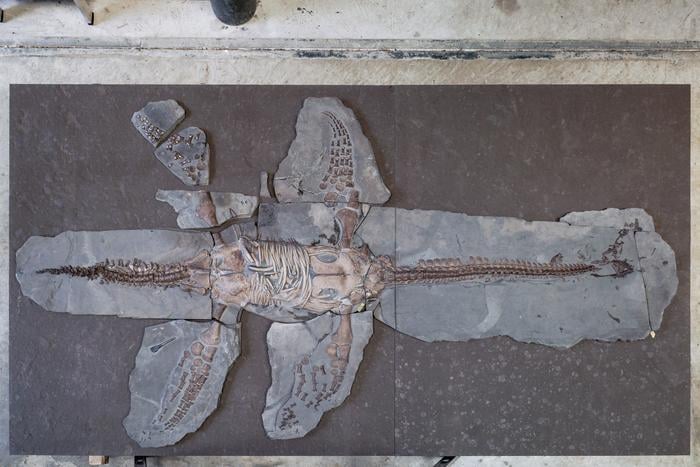
A remarkable discovery of 183-million-year-old skin has revealed that ancient marine reptiles known as plesiosaurs possessed a previously unknown adaptation – a combination of smooth and scaly skin that likely gave them an edge both in swimming and navigating the ocean floor.
The analysis, published in Current Biology, marks the first detailed examination of plesiosaur soft tissue, offering unprecedented insights into how these long-necked marine predators moved through prehistoric seas.
A Rare Glimpse into Prehistoric Skin
“Fossilized soft tissue, such as skin and internal organs, is exceptionally rare,” explains Miguel Marx, a PhD student at Lund University and the study’s lead author. “We used a broad range of techniques to identify smooth skin in the tail region as well as scales along the rear edge of the flippers. This provided us with unparalleled insights into the appearance and biology of these long-extinct reptiles.”
The specimen, discovered near Holzmaden, Germany, has been preserved in remarkable detail, even retaining cellular structures that have survived since the Early Jurassic period. Using advanced microscopic and spectroscopic analyses, researchers identified both smooth tail skin and small, triangular scales on the flippers.
Swimming Strategy Revealed
The discovery suggests these marine reptiles evolved a sophisticated dual-purpose skin covering. The smooth skin would have reduced drag during swimming, while the scaly flippers likely provided better traction when moving across rough seafloors – an important advantage for a predator that hunted fish and squid-like creatures.
This finding helps resolve a longstanding mystery about plesiosaur locomotion and hunting behavior that has puzzled scientists since these creatures were first studied over two centuries ago.
Cellular Time Capsule
“I was shocked when I saw skin cells that had been preserved for 183 million years. It was almost like looking at modern skin,” Marx notes, describing the extraordinary preservation of the specimen’s cellular structure.
The research revealed intact keratinocytes – specialized skin cells – and even preserved cell nuclei, providing an unprecedented window into the microscopic anatomy of these ancient marine reptiles. The skin structure shows similarities to modern marine reptiles like sea turtles, suggesting comparable adaptations for life in the ocean.
Beyond the Bones
This research represents more than just a glimpse at prehistoric skin – it provides crucial insights into how marine reptiles evolved to dominate the oceans for over 140 million years. The study demonstrates that, like modern sea creatures, plesiosaurs developed specialized adaptations to excel in their marine environment.
The research was conducted through an international collaboration including Lund University, Uppsala University, RISE (Research Institutes of Sweden), Naturkunde-Museum Bielefeld, and Urwelt-Museum Hauff, where the specimen is housed.