Skip to content
ScienceBlog.com
  • Featured Blogs
    • EU Horizon Blog
    • ESA Tracker
    • Experimental Frontiers
    • Josh Mitteldorf’s Aging Matters
    • Dr. Lu Zhang’s Gondwanaland
    • NeuroEdge
    • NIAAA
    • SciChi
    • The Poetry of Science
    • Wild Science
  • Topics
    • Brain & Behavior
    • Earth, Energy & Environment
    • Health
    • Life & Non-humans
    • Physics & Mathematics
    • Social Sciences
    • Space
    • Technology
  • Our Substack
  • Follow Us!
    • Bluesky
    • Threads
    • FaceBook
    • Google News
    • Twitter/X
  • Contribute/Contact

Chalmers University of Technology

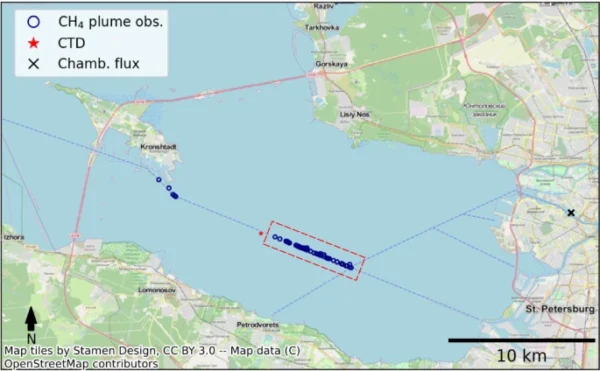
Dashed blue lines show shipping lanes, and dark blue circles mark CH₄ plumes. The sampled area (5.46 km × 0.12 km; 0.66 km²) is outlined by a red dashed box. The CTD profile site is marked by a red star, chamber flux measurements by a black cross, and the flood-protection dam by a solid red line spanning the bay via Kotlin Island.

Ships Trigger Hidden Methane Emissions from Seabed

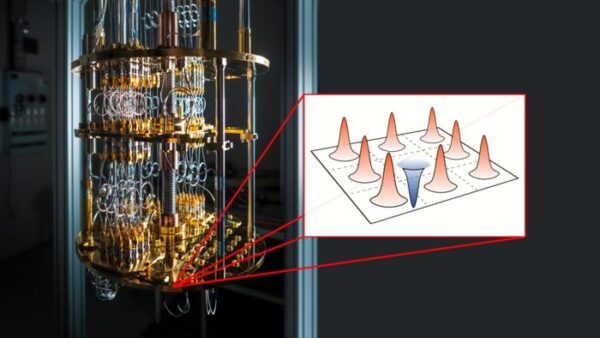
Quantum computers can handle complex problems because they can hold many possible states at once—a phenomenon called quantum superposition. These superpositions are usually hard to describe or simulate. But now, a research team has found a simpler way to simulate some of them. The image shows one such superposition, created inside a type of quantum computer called a continuous-variable quantum computer. The team also tracked how these states interact and change, and successfully simulated those changes using wave-like patterns, as seen in the illustration.

Researchers Crack the Code to Simulating Error-Proof Quantum Machines

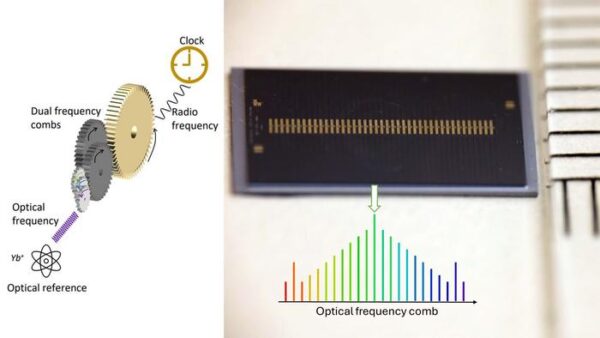
Like the teeth of a comb, a microcomb consists of a spectrum of evenly distributed light frequencies. Optical atomic clocks can be built by locking a microcomb tooth to a ultranarrow-linewidth laser, which in turn locks to an atomic transition with extremely high frequency stability. That way, frequency combs act like a bridge between the atomic transition at an optical frequency and the clock signal at a radio frequency that is electronically detectable for counting the oscillations – enabling extraordinary precision. The researchers’ photonic chip, on the righthand side of the image, contains 40 microcombs generators and is only five millimeters wide.

Tiny Light-Based Chips Could Make Your GPS Accurate to the Centimeter

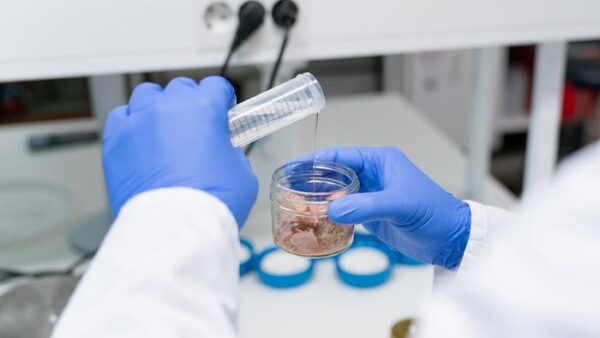
In the image you can see one of the researchers pouring the liquid amino acid cysteine into a jar of canned tuna. The study showed that this novel ‘active packaging’ technique removed up to 35 percent of the accumulated mercury in canned tuna, significantly reducing human exposure to mercury via food.

Simple Packaging Trick Could Make Tuna Safer to Eat, Scientists Find

This artist's concept shows a quantum refrigerator based on superconducting circuits. The device cools qubits to extremely low temperatures using three qubits: a hot qubit (top right), a cold qubit (bottom right), and a target qubit (bottom left). Heat from a nearby hot environment powers the process, allowing the refrigerator to extract thermal energy from the target qubit and release it into a cold environment. This brings the target qubit to a low-error ground state, ideal for quantum computing. The device was developed at the Myfab nanofabrication lab, Chalmers University of Technology, Sweden.

Self-Powered Quantum Refrigerator Sets New Cold Record for Computing

The hidden centre of galaxy NGC 1052 (artist’s impression). In this artist’s impression we are nearing the supermassive black hole at the centre of galaxy NGC 1052. Here, material collects in a spinning disk before falling into the black hole, and magnetic fields build up which may help launch the galaxy’s powerful jets. Credit: Chalmers University of Technology | 3dVision | Johan Bournonville | Anne-Kathrin Baczko

Scientists Close In on How Black Holes Launch Powerful Cosmic Jets

A research group, led by Chalmers University of Technology in Sweden, presents an ordinary silk thread, coated with a conductive plastic material, that shows promising properties for turning textiles into electricity generators. Here, a button is sewn with the new thread.

Scientists Create Electric Thread That Turns Body Heat into Power

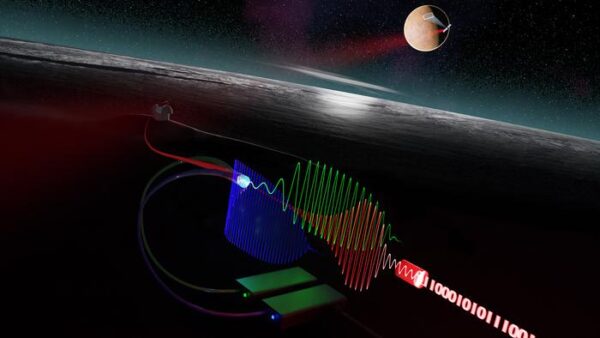
In the new communication system from researchers at Chalmers University of Technology, in Sweden, a weak optical signal (red) from the spacecraft's transmitter can be amplified noise-free when it encounters two so-called pump waves (blue and green) of different frequencies in a receiver on Earth. Thanks to the researchers' noise-free amplifiers in the receiver, the signal is kept undisturbed and the reception on Earth becomes record-sensitive, which in turn paves the way for a more error-free and faster data transmission in space in the future.

Faster space communication with record-sensitive receiver

Image description: 3D visualisation of CCS at Sleipner, where carbon dioxide has been successfully stored deep below the North Sea outside the coast of Norway since 1996

Carbon Capture and Storage Falls Short of Climate Targets, Study Finds

hydrogen powered airliner

Hydrogen-Powered Planes Could Revolutionize Short-Haul Flights by 2045

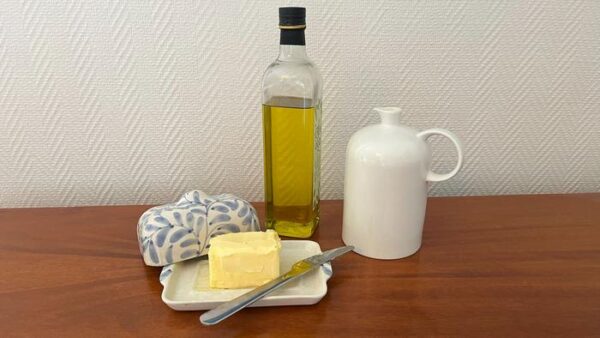
butter and olive oil

Blood fat profiles confirm health benefits of replacing butter with high-quality plant oils

A black hole and spiral wind

Cosmic Growth Spurt: Supermassive Black Hole Mimics Star Formation

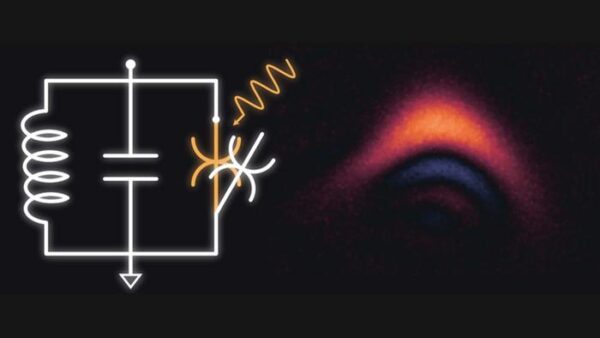
The researchers built a system (circuit diagram on the left) that can be controlled by microwave pulses (wiggly arrow) to turn on or off different operations. This system creates a special quantum state (cubic phase state) useful for fixing errors in quantum computers. The blue areas on the right show a unique property (Wigner negative regions) that proves this state is truly quantum.

Breakthrough may clear major hurdle for quantum computers

Men in yellow vests standing in front of a dirty power plant

Navigating the Coal Phase-Out: The Trillion-Dollar Question of Just Transition

Older posts
Page1 Page2 Page3 Next →
Substack subscription form sign up

Comments

  • Marco Messina on More Than a Third of Americans Have Lost Relationships Over Politics
  • Anon on Why Fructose Behaves Less Like a Calorie and More Like a Hormone
  • Mark Mellinger on Living Plastic Can Self-Destruct on Command
  • Marie Feret on The Silent Frequency That Makes Old Buildings Feel Haunted
  • Dax on The Silent Frequency That Makes Old Buildings Feel Haunted
© 2026 ScienceBlog.com | Follow our RSS / XML feed