Skip to content
ScienceBlog.com
  • Featured Blogs
    • EU Horizon Blog
    • ESA Tracker
    • Experimental Frontiers
    • Josh Mitteldorf’s Aging Matters
    • Dr. Lu Zhang’s Gondwanaland
    • NeuroEdge
    • NIAAA
    • SciChi
    • The Poetry of Science
    • Wild Science
  • Topics
    • Brain & Behavior
    • Earth, Energy & Environment
    • Health
    • Life & Non-humans
    • Physics & Mathematics
    • Social Sciences
    • Space
    • Technology
  • Our Substack
  • Follow Us!
    • Bluesky
    • Threads
    • FaceBook
    • Google News
    • Twitter/X
  • Contribute/Contact

MIT

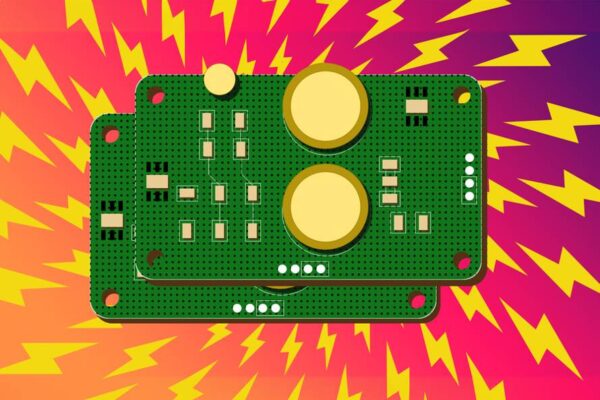
Sensor illustration

Battery-Free Sensors Are Powered by Ambient Energy

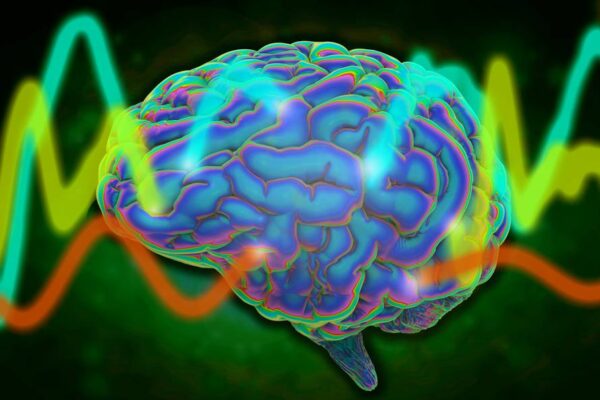
brain illustration

MIT Study Reveals Universal Brain Patterns

Aditya Mehrotra performs a “shakedown” test — running the hydrogen-powered electric motorcycle at high speeds to ensure that the mechanical and electrical systems hold up. Credits:Photo: Adam Glanzman

The future of motorcycles could be hydrogen

To simplify the solving of massive numbers of partial differential equations (PDEs) for computational modeling, new data-driven surrogate models compute the goal property of a solution to PDEs rather than the whole solution. Credits:Image: Joshua Sortino/Unsplash

Technique could efficiently solve partial differential equations for numerous applications

stripy liquid

Stripes in a flowing liquid crystal suggest a route to “chiral” fluids

In the search for extraterrestrial life, MIT scientists say a planet’s carbon-lite atmosphere, relative to its neighbors, could be a sure and detectable signal of habitability. Credits:Image: Christine Daniloff, MIT; iStock

A carbon-lite atmosphere could be a sign of water and life on other terrestrial planets

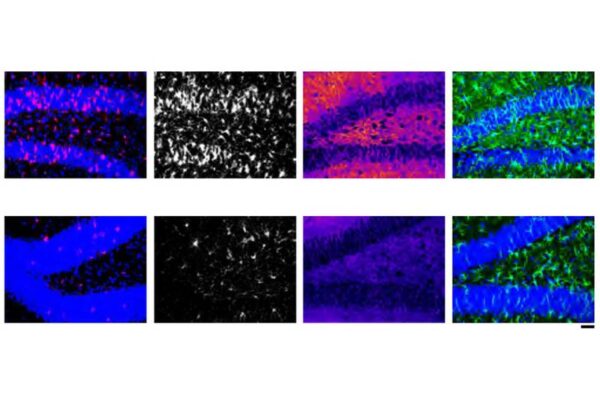
In the brain's immune cells, called microglia, the gene product PU.1 is associated with excessive inflammation in neurological disorders such as Alzheimer's disease. MIT researchers delivered a small interfering RNA (siRNA) via lipid nanoparticles to reduce expression of PU.1 in mice. Microglia stained for PU.1 or related markers are less evident in the bottom row, which reflects the effects of the siRNA, compared to an experimental control (top row).

Nanoparticles Target Brain Cells to Quell Alzheimer’s Inflammation

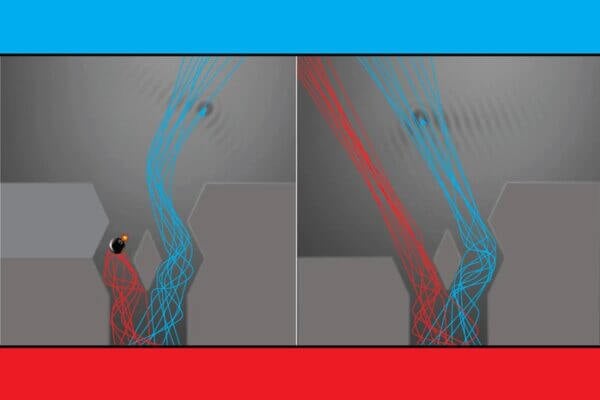
MIT mathematicians tracked a droplet as it bounced through a structure inspired by the theoretical “quantum bomb test.” The shows the droplet’s trajectories when the "bomb" is present, and the right panel shows the trajectories taken when the "bomb" is absent. Credits:Credit: Courtesy of the researchers

Classical Droplets Mimic Quantum Wonders: Bridging Worlds in Bomb-Detecting Behavior

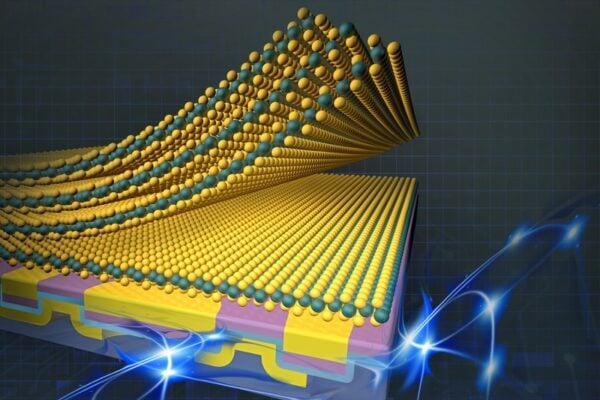
This artist’s rendition shows the newly developed integration platform. By engineering surface forces, researchers are able to directly integrate 2D materials into devices in a single contact-and-release step. Credits:Image: Courtesy of Sampson Wilcox/Research Laboratory of Electronics

Researchers safely integrate fragile 2D materials into devices

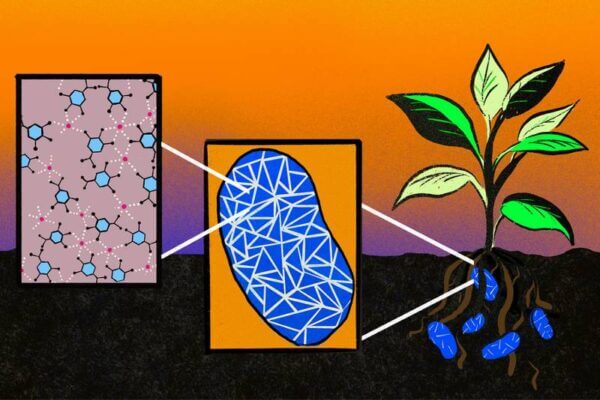
MIT chemical engineers devised a metal-organic coating that protects bacterial cells from damage without impeding their growth or function. These coated bacteria could make it much easier for farmers to deploy microbes as fertilizers. At left, the inset shows the components that create the protective shell of the microbes, as represented in the center inset by triangular formations. Credits:Image: Jose-Luis Olivares, MIT based on figures courtesy of the researchers

Microbes could help reduce the need for chemical fertilizers

A machine-learning technique developed by researchers from MIT and elsewhere enables deep learning models, like those that underlie AI chatbots or smart keyboards, to efficiently and continuously learn from new user data directly on an edge device like a smartphone. Credits:Image: MIT News

Technique enables AI on edge devices to keep learning over time

At the interface of water and air, light can, in certain conditions, bring about evaporation without the need for heat, according to an MIT study. Credits:Image: iStock

In a surprising finding, light can make water evaporate without heat

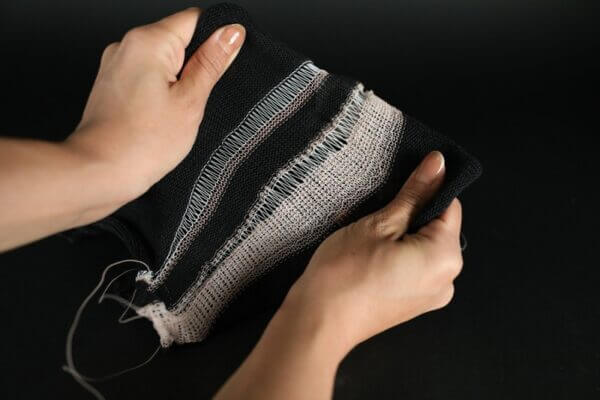
Researchers from MIT and Northeastern University developed a liquid crystal elastomer fiber that can change its shape in response to thermal stimuli. The fiber, which is fully compatible with existing textile manufacturing machinery, could be used to make morphing textiles, like a jacket that becomes more insulating to keep the wearer warm when temperatures drop.

Shape-shifting fiber can produce morphing fabrics

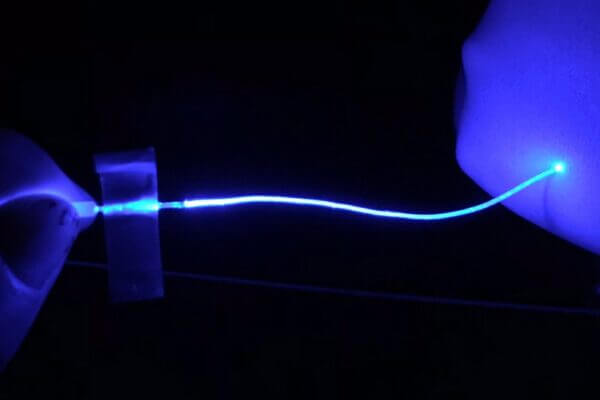
Fiber glowing blue

Soft optical fibers block pain while moving and stretching with the body

Older posts
Newer posts
← Previous Page1 … Page5 Page6 Page7 … Page66 Next →
Substack subscription form sign up

Comments

  • John E on A New Theory Says DMT Entities Might Be Real, and Proposes How to Test It
  • Simon on A New Theory Says DMT Entities Might Be Real, and Proposes How to Test It
  • Sue Ann Hayes on Hidden Nuclear Protein Fuels Pancreatic Cancer’s Deadly Aggression
  • Curtis Webber on The GPS-Killer? This Quantum Device ‘Feels’ Motion Like a Brain—Down to the Atomic Level
  • Ran on How the Age You First Had Sex Could Shape How You Age Decades Later
© 2026 ScienceBlog.com | Follow our RSS / XML feed