
Skip to content
ScienceBlog.com
  • Featured Blogs
    • EU Horizon Blog
    • ESA Tracker
    • Experimental Frontiers
    • Josh Mitteldorf’s Aging Matters
    • Dr. Lu Zhang’s Gondwanaland
    • NeuroEdge
    • NIAAA
    • SciChi
    • The Poetry of Science
    • Wild Science
  • Topics
    • Brain & Behavior
    • Earth, Energy & Environment
    • Health
    • Life & Non-humans
    • Physics & Mathematics
    • Social Sciences
    • Space
    • Technology
  • Our Substack
  • Follow Us!
    • Bluesky
    • Threads
    • FaceBook
    • Google News
    • Twitter/X
  • Contribute/Contact

University of Illinois

Anxiety about artificial intelligence has been driven by its rapid development as well as knowledge worker concerns about potentially being replaced by the transformative technology, says Robert Brunner, the associate dean for innovation and chief disruption officer at the Gies College of Business at the University of Illinois Urbana-Champaign. Photo by Fred Zwicky

What’s the transformative potential of artificial intelligence?

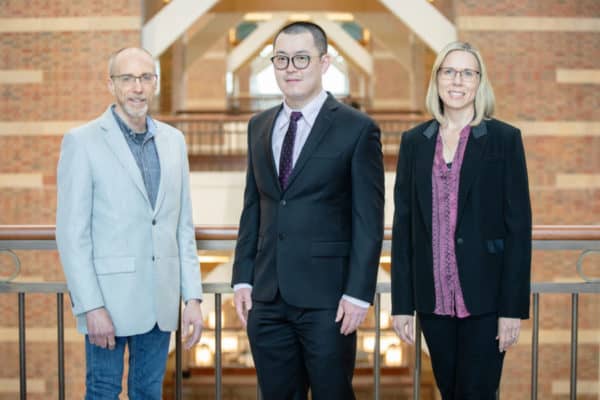
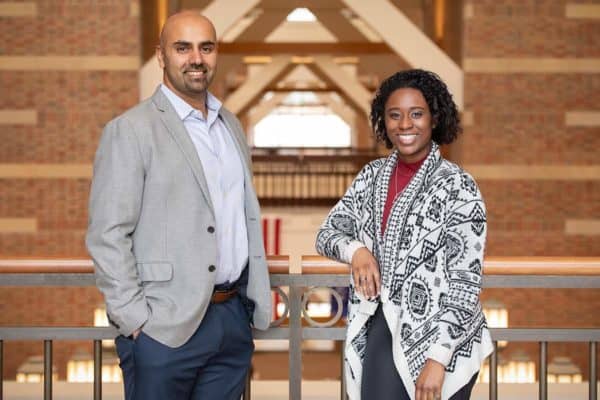
From left: Jemin Jeon, Xiao Su, and Johannes Elbert

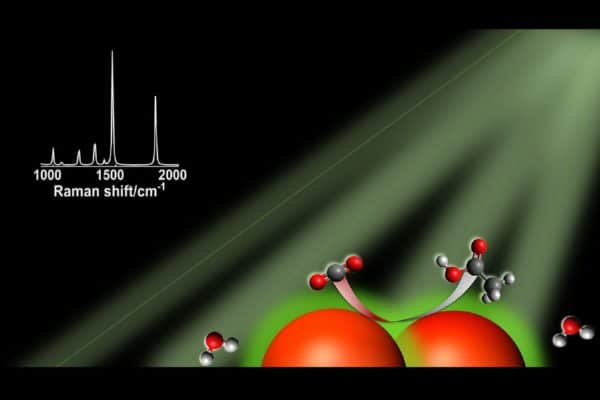
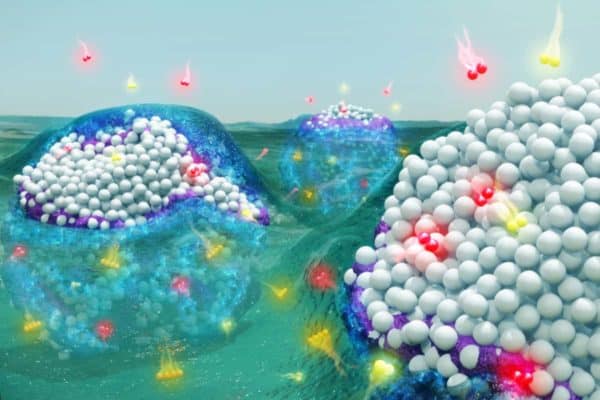
A Better Way to Distinguish Left and Right-Handed Molecules

Smart coatings on orthopedic implants, developed at the University of Illinois Urbana-Champaign, have bacteria-killing nanopillars on one side and strain-mapping flexible electronics on the other. This could help physicians guide patient rehabilitation and repair or replace devices before they fail. Image by Beckman Imaging Technology Group

Smart Coatings Inspired by Bugs Zap Bacteria and Monitor Strain

Illinois history professor Po-Shek Fu wrote about how Hong Kong media was used in a cultural cold war in Asia and the effects it had on the political and cultural environments in Hong Kong. Photo by Fred Zwicky

How Hong Kong media waged Asia’s cultural cold war

This artist's concept shows the brilliant glare of two quasars residing in the cores of two galaxies that are in the chaotic process of merging. The gravitational tug-of-war between the two galaxies ignites a firestorm of star birth.

Hubble unexpectedly finds double quasar in distant universe

The Grainger College of Engineering at the University of Illinois Urbana-Champaign

OpenAI’s ChatGPT costs $100k per day to run; accelerators could help

A niobium superconducting cavity. The holes lead to tunnels which intersect to trap light and atoms.

Experiment translates quantum information between technologies

There’s nothing sacrosanct about the five-day workweek, which is long overdue for an overhaul, says Robert Bruno, a professor of labor and employment relations at Illinois.

Should the workweek be shortened to four days?

Research by Greg Girolami, the William and Janet Lycan Professor of Chemistry, uncovered previously unknown details about the enigmatic English scholar Margaret Bryan, including her family background and the names of her husband and two daughters. Photo by Fred Zwicky

Research uncovers details about the mysterious author of early astronomy textbooks

Top of a very tall building peeking out from clouds in Shanghai

Why are so many tall and supertall buildings being built?

A soybean protein blocks LDL cholesterol production, reducing risks of metabolic diseases

The Jan. 8 insurrection in Brazil’s seat of government was styled after the Jan. 6, 2021, attack on the U.S. Capitol, says Jerry Dávila, the Lemann Chair in Brazilian History at the University of Illinois Urbana-Champaign and executive director of the Illinois Global Institute. Photo by L. Brian Stauffer

What led to the attempted coup in Brazil, what comes next?

The Cline Center for Advanced Social Research’s Coup d’État Project initially categorized the storming of the U.S. Capitol on Jan. 6, 2021, as an “attempted dissident coup.” But that classification has evolved to include the additional classification “attempted auto-coup d’état,” said Scott Althaus, the center’s director and a professor of both political science and communication at Illinois. Photo by L. Brian Stauffer

Why was the Jan. 6 assault on the US Capitol considered an ‘auto-coup d’état’?

A new model will help biologists calculate the energy involved when one organism stabs another with its puncturing tools. Pictured: A viper skull.

Who does it best? Scientists study effectiveness of fangs, claws and other biological weapons

Older posts
Newer posts
← Previous Page1 … Page3 Page4 Page5 … Page14 Next →
Substack subscription form sign up

Comments

  • Simon on A New Theory Says DMT Entities Might Be Real, and Proposes How to Test It
  • Sue Ann Hayes on Hidden Nuclear Protein Fuels Pancreatic Cancer’s Deadly Aggression
  • Curtis Webber on The GPS-Killer? This Quantum Device ‘Feels’ Motion Like a Brain—Down to the Atomic Level
  • Ran on How the Age You First Had Sex Could Shape How You Age Decades Later
  • Sparty on How the Age You First Had Sex Could Shape How You Age Decades Later
© 2026 ScienceBlog.com | Follow our RSS / XML feed