Skip to content
ScienceBlog.com
  • Featured Blogs
    • EU Horizon Blog
    • ESA Tracker
    • Experimental Frontiers
    • Josh Mitteldorf’s Aging Matters
    • Dr. Lu Zhang’s Gondwanaland
    • NeuroEdge
    • NIAAA
    • SciChi
    • The Poetry of Science
    • Wild Science
  • Topics
    • Brain & Behavior
    • Earth, Energy & Environment
    • Health
    • Life & Non-humans
    • Physics & Mathematics
    • Social Sciences
    • Space
    • Technology
  • Our Substack
  • Follow Us!
    • Bluesky
    • Threads
    • FaceBook
    • Google News
    • Twitter/X
  • Contribute/Contact

University of Michigan

World-class faculty. Groundbreaking research. An exceptional health system. Beautiful surroundings. A robust cultural life.Welcome to the University of Michigan, a place with a storied past and a boundless future. We invite you to explore the diverse and vibrant community that makes The Michigan DifferenceTM come to life.
15% of Americans deny climate change is real, AI study finds

Nearly 15% of Americans deny climate change is real, AI study finds

Rooftop garden growing produce

Urban agriculture has carbon footprint 6 times larger than conventional produce

brain illustration

Bariatric surgery may slow cognitive decline for people with obesity

DNA illustration

Link Between Risk-Taking and Genetic Basis of Male Bisexual Behavior

Infographic

Parents’ top resolutions: More patience, less time on phones

Depression illustration

Genetic “protection” against depression was no match for pandemic stress

abstract illustration of aging man and dna

Genetic mutations that promote reproduction tend to shorten human lifespan

Of these two images labeled “get water”, the image on from the poorer household on the left (monthly income $39) received a lower CLIP score (0.21) compared to the image form the wealthier household on the right (monthly income $751; CLIP score 0.25). Image credit: Dollar Street, The Gapminder Foundation

Biases in large image-text AI model favor wealthier, Western perspectives

Illustration of a star and space rocks

Extreme conditions in stars produce the universe’s heaviest elements

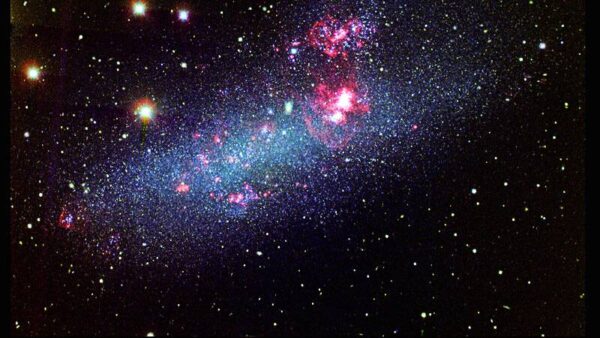
University of Michigan astronomer Sally Oey studied a star-forming region in host galaxy, NGC 2366, which is a typical dwarf irregular galaxy. Image courtesy: Observatorio de Calar Alto, J. van Eymeren (AIRUB, ATNF) & Á.R. López-Sánchez

Dwarf galaxies use 10-million-year quiet period to churn out stars

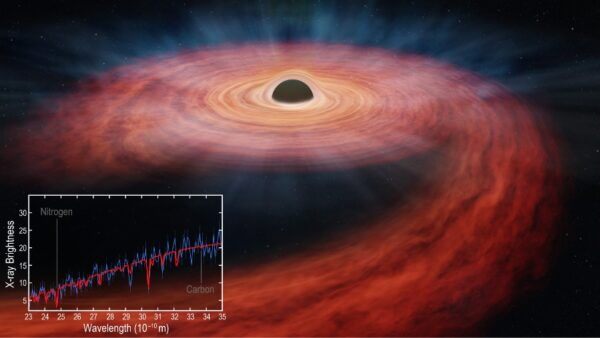
This artist’s illustration depicts the “tidal disruption event” (TDE) called ASASSN-14li, which is the focus of the latest study. As a star approached too closely to the supermassive black hole at the system, the strong gravity tore the star apart. This artist’s impression depicts the aftermath of this destruction. After the star was ripped apart, some of its gas (red) was left orbiting around and falling into the black hole. A portion of the gas was driven away in a wind (blue). Image credit: NASA/CXC/University of Michigan/J. Miller et al; Illustration: NASA/CXC/M.Weiss

A giant black hole destroys a massive star

Physician reads a color monitor brain scan. From University of Michigan

Diabetes linked to functional and structural brain changes through MRI

An experimental prototype of the Battery Sleuth authenticator device installed in a vehicle. Image credit: Kang Shin

A surprisingly simple way to foil car thieves

Illustration of tinnitus in human ear. credit pixabay

Study shows promising treatment for tinnitus

Older posts
Newer posts
← Previous Page1 … Page3 Page4 Page5 … Page16 Next →
Substack subscription form sign up

Comments

  • Mark Mellinger on Living Plastic Can Self-Destruct on Command
  • Marie Feret on The Silent Frequency That Makes Old Buildings Feel Haunted
  • Dax on The Silent Frequency That Makes Old Buildings Feel Haunted
  • Karoly Mirnics on Common Prescription Drugs May Disrupt Cholesterol Pathways in the Womb and Raise Autism Risk
  • Aizen on Laziness helped lead to extinction of Homo erectus
© 2026 ScienceBlog.com | Follow our RSS / XML feed