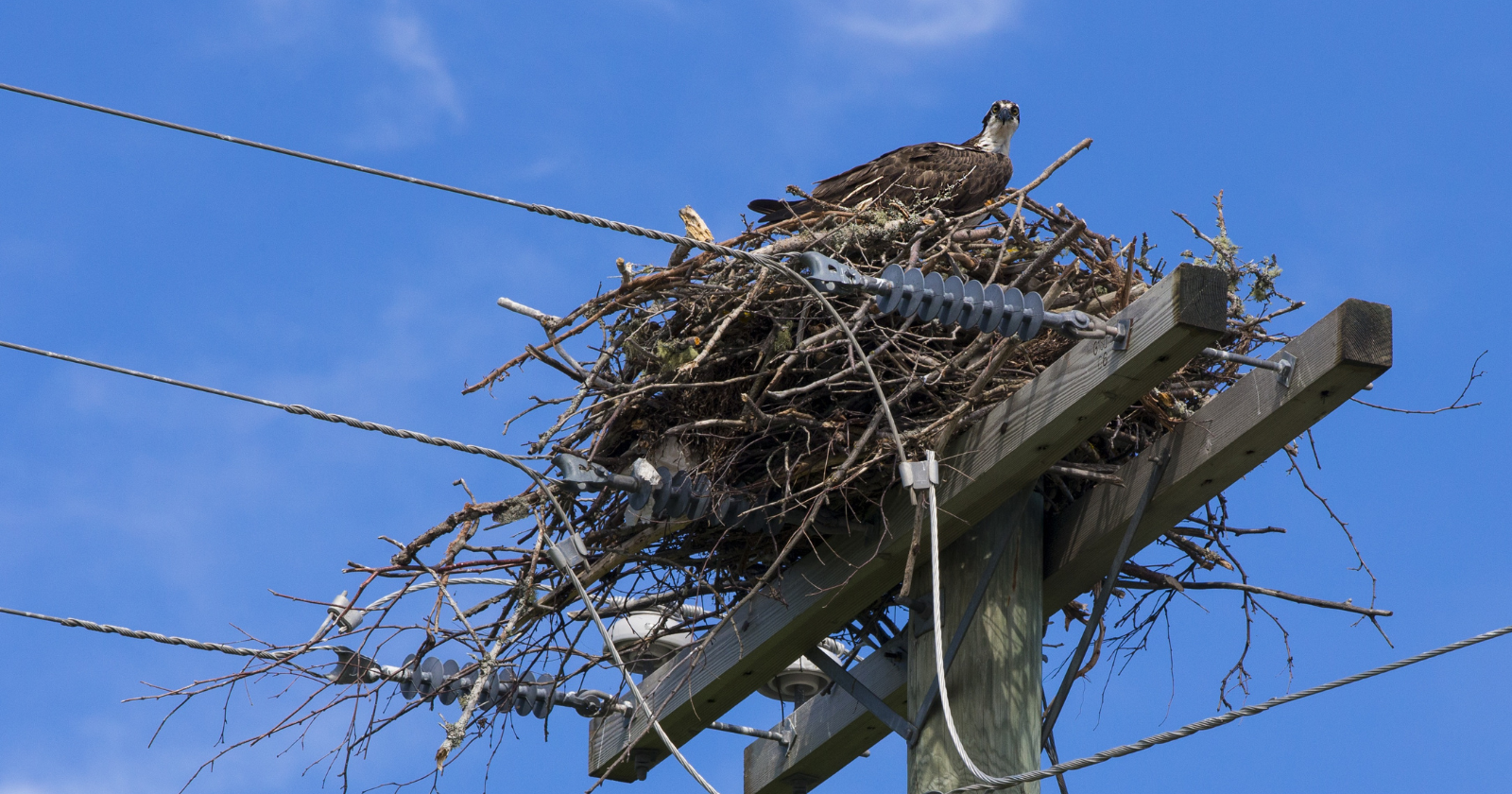
The osprey is one of American conservation’s proudest comebacks, a fish-hunting raptor with a six-foot wingspan that DDT nearly wiped off the Atlantic coast and that now nests from Florida to Maine in numbers not seen in a century. The recovery worked so well that a new problem has caught fire, in the most literal sense available.
Ospreys build enormous nests, and increasingly they build them on top of utility poles.
A bird that thinks like a lineman
The attraction is easy to understand from the bird’s side. An osprey wants the tallest structure near the water, with clear sightlines and no leafy canopy in the way. Before Europeans arrived that meant dead trees. Today, along developed coastlines where the big snags have been cleared, the tallest bare structure near the water is almost always a power pole, complete with convenient crossarms that cradle a nest like an open hand.
And an osprey nest is not a bundle of twigs. Pairs return to the same nest year after year, adding sticks each season, weaving in driftwood, seaweed, rope and whatever else the shoreline offers. Mature nests can reach the size of a kiddie pool and weigh a couple of hundred pounds, with the biggest historical nests in trees reputed to go far heavier. All of it is dry, resinous, salt-crusted tinder, resting inches above energized equipment.
How a nest becomes a torch
The failure mode is mundane. A stick slips loose and bridges two conductors, or dangles from the nest into a line. Electricity arcs across it, the stick smolders, and the fire climbs into a hundred-pound pile of kindling. Sometimes the birds themselves complete the circuit, with fatal results, and the streaming droppings and wet seaweed they haul in conduct nicely too.
The consequences ripple well past the pole. An Audubon magazine investigation this June catalogued a single season’s worth: a North Carolina DMV office going dark when a pole caught fire after lunch, and on Cape Cod in May, sixth-graders sitting a standardized exam in the dark after their school’s power was cut over a nest blaze half a mile away. Two weeks later in a nearby Cape town, a roadside line burst into flame and knocked out power to more than 3,500 homes and businesses. Cape Cod has become the unofficial capital of the problem: an osprey nest fire in Wellfleet once blacked out 10,000 customers from there to Provincetown, a Mashpee nest fire cut 3,600, and this spring a suspected nest outage hit during a high school prom, which survived on a backup generator.
The birds lose too. Chicks too young to fly have burned on Long Island poles, and eggs have been tipped from smoldering nests.
The utility’s dilemma
For the power companies, the osprey is a uniquely awkward adversary, because it is beloved, federally protected, and stubborn beyond reason. Under the Migratory Bird Treaty Act, an active nest with eggs or chicks generally cannot be touched, so a nest discovered in June typically stays until fall, monitored, while everyone hopes the sticks stay out of the wires. As one Duke Energy scientist summed up the bind for Audubon: “We don’t like dead Osprey; we don’t like flaming poles.”
The standard playbook is relocation and bribery. Eversource, which runs the Cape’s grid and now operates a dedicated osprey management program, removes inactive nests, caps the crossarms with cones and spikes, and erects free-standing platforms nearby, taller and sturdier than the pole, hoping the pair will take the upgrade. Often they do; ospreys took to artificial platforms so readily during their recovery that much of the population has never known anything else, which conservationists point out is partly how the birds got trained onto poles in the first place. But often they don’t. Birds evicted from a pole routinely rebuild on the next pole down the line, and nests balanced awkwardly on top of deterrent spikes shed more loose sticks onto the wires than the original nest did, a complaint Mass Audubon has leveled at the utility’s whole approach.
Living with a successful bird
The numbers guarantee this problem grows. Ospreys are increasing across most of the United States, coastal development keeps replacing dead trees with infrastructure, and every chick fledged from a pole-top nest learns that poles are where ospreys live. Utilities from Maryland to the Pacific Northwest now budget for nest cameras, insulation sleeves, platform programs and seasonal patrols the way they budget for storm damage.
It is worth pausing on what kind of problem this is. Fifty years ago the question was whether ospreys would exist on the Atlantic coast at all. The species answered emphatically, and the cost of that answer is now measured in scorched crossarms and the occasional dark classroom of twelve-year-olds. As comeback stories go, a bird so numerous it competes with the electrical grid for real estate is the kind of problem conservation dreams of having, even if nobody standing under a flaming pole feels lucky at the time.