

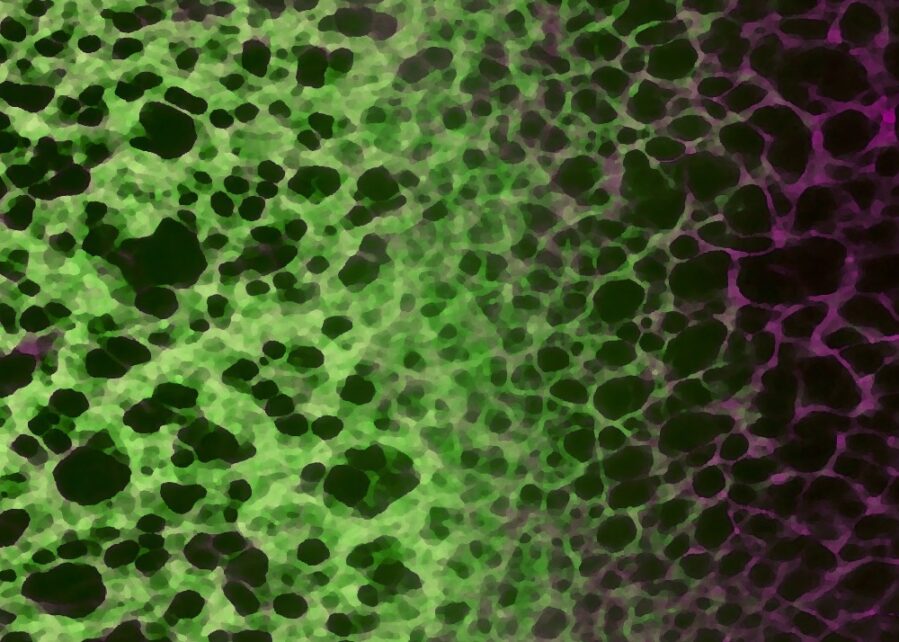
IN YOUR body right now, millions of tiny factories are quietly dismantling themselves. Not catastrophically; more like a controlled renovation. The endoplasmic reticulum, that vast network of membrane tubes and sheets threaded through nearly every cell you possess, is rearranging its architecture as you age. And it’s doing so in a way that might trigger much of what we call “getting old”.
The discovery came from watching worms grow old. Which sounds rather unglamorous until you consider that Caenorhabditis elegans—those transparent nematodes beloved by aging researchers—possess something humans desperately want to study but can’t easily observe: cells you can watch in real time as they age.
Kris Burkewitz at Vanderbilt University in Tennessee and his colleagues developed genetic tools to tag different bits of the ER with fluorescent markers. Rough ER, studded with ribosomes churning out proteins, glowed one colour. Smooth ER, more involved in making fats and lipids, glowed another. Then they simply watched what happened over the worms’ brief three-week lifespan.
The results were striking. Within days of reaching adulthood, cells began dramatically reducing their rough ER, those protein-making factories. By day seven, the network had largely collapsed into sparse, interconnected tubes. The transformation wasn’t subtle. Roughly 70% of the protein-making machinery vanished.
“Where many prior studies have documented how the levels of different cellular machineries change with age, we are focusing instead on how aging affects the way that cells house and organize these machineries within their complex inner architectures,” says Burkewitz.
Think of it like this. A factory needs specialized equipment, but that equipment only functions efficiently when arranged in the right sequence, in the right positions. When production demands shift, the factory reorganizes. Makes sense. What’s less obvious is why aging cells would deliberately dismantle their protein-making capacity.
The team found roughly the same pattern across tissues. Hypodermis, intestine, muscle, neurons. Even in mice and yeast. Ancient databases of aging proteomes confirmed it: the suite of proteins involved in ER protein processing steadily declined across species, across tissues, across evolutionary distance. This wasn’t some quirk of worms. It’s conserved biology.
But here’s the twist. The process isn’t passive decay, it’s active demolition. The ER doesn’t just fall apart; cells dismantle it through ER-phagy, a specialised form of autophagy that selectively targets ER subdomains for breakdown. When Burkewitz’s team blocked autophagy genes, aging cells retained their youthful ER networks. Block the demolition crew, keep the factory.
That raises an obvious question. If we can keep the ER intact by blocking autophagy, why don’t long-lived animals do that? Turns out they do the opposite. Animals with extended lifespans, whether through reduced insulin signaling, mTOR suppression, or germline removal, all showed the same pattern: they remodeled their ER earlier and more aggressively than normal animals.
And here’s where it gets properly interesting. When the researchers blocked ER-phagy in long-lived worms, the longevity benefit vanished. ER remodeling isn’t just correlated with healthy aging—it’s required for it.
Eric Donahue, who recently finished his PhD working on the project, put it plainly. “We didn’t just add a piece to the puzzle—we found a whole section that hasn’t even been touched.”
The shift makes sense when you consider what’s happening metabolically. Protein production declines with age. That’s well established. What nobody quite appreciated was that cells might be proactively remodeling their architecture to match that decline, essentially rightsizing their industrial capacity.
The research also revealed tissue-specific pathways controlling ER turnover. In the hypodermis, a protein called TMEM-131—involved in collagen secretion—proved essential for ER-phagy. Block it, and the ER stayed intact. In the intestine, the ire-1–xbp-1 branch of the unfolded protein response did the job. Different tissues, different mechanisms, same outcome.
What’s particularly intriguing is the timing. “Changes in the ER occur relatively early in the aging process,” says Burkewitz. “One of the most exciting implications of this is that it may be one of the triggers for what comes later: dysfunction and disease.”
That’s a rather different way of thinking about aging. Instead of viewing ER decline as damage accumulating, perhaps it’s an adaptive response that becomes maladaptive later. Cells preemptively scale down protein production, which helps in the short term but creates problems down the road as the ER coordinates so many other cellular functions.
The ER isn’t just a protein factory, after all. It’s the cell’s calcium store, its lipid synthesis hub, its quality control centre. It forms contact sites with virtually every other organelle. Remodel the ER early, and you’re potentially setting up dominoes that fall throughout the cell.
Whether that makes ER-phagy a target for intervention remains to be seen. The fact that blocking it shortens lifespan suggests caution. But understanding when and how cells reorganize their internal architecture could reveal why some people age more successfully than others—and perhaps, eventually, what might be done about it.
For now, the message is clear: aging isn’t just about things breaking down. Sometimes it’s about deliberately taking them apart. The question is whether we’re dismantling wisely or simply making the best of a bad situation.
Stud link: https://www.nature.com/articles/s41556-025-01860-1