Scientists Spot Planet in the Making Sculpting Its Star’s Disc

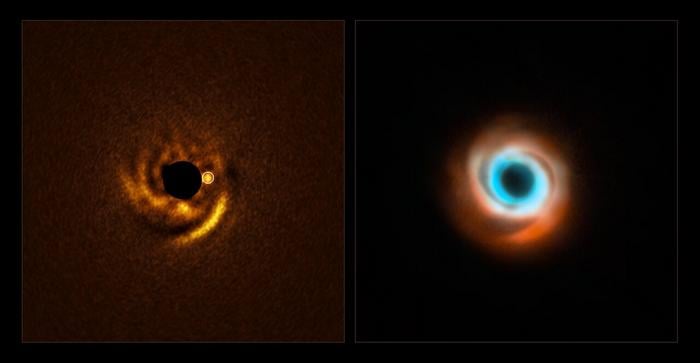
For the first time, astronomers may have caught a planet forming in real time, watching as it sculpts the swirling gas and dust around its young host star. Using the European Southern Observatory’s (ESO) Very Large Telescope, researchers observed a bright signal nestled within a spiral arm of the star HD 135344B’s protoplanetary disc—right where theory predicted a newborn planet might emerge.

Planet caught shaping spiral arms 440 light-years away

Located about 440 light-years from Earth, HD 135344B is a young star encircled by a thick disc of gas and dust. These discs often display intricate patterns—rings, gaps, or spirals—that scientists suspect are carved by developing planets. But until now, no one had directly seen a protoplanet embedded in one of those spirals. The new observations, taken with the telescope’s Enhanced Resolution Imager and Spectrograph (ERIS), change that.

“We will never witness the formation of Earth,” said Francesco Maio, lead author of the study, “but here… we may be watching a planet come into existence in real time.” The candidate planet is estimated to be about twice the mass of Jupiter and orbits its star at roughly the same distance as Neptune does from the Sun.

How the planet was found

Earlier instruments, like VLT’s SPHERE and ALMA, revealed HD 135344B’s dramatic spiral arms—but no planet. ERIS, however, offers sharper imaging and was able to capture light emitted directly from the embedded object, boosting scientists’ confidence in the detection.

  • The candidate planet is embedded in a spiral arm of the disc
  • It is roughly two times Jupiter’s mass
  • The planet appears at a distance comparable to Neptune’s orbit
  • Its location aligns precisely with theoretical predictions

“This gives us a much higher level of confidence in the planet’s existence, as we’re observing the planet’s own light,” Maio said. He is a doctoral researcher at the Arcetri Astrophysical Observatory in Florence, part of Italy’s National Institute for Astrophysics.

Another discovery hints at planetary birth by instability

In a second study, a team led by ESO researcher Anuroop Dasgupta observed another young star, V960 Mon, using ERIS. They identified a compact object near one of that star’s spiral arms. This object may be a planet or a brown dwarf—a failed star—forming through gravitational instability, a process where massive clumps of material collapse under their own gravity.

“With ERIS, we set out to find any compact, luminous fragments… and we did,” Dasgupta said. If confirmed, this would be the first clear detection of a planet or substellar object forming via this collapse-driven method.

Unlocking the secrets of planetary formation

Both discoveries were made possible by ERIS’s high sensitivity and resolution, which allow astronomers to peer through dusty discs and directly image faint objects. Together, they offer rare glimpses into the earliest stages of planetary life.

Primary study: Maio et al., “Unveiling a protoplanet candidate embedded in the HD 135344B disk with VLT/ERIS,” Astronomy & Astrophysics (DOI: 10.1051/0004-6361/202554472)
Secondary study: Dasgupta et al., Astrophysical Journal Letters (DOI: 10.3847/2041-8213/ade996)


Discover more from European Space Agency Tracker

Subscribe to get the latest posts sent to your email.

Leave a Comment