

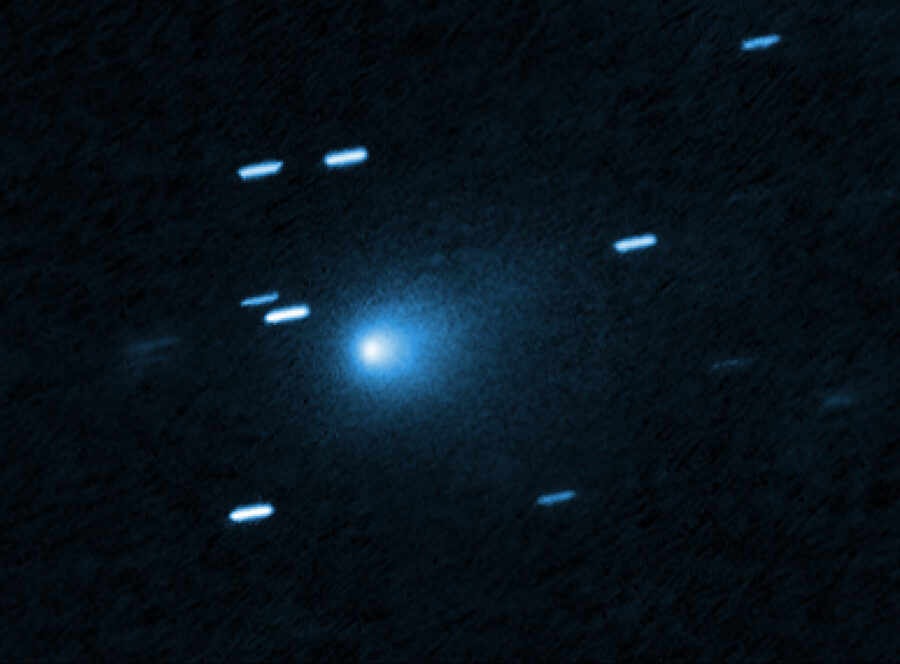
The Hubble Space Telescope has captured the clearest images yet of a rare interstellar visitor speeding through our solar system at an unprecedented 210,000 kilometers per hour, making it the fastest object ever recorded in our cosmic neighborhood.
The comet, designated 3I/ATLAS, represents only the third known interstellar interloper detected in our solar system, following the mysterious cigar-shaped 1I/’Oumuamua in 2017 and the more comet-like 2I/Borisov in 2019. New research published in The Astrophysical Journal Letters reveals this latest visitor is actively shedding dust as it approaches the Sun, offering scientists an unprecedented opportunity to study a comet from another star system.
A Cosmic Speed Record
What sets 3I/ATLAS apart is its extraordinary velocity. “The orbit is the most dynamically extreme of any object yet recorded in the solar system, with a velocity at infinity of approximately 60 km s-1,” researchers noted. This breathtaking speed provides evidence that the comet has been drifting through interstellar space for billions of years, with gravitational encounters with countless stars and nebulae accelerating it to these record-breaking speeds.
The comet’s hyperbolic orbit has an eccentricity of 6.143 and an inclination of 175.1 degrees, making it fundamentally different from objects native to our solar system. It will reach its closest approach to the Sun on October 29, 2025, at a distance of 1.357 astronomical units.
Hubble Reveals Active Dust Production
Using Hubble’s exceptional resolution capabilities, astronomers led by David Jewitt from UCLA captured detailed images showing 3I/ATLAS is far from a dormant chunk of ice and rock. The observations reveal active dust emission from the Sun-facing side of the nucleus, creating a distinctive fan-shaped plume pointing toward our star.
“The dust is preferentially extended in a broad plume or fan along position angle 280±10°, about 180° from the projected negative heliocentric velocity and anti-solar directions,” the researchers observed. This pattern indicates that sublimation is occurring primarily on the hot daytime side of the comet, similar to behavior seen in solar system comets.
The team also detected a much fainter tail streaming away from the Sun, formed by radiation pressure pushing smaller dust particles in the opposite direction.
Sizing Up the Invisible Nucleus
Despite Hubble’s remarkable capabilities, the comet’s solid nucleus remains hidden within its dust shroud. However, the observations allowed scientists to place meaningful constraints on its size. The analysis reveals that the nucleus cannot be larger than 2.8 kilometers in radius, corresponding to an absolute magnitude greater than 15.4.
“Unfortunately, no convincing nucleus signal could be extracted from the HST data by this procedure, indicating the dominance of coma dust over nucleus scattering,” the researchers noted. This finding fundamentally changes earlier estimates that suggested the nucleus might be as large as 10 kilometers across.
The lower size limit depends on what type of ice drives the comet’s activity. If carbon monoxide ice powers the dust production, the nucleus must be at least 0.16 kilometers in radius. For the less volatile carbon dioxide, it would need to be 0.23 kilometers across, while water ice would require a minimum radius of 0.80 kilometers.
Massive Dust Loss Rates
The Hubble observations enabled researchers to calculate that 3I/ATLAS is losing dust at rates between 6 and 60 kilograms per second, depending on the average size of the particles being ejected. This represents a colossal outpouring of material as the comet experiences its first significant heating in billions of years.
The team estimated dust ejection speeds of 22 meters per second toward the Sun for one-micron particles, dropping to about 2 meters per second for larger 100-micron particles. These relatively low speeds compared to the thermal velocities of sublimating gas suggest either large particle sizes, weak gas flow, or limited active surface area on the nucleus.
Billions of Years in Deep Space
The extreme entry velocity of 3I/ATLAS suggests it has been wandering through interstellar space for several to ten billion years, accumulating speed through gravitational encounters with stars and other massive objects throughout the galaxy. This extended exposure to galactic cosmic rays likely damaged the molecular structure of its outer layers, potentially creating a protective crust that inhibits sublimation.
The preferential mass loss from the Sun-facing side suggests this protective layer, if it exists, must be thinner than the daily thermal penetration depth of about one centimeter. Alternatively, the comet’s spin axis might be oriented so that one hemisphere receives continuous sunlight, allowing heat to penetrate deeper into any radiation-damaged surface layers.
Comparing Interstellar Visitors
When compared to its two predecessor interstellar visitors, 3I/ATLAS shows dramatically different characteristics. The scaled mass loss rate is 100,000 to one million times greater than 1I/’Oumuamua, which showed no obvious signs of activity. Meanwhile, 3I/ATLAS appears comparable to or more active than 2I/Borisov, which was clearly comet-like in behavior.
This diversity among interstellar objects reflects the varied conditions in planetary systems throughout our galaxy, where these visitors likely formed billions of years ago before being ejected into interstellar space through gravitational interactions.
Ground-Based vs. Space-Based Views
The Hubble observations resolve a significant discrepancy between ground-based and space-based measurements. While Earth-based telescopes suggested the object had an absolute magnitude of around 12.3 to 12.4, Hubble’s more precise measurements show the nucleus itself has an absolute magnitude greater than 15.4, proving that ground-based observations were seeing primarily dust rather than the solid nucleus.
This finding has important implications for estimating the population of interstellar objects. “The non-detection of the nucleus means that we cannot easily use the discovery of 3I to assess the number density of interstellar objects or their size distribution,” the researchers cautioned.
Future Observational Opportunities
3I/ATLAS was discovered on July 1, 2025, by the Asteroid Terrestrial-impact Last Alert System (ATLAS) when it was about 675 million kilometers from the Sun. The comet should remain visible to ground-based telescopes through September, after which it will pass too close to the Sun for safe observation. It’s expected to reappear on the far side of the Sun by early December.
The discovery four months before perihelion provides an unprecedented opportunity to study how an interstellar comet responds to its first significant heating event in billions of years. Future observations, potentially including those from the James Webb Space Telescope, could reveal the chemical composition of this alien visitor.
Implications for Planetary Defense and Future Missions
ESA’s Planetary Defence Office has been tracking 3I/ATLAS since its discovery, demonstrating the importance of monitoring systems for detecting unusual objects entering our solar system. The observations also inform planning for future missions like ESA’s Comet Interceptor, scheduled to launch in 2029, which will wait in space for a suitable target, possibly including an interstellar visitor.
While 3I/ATLAS moves too fast and follows too extreme a trajectory for current spacecraft to intercept, it serves as a pathfinder for understanding how future missions might study these mysterious cosmic wanderers.
A Window Into Galactic Diversity
The active nature of 3I/ATLAS provides scientists with their best opportunity yet to analyze material from another stellar system. Unlike the enigmatic 1I/’Oumuamua, which revealed few secrets before disappearing, this comet’s dust production offers a direct sample of ice and rock that formed around a distant star billions of years ago.
As 3I/ATLAS continues its dramatic plunge toward the Sun, astronomers worldwide will be watching to see how this interstellar visitor responds to increasing solar heating, potentially revealing secrets about planetary formation processes in other star systems and the conditions that prevail in the vast spaces between the stars.