

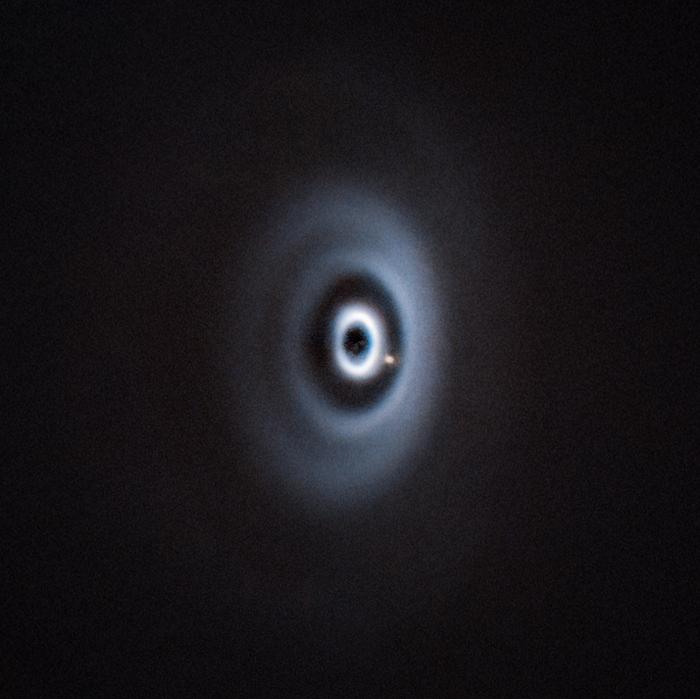
High in the Chilean desert, one of Earth’s most powerful telescopes has captured the birth of a world. Astronomers using the European Southern Observatory’s Very Large Telescope have directly imaged WISPIT 2b, a young gas giant still glowing from its formation, nestled in the wide gap of a multi-ringed disk around the star WISPIT 2.
Only about five million years old, the planet is likely several times more massive than Jupiter and represents a rare, unambiguous glimpse of a planet caught in the act of forming. For planetary scientists, it is a breakthrough moment: the first time a confirmed planet has been detected in such a ringed disk, a natural laboratory for testing long-debated theories of how giant planets take shape.
From Rings to Revelation
The star WISPIT 2, a Sun-like object about 430 light-years away, was a routine target in a survey designed to find wide-orbit planets. The initial “snapshot” observations, just minutes long, revealed something unexpected. Around the star stretched a striking set of concentric dust rings, spanning 380 astronomical units, far larger than our own solar system.
“When we saw this multi-ringed disk for the first time, we knew we had to try and see if we could detect a planet within it, so we quickly asked for follow-up observations,” said Dr Christian Ginski, astronomer at the University of Galway (University of Galway).
Those follow-ups, taken across several years, confirmed a point of light within the largest gap. The dot was not a background star. It moved with WISPIT 2, consistent with a planet orbiting its host.
A Young Planet in Orbit
WISPIT 2b’s position, about 57 astronomical units from its star, places it deep inside a 59 au-wide gap between bright rings of dust. That gap, and the planet’s estimated mass of 4–10 times Jupiter’s, align closely with hydrodynamic models of how young planets carve paths through disks.
Photometric analysis shows the planet radiating strongly in the near-infrared, evidence of its youth and heat. In addition, a companion study from the University of Arizona detected the planet in visible light at hydrogen-alpha wavelengths, a signal that it is still accreting gas as it builds its atmosphere.
“Discovering this planet was an amazing experience—we were incredibly lucky,” said Richelle van Capelleveen of Leiden University, the study’s lead author (Leiden University).
A Laboratory for Planet Formation
Planet-forming disks have long teased astronomers with rings and spirals thought to be sculpted by hidden worlds. Yet actually confirming an embedded planet has been nearly impossible. Only one other star, PDS 70, has offered such clarity. WISPIT 2b now joins that elite company, but with a far more elaborate disk. Its sharply defined rings and unusually wide gap offer a chance to measure disk viscosity — a fundamental but poorly constrained parameter that shapes how planets grow and migrate.
The system also challenges theories of giant planet origins. Some argue such wide-orbit giants form through rapid collapse of unstable disks. Others point to slow core accretion. The evidence from WISPIT 2b — a planet carved into its birth ring, glowing with residual heat — suggests that core accretion at large separations may indeed be possible.
Human Hands Behind the Data
This landmark discovery was led not by senior professors but by early-career researchers. PhD student Richelle van Capelleveen directed the study, working with colleagues from Leiden, Galway, and Arizona. Graduate students Chloe Lawlor, Jake Byrne, and Dan McLachlan, all at Galway, contributed to the observations and analysis.
“I feel incredibly fortunate to be involved in such an exciting and potentially career defining discovery,” said Lawlor. “WISPIT 2b, with its position within its birth disk, is a beautiful example of a planet that can be used to explore current planet formation models.”
Key Findings
- Star: WISPIT 2 (TYC 5709-354-1), a Sun-like star ~5 million years old, 133 pc (430 light-years) away.
- Disk: 380 au radius, four concentric rings with wide gaps, imaged in scattered light.
- Planet: WISPIT 2b, orbiting ~57 au from star, inside a 59 au-wide disk gap.
- Mass: Estimated 4–10 Jupiter masses, based on infrared photometry and gap modeling.
- Methods: Direct imaging in infrared (ESO VLT/SPHERE) and visible (University of Arizona Hα observations).
- Significance: First confirmed planet in a multi-ringed disk, a critical testbed for planet–disk interaction and theories of giant planet formation.
Takeaway
Astronomers have directly imaged a young gas giant, WISPIT 2b, orbiting inside a wide gap of a multi-ringed disk around a Sun-like star. The discovery, led by early-career researchers, confirms that giant planets can form in situ at wide separations and provides a new benchmark system for understanding how planets and their birth disks evolve together.
Journal: The Astrophysical Journal Letters
DOI: 10.3847/2041-8213/adf721