

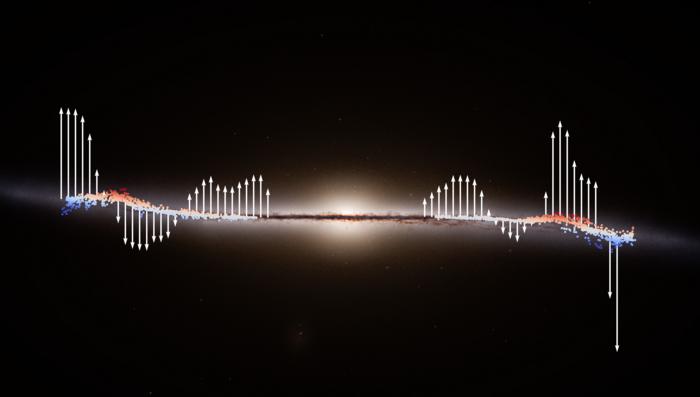
The Milky Way has been caught in the act of making waves. Using data from the European Space Agency’s Gaia telescope, astronomers have discovered a massive ripple surging outward through our galaxy’s disc, stretching across tens of thousands of light-years and affecting the motion of countless stars.
The finding adds another layer of complexity to our understanding of the galaxy we call home. Scientists have known for decades that the Milky Way rotates, and more recently that its disc warps like the brim of a weathered hat. But this newly detected wave represents something different: a large-scale disturbance propagating through the stellar disc like ripples spreading across a pond after a stone is thrown in.
What makes this even more compelling is our ability, thanks to Gaia, to also measure the motions of stars within the galactic disc.
That is according to Eloisa Poggio, an astronomer at Italy’s Istituto Nazionale di Astrofisica who led the research team. Her group analyzed the positions and movements of roughly 17,000 young giant stars and 3,400 Cepheid variable stars, stellar types bright enough to be tracked across vast distances.
A Galactic Stadium Wave
The wave itself rises about 150 to 200 parsecs (roughly 500 to 650 light-years) above and below the galaxy’s warped disc. It extends across at least 10,000 light-years of the outer Milky Way, appearing between 10,000 and 14,000 light-years from the galactic center. For perspective, the entire galaxy spans approximately 100,000 light-years.
What caught the researchers’ attention was not just the wave’s spatial pattern but its motion signature. Stars in the elevated portions of the wave are moving vertically in a pattern slightly offset from their positions, creating what physicists recognize as the hallmark of propagating waves. Think of spectators performing “the wave” in a stadium, frozen in time. Some people stand upright at the wave’s crest, others have just sat down, and still others are beginning to rise as the wave approaches them.
The vertical motion pattern appearing ahead of the spatial crest suggests the wave is traveling outward, away from the galactic center. Stars caught in this cosmic ripple are also moving radially outward at speeds of 10 to 15 kilometers per second.
Distinguishing Features
This newly mapped wave differs from other known structures in the Milky Way. It is much larger than the Radcliffe Wave, a 2.7-kiloparsec filament of dense gas clouds discovered in 2020 that lies relatively close to our solar system. The orientation also does not match the galaxy’s spiral arms, which trail behind the direction of rotation. Instead, this wave cuts across the disc with an almost radial geometry.
The cause remains unclear. One possibility involves a past collision with a dwarf galaxy, perhaps the Sagittarius dwarf galaxy that has been making repeated passes through the Milky Way’s disc. Computer simulations have shown that such encounters can excite bending waves and vertical oscillations in galactic discs. However, some models struggle to reproduce both the amplitude and wavelength of observed perturbations in the Milky Way, suggesting the full story may be more complicated.
The intriguing part is not only the visual appearance of the wave structure in 3D space, but also its wave-like behaviour when we analyse the motions of the stars within it.
Another wrinkle: the wave appears in young stellar populations that likely retain the motion of the gas clouds from which they formed. This raises the question of whether astronomers are seeing a disturbance in the stars themselves or in the underlying gas disc that gave birth to them.
The research team used Gaia’s third data release, which provides extraordinarily precise measurements of stellar positions and motions in three dimensions. By first modeling the Milky Way’s large-scale warp and then examining what remained, they could isolate the wave pattern from other galactic features.
Future data releases from Gaia, expected to include improved measurements for variable stars like Cepheids, should help refine these maps and potentially reveal whether this great wave connects to other known structures. The telescope’s fourth data release will provide even better positions and velocities for Milky Way stars, according to Johannes Sahlmann, ESA’s Gaia Project Scientist.
For now, the discovery serves as a reminder that the Milky Way remains a dynamic, evolving system. The galaxy is not a static disc of stars but rather an active environment where perturbations ripple outward, spiral arms rotate through, and dwarf galaxies occasionally crash through like wrecking balls. Our cosmic neighborhood, it turns out, is quite a turbulent place.