

Scientists combing through old spacecraft data have discovered something that makes Saturn’s tiny moon Enceladus look increasingly like a place where life could exist. Fresh organic molecules, spewing from cracks in the moon’s icy surface, suggest that sophisticated chemical reactions are happening in the ocean beneath.
The findings, published today in Nature Astronomy, come from a 2008 flyby when NASA’s Cassini spacecraft punched through jets of ice at nearly 18 kilometers per second. At that speed, the ice grains hit the spacecraft’s dust analyzer so hard that they revealed chemical signatures previously hidden in slower encounters.
Speed Reveals Hidden Molecules
Lead author Nozair Khawaja and his team at Freie Universitat Berlin spent years figuring out how to read the high-velocity impact data. The payoff: they found organic compounds that include aliphatic and cyclic molecules, ethers, and tentatively, nitrogen and oxygen-bearing compounds. These are the kinds of molecules that, on Earth, participate in chains of reactions leading to amino acids and other building blocks of life.
“The ice grains contain not just frozen water, but also other molecules, including organics. At lower impact speeds, the ice shatters, and the signal from clusters of water molecules can hide the signal from certain organic molecules. But when the ice grains hit CDA fast, water molecules don’t cluster, and we have a chance to see these previously hidden signals.”
The discovery matters because these ice grains were only minutes old when Cassini sampled them. Previous detections came from the E ring around Saturn, where ice particles can drift for hundreds of years, potentially altered by radiation. The fresh samples prove that complex organic chemistry is actively occurring inside Enceladus, not just accumulating from space weathering.
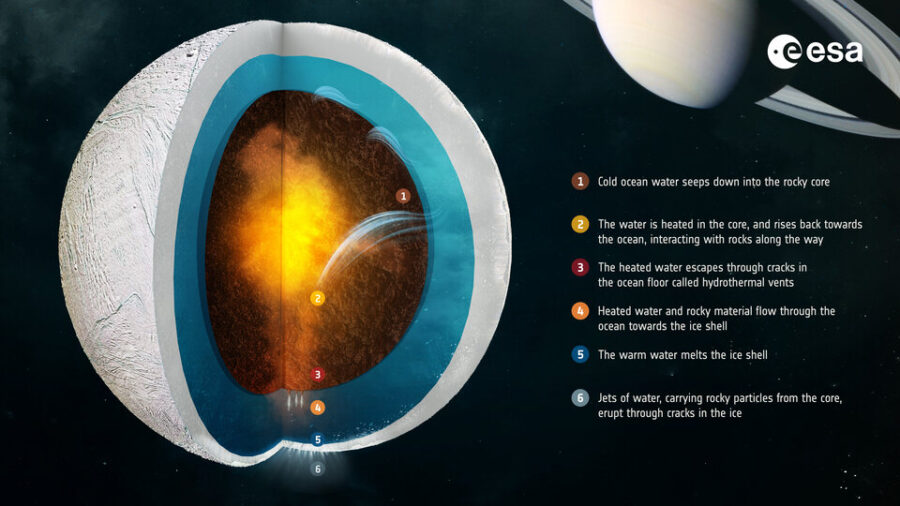
Enceladus, barely 500 kilometers across, has captivated planetary scientists since 2005 when Cassini first spotted water jets erupting from its south pole. The moon harbors a global ocean beneath an ice shell perhaps 20 kilometers thick. That ocean contacts a rocky core where hydrothermal vents likely exist, providing energy and minerals that drive chemical reactions.
Chemistry That Looks Familiar
The newly identified molecules include aromatics (ring-shaped carbon compounds), aldehydes like acetaldehyde, and various esters and ethers. On Earth, these same compounds serve as intermediates in metabolic pathways. Their presence on Enceladus suggests the ocean has the right conditions for increasingly complex chemistry.
Co-author Frank Postberg emphasizes the implications:
“These molecules we found in the freshly ejected material prove that the complex organic molecules Cassini detected in Saturn’s E ring are not just a product of long exposure to space, but are readily available in Enceladus’s ocean.”
The team cannot yet determine whether these organics formed on Enceladus or arrived via ancient comets and asteroids. Isotopic analysis would settle that question, but Cassini’s instruments lacked that capability. Either way, the molecules are there now, dissolved in a warm ocean with energy sources and mineral catalysts.
Recent modeling studies predict that Enceladus’s hydrothermal systems should produce exactly the kinds of molecules Khawaja’s team found: aromatics, esters, alkenes, aldehydes, and low-mass nitrogen compounds. The one surprise is ethers, which theoretical work has not yet addressed.
Five of the six elements essential for life as we know it (carbon, hydrogen, nitrogen, oxygen, phosphorus, and sulfur) have now been confirmed in material from Enceladus. Only sulfur remains undetected, though scientists expect it exists in the rocky core.
The European Space Agency is already studying concepts for a dedicated Enceladus mission that would orbit the moon and land near the south polar jets. Modern instruments could analyze the ice grains in far greater detail than Cassini managed, potentially detecting amino acids or even more complex molecules.
Khawaja notes that even a negative result would be scientifically valuable. Finding all the right chemical ingredients but no life would force researchers to reconsider what conditions are truly necessary for biology to emerge.
For now, the 17-year-old data keeps yielding surprises. The 2008 flyby lasted only minutes, but researchers are still finding new details in the mass spectra. Each ice grain that slammed into Cassini’s detector carried a unique chemical fingerprint from the ocean below.
The spacecraft may be gone, having plunged into Saturn’s atmosphere in 2017, but its legacy grows richer. Every new analysis strengthens the case that Enceladus ranks among the most promising places to search for life beyond Earth.