
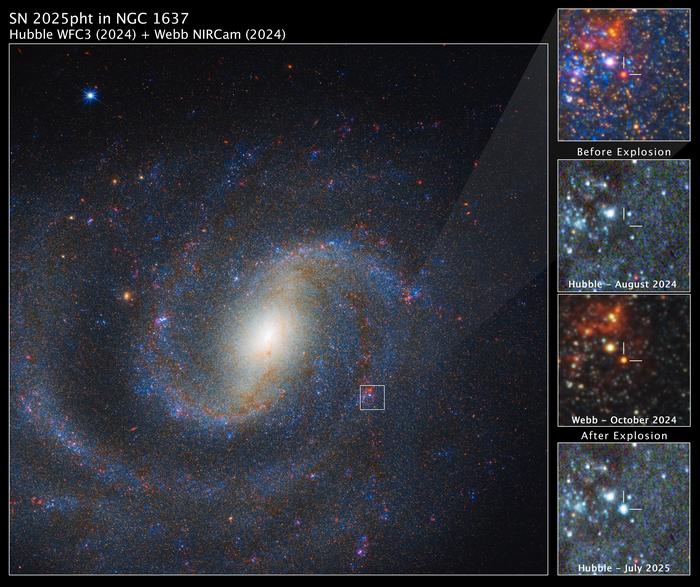
Astronomers have spent decades scratching their heads over a cosmic puzzle: massive red supergiant stars should explode all the time, yet we rarely see them do it. The answer, it turns out, was hiding in plain sight. Or rather, hiding behind a thick veil of dust.
A Northwestern University-led team used NASA’s James Webb Space Telescope to catch a red supergiant star in the act of exploding, revealing for the first time that these stellar giants are wrapped in unexpectedly dense clouds of dust before they go supernova. The discovery marks JWST’s first direct identification of a supernova progenitor star and may finally explain why theoretical predictions and actual observations have been so frustratingly mismatched.
The star, designated SN2025pht, sits in the spiral galaxy NGC 1637, some 40 million light-years from Earth. Astronomers first spotted its explosion on June 29, 2025, using the All-Sky Automated Survey of Supernovae. But the real revelation came when researchers compared before-and-after images from both Hubble and JWST.
A Star That Shouldn’t Have Been Invisible
“It’s the reddest, dustiest red supergiant that we’ve seen explode as a supernova,” said Aswin Suresh, a graduate student at Northwestern and key coauthor on the study published October 8 in The Astrophysical Journal Letters.
The progenitor star was shining about 100,000 times brighter than our sun, yet the surrounding dust made it appear more than 100 times dimmer in visible light. The dust was so thick it blocked shorter, bluer wavelengths almost entirely, leaving only the red end of the spectrum to peek through. Hubble couldn’t see it at all before the explosion. Only JWST’s infrared capabilities could pierce the cosmic fog.
Red supergiants are among the universe’s largest stars, bloated behemoths in the final stages of their lives. When their cores collapse, they explode as Type II supernovae, leaving behind either a neutron star or black hole. The most famous example is Betelgeuse, the reddish star marking Orion’s shoulder. According to theoretical models, red supergiants should make up the majority of core-collapse supernovae. Yet observers have consistently failed to find them before they explode.
Charlie Kilpatrick, a research assistant professor at Northwestern’s Center for Interdisciplinary Exploration and Research in Astrophysics who led the study, has been thinking about this problem for years. The new observations support a hypothesis he’s championed: the most massive aging stars are also the dustiest, and those thick cloaks dim their light to the point of near-invisibility.
“For multiple decades, we have been trying to determine exactly what the explosions of red supergiant stars look like. Only now, with JWST, do we finally have the quality of data and infrared observations that allow us to say precisely the exact type of red supergiant that exploded and what its immediate environment looked like.”
Carbon Where It Shouldn’t Be
The dust itself held another surprise. Red supergiants typically produce oxygen-rich, silicate dust. But this star’s dust appeared rich with carbon instead. The finding suggests powerful convection in the star’s final years dredged up carbon from deep inside, enriching the surface and fundamentally altering the type of dust it produced.
The discovery opens new possibilities for understanding massive stellar evolution. With JWST now operational and NASA’s Nancy Grace Roman Space Telescope on the horizon, astronomers can finally study these dust-shrouded giants in detail. Roman will have the resolution and infrared sensitivity to potentially witness these stars’ variability as they expel massive quantities of dust near the end of their lives.
The timing was fortunate – astronomers had been waiting for exactly this scenario, for a supernova to explode in a galaxy JWST had already observed. Now they’re actively searching for similar red supergiants that may explode in the future. The quality of data from these new instruments, Kilpatrick notes, will exceed anything observed in the past 30 years. After decades of searching in the wrong wavelengths, astronomers can finally see what was always there.
Discover more from European Space Agency Tracker
Subscribe to get the latest posts sent to your email.