
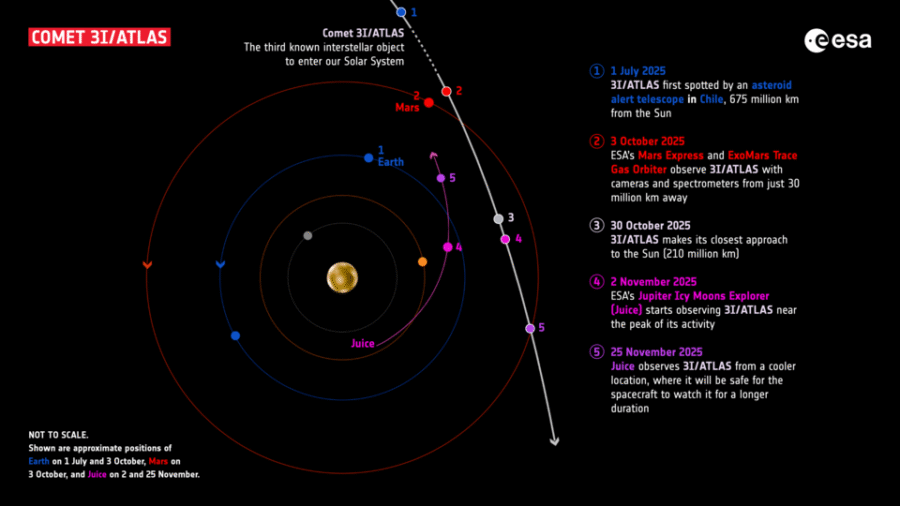
Thirty million kilometers sounds like a vast distance, but in cosmic terms, it was practically a front-row seat. Last week, two European spacecraft orbiting Mars captured humanity’s closest view yet of an interstellar comet that may predate our entire solar system by three billion years.
Between October 1 and 7, ESA’s ExoMars Trace Gas Orbiter and Mars Express turned their cameras toward comet 3I/ATLAS as it swept past the Red Planet. The resulting images show a fuzzy white dot moving through space, but that unassuming speck represents something extraordinary: a visitor from another star system, carrying secrets about worlds we may never reach.
“This was a very challenging observation for the instrument,” says Nick Thomas, who leads the camera team for ExoMars. “The comet is around 10,000 to 100,000 times fainter than our usual target.”
A Blurry Target With Big Implications
The spacecraft cameras were designed to photograph Mars from just a few hundred kilometers away, so capturing a dim comet 30 million kilometers distant pushed them to their limits. The ExoMars Trace Gas Orbiter’s CaSSIS camera managed to capture the comet’s coma (a halo of gas and dust surrounding the icy nucleus) but couldn’t distinguish the nucleus itself. Spotting that kilometer-wide core at such distance would be like trying to see a mobile phone sitting on the Moon from Earth.
What the images do reveal is a coma spanning several thousand kilometers, created as the Sun’s heat vaporizes ice from the comet’s surface. The full extent of this dusty envelope remains uncertain because its brightness fades rapidly with distance, eventually disappearing into the background noise of the images.
Mars Express, using a shorter exposure time of just 0.5 seconds compared to ExoMars’s five seconds, hasn’t yet revealed the comet in its data. Scientists are now combining multiple images to tease out the faint visitor, and they’ve attempted spectral measurements that could reveal the comet’s chemical composition. Whether those instruments captured enough light for meaningful analysis remains unclear.
The Rarest of Travelers
Comet 3I/ATLAS belongs to an exclusive club. Since 2017, astronomers have confirmed only three interstellar objects passing through our solar system: 1I/’Oumuamua, 2I/Borisov, and now 3I/ATLAS. These wanderers are fundamentally different from the countless comets born alongside our planets 4.6 billion years ago. They formed in the gravitational embrace of distant stars, carrying chemical signatures from planetary systems we can only imagine.
The Asteroid Terrestrial-impact Last Alert System telescope in Chile first spotted 3I/ATLAS on July 1, 2025. Its trajectory suggests an age that staggers the imagination: roughly 7.6 billion years old, making it senior to our Sun, Earth, and everything else in our cosmic neighborhood.
“When Comet Interceptor was selected in 2019, we only knew of one interstellar object. Since then, two more such objects have been discovered, showing large diversity in their appearance. Visiting one could provide a breakthrough in understanding their nature.”
That quote comes from Michael Kueppers, project scientist for ESA’s upcoming Comet Interceptor mission, scheduled to launch in 2029. The spacecraft will wait in a parking orbit, ready to chase down either a pristine comet from the distant Oort Cloud or, if luck permits, an interstellar interloper like 3I/ATLAS.
Next month, ESA’s Juice spacecraft (currently en route to Jupiter’s icy moons) will observe 3I/ATLAS from a greater distance but at a more opportune moment: just after the comet’s closest approach to the Sun, when solar heating should make it significantly more active. Those observations won’t return to Earth until February 2026 due to Juice’s current position and data transmission constraints.
For now, scientists continue picking apart the Mars orbiter data, looking for spectral fingerprints that might reveal whether this ancient wanderer resembles comets from our own solar system or represents something genuinely alien. The analysis will take months, but even fuzzy images of a distant dot carry weight when that dot traveled here from another star.
Discover more from European Space Agency Tracker
Subscribe to get the latest posts sent to your email.