

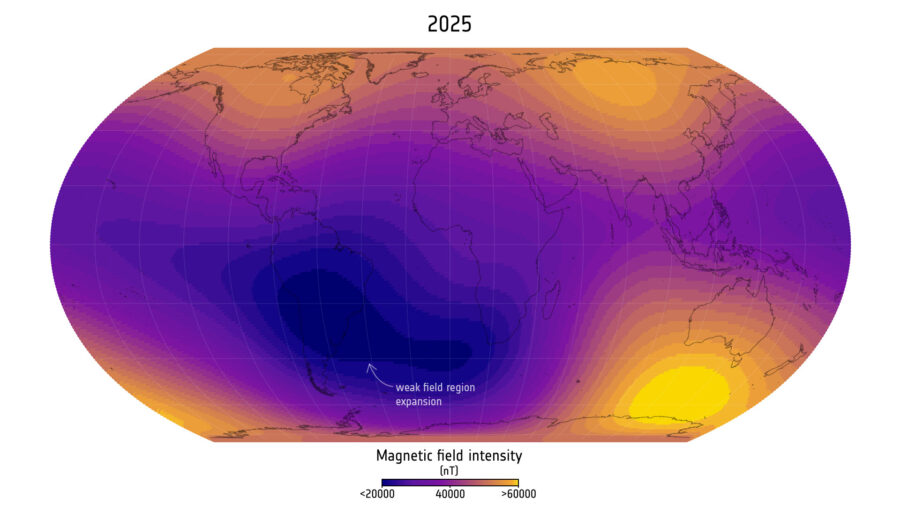
A quiet dent in Earths invisible shield keeps spreading across the South Atlantic. New satellite maps show the weak spot has grown since 2014 and is evolving faster near southern Africa.
Using 11 years of measurements from ESAs three Swarm satellites, researchers report that the South Atlantic Anomaly has expanded while a swath southwest of Africa has weakened even more rapidly since 2020. The work appears in Physics of the Earth and Planetary Interiors and relies solely on Swarm data to track the cores magnetic imprint at Earths surface and at the core mantle boundary.
Picture a slow river of molten iron 3000 kilometers down, swirling like dark smoke under a glass lid. Subtle changes in that flow tug on the planets magnetic field, shifting strong and weak zones in ways that matter to satellites and navigation systems. Swarm delivers the cleanest view yet of those changes.
“The South Atlantic Anomaly is not just a single block. It is changing differently towards Africa than it is near South America.”
Lead author Chris Finlay of the Technical University of Denmark points to reverse flux patches at the core mantle boundary, where field lines dive back into the core instead of emerging. One such patch appears to be moving westward beneath Africa, amplifying local weakening within the broader anomaly.
Satellites See A Larger Weak Zone And Shifting Strong Ones
Between 2014.0 and 2025.0, the area where surface field intensity in the South Atlantic drops below key thresholds grew steadily. The minimum intensity in the weakest part fell by hundreds of nanotesla, and the below 26000 nT region expanded by nearly one percent of Earths surface. That scale is not abstract, it is comparable to Greenland sized steps as the contours creep outward.
Swarm also tracks the strong field highs. Over Canada the strong zone shrank in area and peak strength. Over Siberia the opposite occurred, with gains in both area and intensity. That northward rebalancing helps explain the well documented drift of the northern magnetic pole toward Siberia in recent years, a shift with practical implications for aviation and compass based navigation.
In contrast, the Southern polar high between Australia and Antarctica changed little over the Swarm era. The asymmetry, two highs in the north and one in the south, remains a signature clue to the geodynamo processes at depth.
“Normally we would expect to see magnetic field lines coming out of the core in the southern hemisphere. But beneath the South Atlantic Anomaly we see unexpected areas where the field goes back into the core.”
Those patterns, together with measured accelerations, indicate both advection and stretching by core flows and possible episodes of magnetic flux expulsion may be at work. Swarm based models capture most of the surface secular variation with low spherical harmonic degrees, underscoring that large scale core dynamics drive the observed changes.
Space Safety Stakes And The Long Record Ahead
The South Atlantic Anomaly is not an abstract map feature. Satellites that pass through it encounter higher radiation doses, raising risks of memory upsets, instrument glitches, and occasional blackouts. Operators already mitigate exposure with shielding and operational workarounds. Continued growth or intensification near Africa would increase the operational burden, especially for low Earth orbit fleets.
Swarm, launched in November 2013, now provides the longest continuous set of absolute magnetic measurements from a single spaceborne instrument suite. That continuity matters. It anchors global magnetic models used in navigation, monitors space weather hazards, and enables finer tests of core dynamics from the surface to the core mantle boundary. ESA reports the satellites remain healthy, and extending the record beyond 2030 would add leverage by spanning the coming solar minimum and providing a stable baseline as new missions come online.
I find the systems picture useful. Inputs are the core flows and boundary interactions, the levers are advection, stretching, and flux expulsion, and the outputs are shifting weak and strong patches that shape satellite risk and navigation error. Swarm turns that abstraction into numbers you can track, from percent changes in area to nanotesla per year accelerations at depth.
If the weak zone continues to widen and the Canadian and Siberian highs keep trading places, future pole motion and regional declination changes should follow suit. The dent is not destiny, but it is a real and growing feature that engineers and navigators cannot ignore.
Physics of the Earth and Planetary Interiors: 10.1016/j.pepi.2025.107447